
More than a billion sterile flies have been released as part of the ongoing federal effort to combat the New World screwworm — a flesh-eating livestock parasite — according to CNN. Officials are openly questioning whether current release numbers will be sufficient to contain the outbreak.
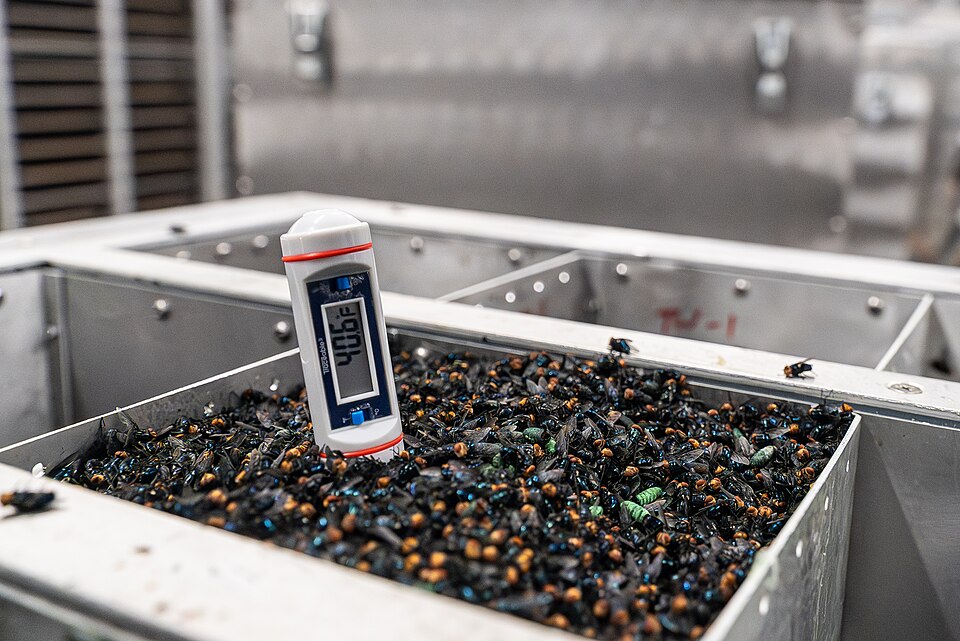
The sterile fly program, built on decades of multinational cooperation, uses continuous aerial release to halt the spread of New World Screwworm by overwhelming wild populations with sterile males. With multi agency coordination—from CBP inspections to USDA documentation, facility processing, Texas National Guard, and specialized aviation support—the operation demonstrates an intensive, international effort to protect livestock, wildlife, and communities across the region.
Videos are at the Defense Visual Information Distribution System (DVIDS) https://www.dvidshub.net/feature/NewWorldScrewworm
Photos are at DVIDS and the USDA APHIS Flickr Collection https://www.flickr.com/photos/usdagov/collections/72157625204032244/
USDA Media by Lance Cheung. Attribution appreciated.
WHAT NEW WORLD SCREWWORM IS
The New World screwworm (Cochliomyia hominivorax) is a parasitic fly whose larvae infest living flesh. Female screwworm flies lay eggs in open wounds, navels of newborn livestock, or other exposed tissues; the larvae that hatch then feed on living tissue, creating increasingly large wounds that attract additional egg-laying. Untreated screwworm infestation is lethal. The parasite was eradicated from the United States in the 1960s through a massive sterile fly release program; its re-emergence is a serious agricultural biosecurity event.
THE STERILE FLY TECHNIQUE
The Sterile Insect Technique is the specific control method being deployed: male screwworm flies are reared in laboratory facilities, sterilized with radiation, and released into the environment in large numbers. When sterile males mate with wild females, no offspring result; if enough sterile males are released relative to wild males, the population collapses because most matings are infertile. The technique eradicated screwworm from the US in the 1960s. The question officials are currently asking: are a billion flies enough to overwhelm the current outbreak’s wild population?
THE CATTLE PRICE CONTEXT
The screwworm outbreak is landing in the specific context of historically high US cattle and beef prices — documented throughout the arc (DOJ beef price investigation on September 7). A screwworm outbreak that reaches US cattle herds would produce additional livestock mortality and reduce herd sizes, further tightening cattle supply and pushing beef prices higher. The biosecurity response is not only an agricultural concern; it is a grocery price concern for the consumers whose kitchen-table economics have been a central political story in 2026.
A billion flies are not enough to be certain. That is the specific admission from officials. The parasite eats living flesh. It was eradicated once before. They are trying to eradicate it again. A billion flies may not be sufficient.
WHAT HAPPENS NEXT
▸ Release numbers — whether additional sterile fly production capacity is deployed
▸ Outbreak geographic spread — whether screwworm has reached US territory or remains in the approach corridor
▸ Beef prices — whether the biosecurity response affects the supply-side factors already driving historically high beef prices
| CONFIDENCE: HIGH | Billion sterile flies released New World screwworm livestock parasite, officials questioning sufficiency, CNN reporting from confirmed reporting. |
SOURCES
▸ CNN — New World screwworm billion sterile flies livestock, September 8, 2026