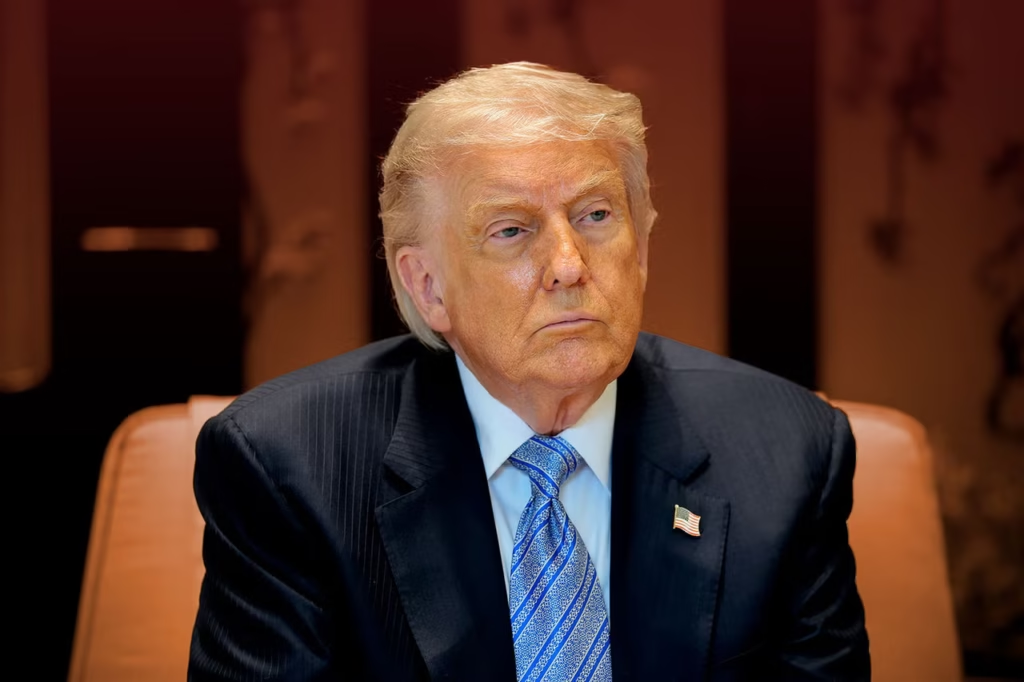
Trump told supporters in New York on August 14 that the US would soon declare the Strait of Hormuz ‘its territory.’ International maritime law experts and ONYX assess this claim directly: it is not supportable under established international law, and there is no recognized mechanism by which the US could establish territorial sovereignty over the Strait of Hormuz. Whether the statement reflects a forthcoming policy, rhetorical escalation, or misunderstanding of maritime law is a separate question from whether it is legally coherent.
WHAT HORMUZ IS UNDER INTERNATIONAL LAW
The Strait of Hormuz is an international strait governed by the United Nations Convention on the Law of the Sea (UNCLOS) Part III. The specific legal framework:
▸ Territorial sovereignty: the strait is bordered by Iran (to the north) and Oman (to the south); both states have territorial waters that extend into the strait. The US has no territorial waters in or adjacent to the strait.
▸ Transit passage: UNCLOS Part III establishes the right of transit passage for all states through international straits connecting one part of the high seas to another. This right cannot be suspended by coastal states (Iran or Oman) and does not require the permission of those states.
▸ US UNCLOS status: the US has signed but not ratified UNCLOS; it nonetheless asserts the customary international law principles it encodes, including transit passage rights.
▸ Territorial claim mechanism: the US could not establish territorial sovereignty over Hormuz without: (a) Iran and Oman ceding their territorial waters; (b) the UN Security Council recognizing a US territorial claim; or (c) military conquest and occupation, which would constitute a violation of the UN Charter’s prohibition on acquiring territory by force.
WHAT THE STATEMENT MOST LIKELY MEANS
The most analytically charitable interpretation: Trump is describing US operational control and freedom of navigation assertion in Hormuz as ‘US territory’ in the rhetorical sense that the US treats it as a space where US military and commercial interests have protected access. This is a real policy position — the US does assert freedom of navigation in Hormuz — but expressed in legally inaccurate territorial language.
The less charitable interpretation: the statement reflects an intention to formalize a US claim to Hormuz governance that goes beyond freedom of navigation, potentially involving a declared zone of control that other nations are required to navigate under US conditions. This would be legally unprecedented and would produce an immediate international legal challenge.
| 🔍 ONYX REALITY CHECK VERDICT: MISLEADING CONTEXT WHY? Trump’s characterization of Hormuz as US ‘territory’ or soon-to-be US ‘territory’ is MISLEADING CONTEXT. The US has no territorial claim over the Strait of Hormuz, which is bordered by Iran and Oman under established international maritime law. The US has legitimate freedom of navigation rights in Hormuz under UNCLOS customary law, which it has consistently asserted. Those rights are real and legally grounded. Describing them as territorial sovereignty conflates a right of access with territorial ownership in a way that has no legal foundation. |
THE GEOPOLITICAL CONSEQUENCE OF THE CLAIM
Even as rhetorical escalation, the Hormuz territorial claim has geopolitical consequences. It:
▸ Provides Iran with a specific propaganda tool — evidence that the US is seeking to colonize its territorial waters — for domestic and international audiences
▸ Complicates Oman’s position as ceasefire mediator — if the US is claiming Oman’s territorial waters as US territory, Oman’s sovereign dignity is implicated
▸ Undermines the legal framework for the ceasefire’s Hormuz governance terms, which are premised on international law rather than US territorial claims
▸ Creates concern among all maritime nations — if the US can claim an international strait as its territory, every state’s freedom of navigation interests are affected
WHAT HAPPENS NEXT
▸ State Department clarification — the diplomatic corps will need to clarify whether this statement reflects policy or rhetoric
▸ International response — Iran, Oman, China, Russia, and EU states will all assess the statement and potentially respond formally
▸ Legal analysis — international maritime law experts will publish formal assessments; ONYX will report the consensus view
| CONFIDENCE: HIGH | Trump August 14 Hormuz ‘territory’ statement is from confirmed reporting. UNCLOS Part III analysis is from established international maritime law. Geopolitical consequence analysis is ONYX editorial, clearly labeled. |
SOURCES
▸ Confirmed reporting — Trump Hormuz territory statement, August 14, 2026
▸ UNCLOS Part III — international strait transit passage established law