
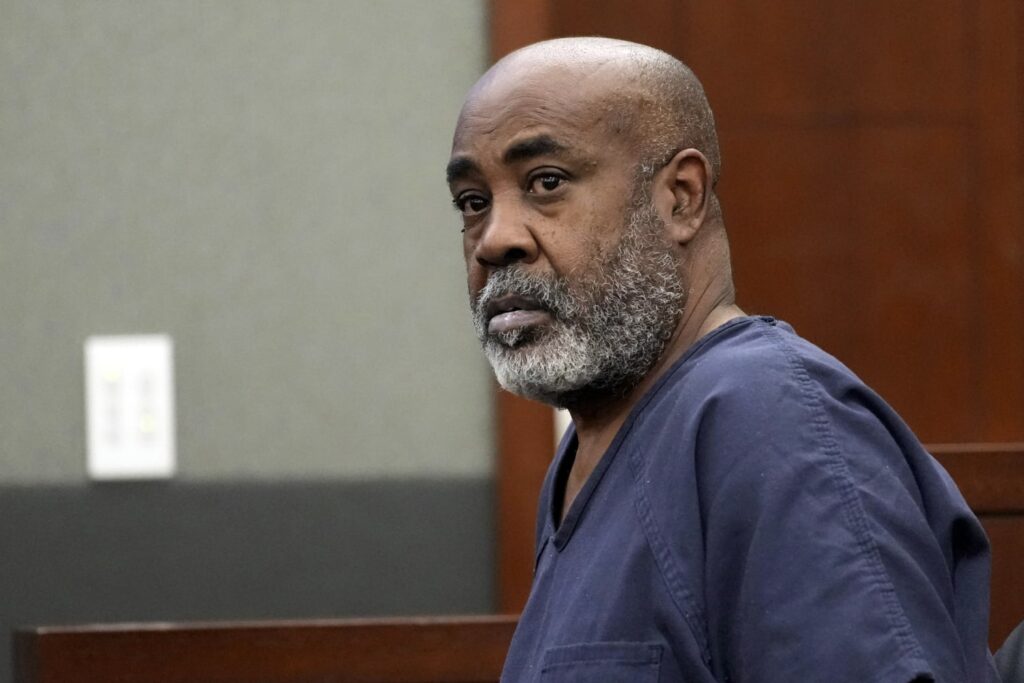
Duane ‘Keffe D’ Davis appeared in court Monday as his murder trial connected to the 1996 killing of Tupac Shakur continued. Prosecutors characterized the case’s unusual evidentiary situation directly: while few witnesses have ever been willing to discuss the killing publicly in nearly 30 years, Davis himself has repeatedly made statements about his alleged involvement — in interviews, in a published memoir, and in other public contexts. The prosecution’s case is built substantially on Davis’s own words, making him, as prosecutors characterized it, the one person who could not remain silent about what happened.
BACKGROUND — WHY THIS CASE TOOK NEARLY 30 YEARS
Tupac Shakur was shot multiple times on September 7, 1996 in Las Vegas after attending a Mike Tyson boxing match and died six days later. The killing occurred in a period of intense East Coast-West Coast hip-hop rivalry and was widely believed to be connected to gang violence in the orbit of the music industry. Despite widespread speculation about the identities of those responsible, no one was charged for nearly three decades. The investigation went cold, remained cold, and then was revived based substantially on Davis’s own public statements.
Davis’s memoir (‘Compton Street Legend’) and various interviews included statements prosecutors characterize as admissions of involvement in the killing. Davis has claimed these statements were exaggerated or taken out of context. The trial’s central question: do Davis’s own words constitute sufficient evidence of criminal involvement?
THE LEGAL THEORY — SELF-INCRIMINATION AS THE EVIDENCE
The prosecution’s evidentiary approach — relying substantially on a defendant’s own public statements — is unusual in homicide cases, where the primary evidence is typically physical or eyewitness. The legal theory requires the prosecution to establish: that Davis’s statements were voluntary; that they accurately describe his involvement (rather than exaggeration or fiction); and that they meet the legal standard for criminal liability in Nevada.
The defense’s counter: the statements were made in an entertainment context (memoir, interviews) where some degree of embellishment is common; they do not constitute a legal confession; and the prosecution’s inability to produce traditional evidence after 30 years reflects the weakness of the case rather than the guilt of the defendant.
For 30 years, almost no one talked. Then Davis talked — publicly, repeatedly, in a memoir. The prosecution’s case is what Davis himself said.
WHAT HAPPENS NEXT
▸ Prosecution evidence presentation — Davis’s own statements will be entered into the record; context and interpretation will be contested
▸ Defense cross-examination — will argue entertainment context for memoir statements
▸ Jury assessment — whether Davis’s words constitute the evidence needed for a murder conviction is the specific jury determination
| CONFIDENCE: HIGH | Davis court appearance and prosecutor characterization (‘hard time being silent’) are from confirmed reporting. 1996 Tupac killing and Davis memoir/interview statements are from established public record. |
SOURCES
▸ Confirmed reporting — Tupac murder trial, Davis court appearance, August 2026