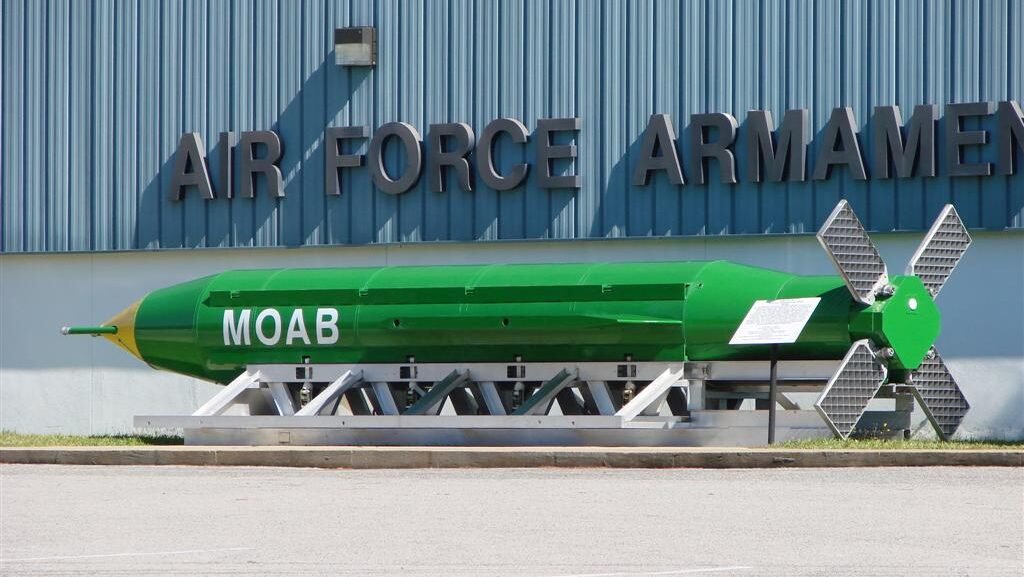
US military officials described contingency options that include the GBU-43/B Massive Ordnance Air Blast — the largest non-nuclear bomb in the American arsenal — targeting Iranian energy or nuclear sites if combat operations resume. CNN and Just Security confirmed the reporting. Contingency plans are not orders; they are options developed against possible scenarios. That the MOAB is among the options signals the scale of what the military is planning for.
🇺🇸 PENTAGON · OCTOBER 15, 2026 · US IRAN MOAB CONTINGENCY PLAN
US military officials have developed contingency plans that include the use of the GBU-43/B Massive Ordnance Air Blast — commonly known as the MOAB, the largest non-nuclear bomb in the American arsenal — targeting Iranian energy or nuclear sites if combat resumes with Iran. CNN and Just Security confirmed the reporting. The plans are contingency options: they describe what the military could do in various escalation scenarios, not what the president has ordered. The development of contingency plans is standard military practice; the existence of a plan does not mean the plan will be executed. What the reporting establishes is that at the level of scale and destruction represented by the MOAB, American military planners are thinking about Iran.
The GBU-43/B is a 21,600-pound thermobaric bomb, sometimes called the mother of all bombs. It was first used operationally in Afghanistan in 2017. It is designed to destroy hardened facilities, tunnel networks, and deeply buried structures. Its relevance to Iran specifically connects to the Iranian nuclear program — facilities like Fordow, bored into mountains, designed to be resistant to conventional strike packages. The MOAB is not a bunker buster in the technical sense; it is a massive pressure weapon. Its appearance in an Iran contingency plan suggests that military planners are looking at targets that require large-scale destruction rather than precision penetration.
WHAT CONTINGENCY PLANS MEAN
The US military maintains contingency plans for a wide range of scenarios involving a wide range of adversaries. The existence of a plan does not indicate that the president has been briefed on it, endorsed it, or is considering executing it. It indicates that military planners have developed options for a range of scenarios and that those options are available if needed. The reporting of contingency plans is standard national security journalism; officials describe plans to establish a record of what options exist, sometimes to signal resolve to adversaries, sometimes to inform the public, sometimes for reasons that are not entirely clear.
The signal value of this reporting is nevertheless real. Iran sees the reporting. The MOAB is a weapon of a specific character — not a surgical strike, not a targeted assassination, but a weapon whose primary effect is massive destruction over a large area. Iranian decision-makers processing US contingency planning that includes the MOAB against their energy and nuclear infrastructure are receiving a message about the scale of destruction the US is willing to contemplate. Whether that message deters or provokes — whether it makes Iranian decision-makers more cautious or more resolved — is a question that deterrence theory cannot answer with certainty and that the current conflict environment makes particularly fraught.
THE NUCLEAR SITE DIMENSION
Iran’s nuclear program and its potential militarization have been a central concern of US and Israeli policy for twenty years. The question of whether and how to destroy Iranian nuclear infrastructure — and whether conventional weapons can do so given the depth and hardening of key facilities — has been a consistent planning challenge. The MOAB inclusion in contingency plans suggests that planners are considering surface-blast approaches to facilities that might resist penetrating munitions, or that the scale of destruction is being contemplated for associated infrastructure rather than the hardened core. Neither Israel nor the United States has acted on the nuclear infrastructure strike option so far; whether the current conflict environment changes that calculus is one of the highest-stakes questions in the region.
“The US military has plans that include the largest non-nuclear bomb in its arsenal, aimed at Iranian energy or nuclear sites, ready if combat resumes. That is a contingency plan. It is not an order. But contingency plans describe what a military is thinking about doing.”
WHAT HAPPENS NEXT
► Iranian response — whether Tehran publicly addresses the MOAB reporting
► Congressional briefing — whether relevant committees are briefed on the contingency planning
► Israeli coordination — whether the reporting connects to joint US-Israeli strike planning
► Diplomatic impact — whether the MOAB reporting affects ongoing ceasefire negotiations with Iran
► Nuclear site status — latest intelligence assessment of Iranian nuclear program advancement
| CONFIDENCE: HIGH | CNN and Just Security confirmed that US military officials described contingency plans including GBU-43/B MOAB targeting Iranian energy and nuclear sites if combat resumes. |
| BIAS CHECK | ASSESSMENT |
| Source weight | CNN, Just Security — strong for Pentagon and national security reporting |
| Contingency plan framing | Described accurately as options, not orders; standard military planning practice noted |
| MOAB characterization | Technical description cited from public military record; not editorialized as aggressive or disproportionate |
| Nuclear framing | Iranian nuclear program characterized from established public record; US planning logic described analytically |
SOURCES
► CNN — US military develops MOAB Iran contingency plans, October 15, 2026
► Just Security — GBU-43 MOAB Iran energy nuclear contingency options, October 15, 2026