The New Yalu River Bridge — a road cable-stayed bridge connecting Dandong, China, and Sinuiju, North Korea — opened after a 12-year construction and delay saga. BBC and NK News confirmed the opening. The bridge represents a significant infrastructure link between China and North Korea, and its opening — at this moment, with North Korean troops reportedly deployed with Russian forces and the geopolitical alignment between Pyongyang, Moscow, and Beijing intensifying — is more than a construction milestone.
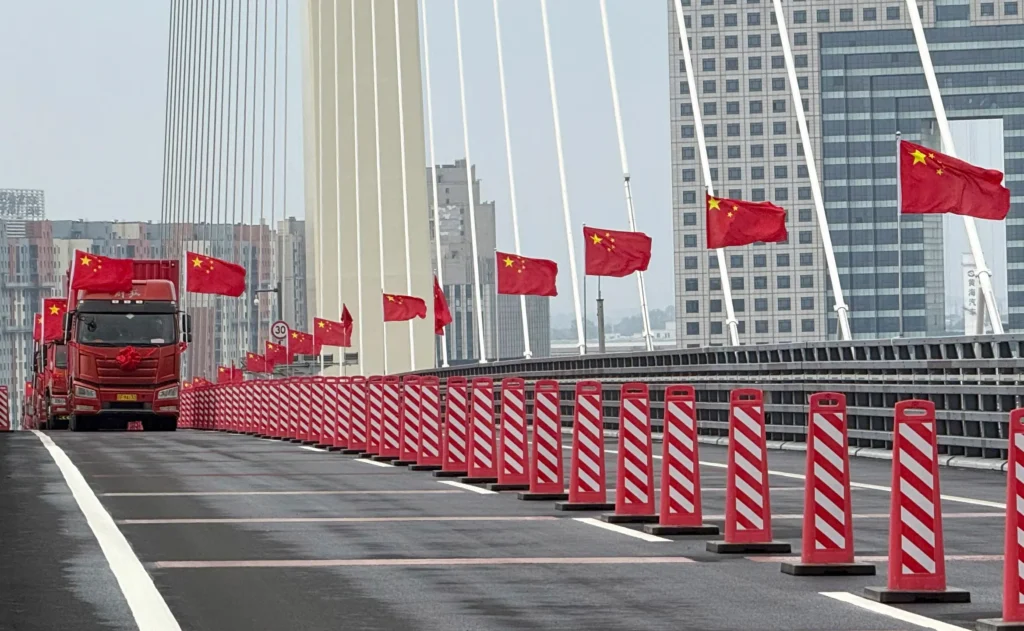
🌉 DANDONG / SINUIJU · OCTOBER 15, 2026 · YALU RIVER BRIDGE OPENS
The New Yalu River Bridge, connecting Dandong on the Chinese side and Sinuiju on the North Korean side of the Yalu River, opened on Wednesday after more than 12 years of construction and geopolitical delay. BBC and NK News confirmed the opening. The bridge is a modern cable-stayed road bridge — a significant infrastructure investment by China — and its delay was a function of North Korean reluctance to facilitate the connection despite Chinese willingness to build it. The opening, occurring now, in a geopolitical environment in which North Korea is a more willing and active partner of both China and Russia than it has been at any point in recent decades, is not a coincidence.
The original Friendship Bridge — the older, narrower span that has carried China-North Korea trade for decades — is aging and capacity-limited. The New Yalu River Bridge is designed to carry significantly more traffic, to modern road standards, and to enable the kind of expanded trade and logistics flow that North Korean economic connectivity to China would require. North Korea has been under severe international sanctions since its nuclear tests; China has been the one country that has maintained substantial economic engagement with Pyongyang throughout the sanctions period. A new, higher-capacity bridge is infrastructure for that engagement to grow.
THE GEOPOLITICAL TIMING
North Korean troops have been deployed with Russian forces in Ukraine, according to multiple Western intelligence assessments. North Korea has been supplying Russia with artillery shells and ballistic missiles throughout the Ukraine war. The relationship between Pyongyang, Moscow, and Beijing has deepened significantly since the start of the full-scale invasion. A bridge opening between China and North Korea in this context is not merely bilateral infrastructure; it is a physical manifestation of a strategic alignment that is reshaping the eastern dimension of the conflict landscape.
The bridge also matters for North Korean economic survival. Sanctions have limited Pyongyang’s ability to access international financial systems and trade with most countries. China has provided a lifeline — energy, food, goods — through the existing Friendship Bridge and through informal and semi-formal trade channels. A new, larger bridge increases the capacity of that lifeline substantially. What flows across it — and whether China uses the bridge to provide North Korea with goods or technology that would otherwise be sanctioned — will be watched closely by US, South Korean, and Japanese intelligence.
WHY A 12-YEAR DELAY
China built its side of the bridge. North Korea did not build its side. The Chinese span was complete years ago; North Korean road connections and the border crossing infrastructure on the Sinuiju side were not. The delay reflects North Korea’s characteristic combination of resource constraints, political caution about infrastructure dependency on China, and the regime’s preference for controlling cross-border flows. That the bridge is now opening suggests that the Kim regime has made a calculation that the economic and strategic benefits of increased Chinese connectivity outweigh the sovereignty and dependency concerns that kept the North Korean side unfinished for a decade.
“China built a bridge to North Korea twelve years ago. North Korea finally finished its end. The bridge opened Wednesday. North Korean troops are in Ukraine. North Korean missiles are in Russia. The bridge is not just about trade.”
WHAT HAPPENS NEXT
► Traffic volume — what goods and what volume cross the bridge in its first weeks of operation
► Sanctions monitoring — whether US, South Korean, and Japanese intelligence track sanctioned goods transit
► South Korean response — whether Seoul formally raises the bridge opening with China
► Russian connection — whether bridge traffic includes any Russia-linked cargo
► North Korean statement — official DPRK characterization of the bridge opening
| CONFIDENCE: HIGH | BBC and NK News confirmed New Yalu River Bridge connecting Dandong, China, and Sinuiju, North Korea, opened after 12-year delay. |
| BIAS CHECK | ASSESSMENT |
| Source weight | BBC, NK News — strong for Korea-related infrastructure and geopolitics reporting |
| Geopolitical framing | DPRK-Russia-China alignment described from established intelligence reporting; bridge opening characterized as consistent with that alignment, not editorial invention |
| Sanctions framing | China role in North Korea economic lifeline described from documented public record; bridge implication characterized as a monitoring question, not a conclusion |
| Delay explanation | 12-year delay characterized from available reporting on North Korean construction and border policy |
SOURCES
► BBC — New Yalu River Bridge China-North Korea opens, 12-year delay, October 15, 2026
► NK News via Wikipedia current events — Dandong Sinuiju bridge opening, October 15, 2026