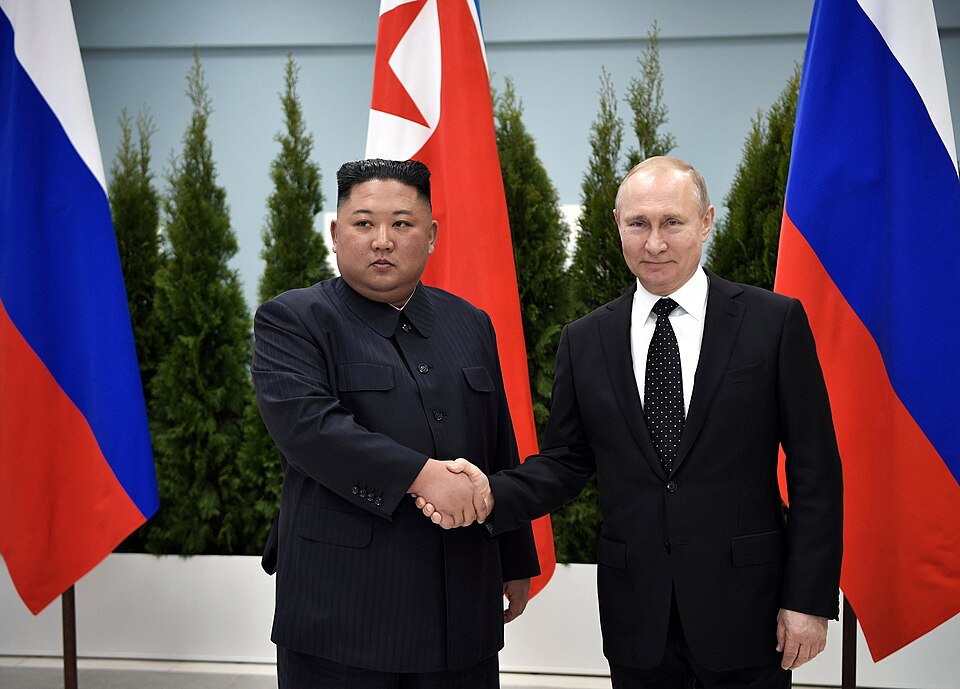
Russia and North Korea have been collaborating in the offensive against Ukraine since 2024 — a confirmed, sustained military partnership between two heavily sanctioned states that has continued and likely deepened throughout the current phase of the war. The partnership is not a recent development; it is a documented, multi-year arrangement in which North Korea provides military resources to Russia in exchange for something North Korea values more than its international isolation: Russian military technology, economic relief, and strategic partnership with a major power.
2-MINUTE CONTEXT — WHAT WE KNOW AND WHEN IT STARTED
The Russia-North Korea military collaboration timeline is now well-documented through a combination of US and allied intelligence disclosures, satellite imagery, and battlefield evidence. The key confirmed elements:
▸ 2023: North Korea begins supplying artillery shells and ammunition to Russia, helping address Russia’s significant early-war munitions shortfall
▸ Late 2023-2024: North Korean ballistic missiles confirmed in use against Ukrainian civilian targets — documented by Ukrainian forces and independently verified
▸ 2024: North Korean military personnel deployed to assist Russian forces, initially in training and logistics roles, later in active combat in some areas
▸ 2025-2026: Collaboration deepened as the Iran war’s effects on US attention and resources reduced Western pressure on both Russia and North Korea
▸ Technology exchange: Russia has provided North Korea with satellite technology, submarine propulsion systems, and other advanced military technology that Pyongyang could not access through other channels
THE TECHNOLOGY EXCHANGE — WHY PYONGYANG DOES THIS
North Korea’s strategic calculus in this partnership is not primarily economic, though the economic benefits (food, fuel, cash) are real. The primary driver is military technology access. Kim Jong Un has been explicit about wanting to develop several specific capabilities that Russia has and that international sanctions prevent North Korea from acquiring:
| WHAT NORTH KOREA PROVIDES | WHAT NORTH KOREA RECEIVES |
| Artillery shells and ammunition (millions of rounds) | Satellite reconnaissance technology |
| Ballistic missiles (KN-23, KN-24 series) | Nuclear submarine propulsion technology |
| Military personnel (training, logistics, combat) | Advanced air defense systems knowledge |
| Industrial production capacity for munitions | Economic relief (food, energy, cash payments) |
| Diplomatic cover for Russia at UN | Strategic partnership with a P5 Security Council member |
| Propaganda legitimacy for Russian narrative | Access to Russian military experience and doctrine |
WHY THIS MATTERS FOR UKRAINE
The Russia-North Korea partnership has materially affected the Ukraine war’s trajectory. Russia’s early-war munitions shortage was severe enough that military analysts believed it would force strategic constraints on Russian offensive operations. North Korean artillery shells eliminated that constraint, enabling Russia to sustain bombardment rates that would otherwise have been impossible.
The North Korean ballistic missiles have added a new target category to Russian strikes — precision-strike capability that Russia’s own missile stockpiles, significantly depleted by two-plus years of war, could not sustain alone. The WHO Dnipro warehouse strike documented in ONYX’s August 10 coverage used missiles whose provenance included North Korean-supplied weapons in the broader barrage context.
North Korean personnel’s combat role has evolved since initial deployment. Early roles were primarily technical — operating specific equipment, training Russian crews, logistics management. More recent reporting suggests some North Korean personnel have been in active combat roles, though the scale and geographic distribution are not fully confirmed.
THE BROADER SANCTIONS-EVASION IMPLICATION
The Russia-North Korea partnership represents the most visible and documented example of what sanctions experts call ‘sanctioned state collaboration’ — heavily sanctioned countries pooling their respective capabilities to compensate for what each cannot access through normal channels. Russia has energy and some technology; North Korea has labor, production capacity, and willingness to absorb risk. Together they create a partnership that partially offsets what each is denied by international sanctions.
Iran is a third vertex in this axis. Iran has supplied drones to Russia throughout the war. The US-Iran ceasefire deal specifically does not address Iran’s weapons supply relationships with Russia or with the Houthis. All three states are operating simultaneously within the ceasefire’s constraints and outside its coverage.
WHAT HAPPENS NEXT
▸ North Korean military presence is expected to continue regardless of US-Iran ceasefire dynamics — the partnership is a bilateral Russia-North Korea arrangement outside US leverage
▸ Technology transfers to North Korea are likely accelerating as the partnership deepens — watch for North Korean missile capability demonstrations
▸ International pressure mechanisms — additional UN sanctions — are blocked by Russian veto; the sanctions regime is structurally unable to address this specific collaboration
▸ South Korean and Japanese intelligence on the partnership is the primary ongoing source; watch for their public statements as the most current available information
| CONFIDENCE: HIGH | Russia-North Korea military collaboration since 2024 is from CBS News confirmed reporting, consistent with prior US and allied intelligence disclosures, South Korean government statements, and satellite imagery documentation. Technology exchange details are from documented US intelligence reports and allied government statements. Analysis of strategic motivation is ONYX editorial based on documented facts. |
| ⚖️ BIAS CHECK — WHO IS SAYING WHAT | |
| Russia | Denies the partnership exists while benefiting from it; standard Russian information posture on sanctioned military relationships |
| North Korea | Does not publicly acknowledge the partnership; Kim Jong Un has not commented on North Korean personnel in Ukraine |
| US / NATO | Have been documenting and publicizing the partnership to apply political pressure; the information release serves their narrative needs |
| South Korea / Japan | Most immediate security interest in the technology transfers; most invested in accurate, detailed monitoring |
| UN Security Council | Structurally unable to act due to Russian veto; the existing sanctions regime is being actively evaded |
SOURCES
▸ CBS News — Russia-North Korea collaboration confirmed, August 2026
▸ US intelligence disclosures — North Korean munitions and personnel in Ukraine (documented, 2023-2026)
▸ South Korean government statements — technology transfer concerns
Q: How many North Korean troops are in Ukraine?
A: Estimates have ranged from several thousand to over 10,000 across different reporting periods. The number varies with rotation schedules. The current figure is not confirmed in the available reporting for this article.
Q: Does this violate UN Security Council sanctions?
A: Yes — the arms transfers and military cooperation violate existing UN Security Council resolutions on North Korea. Russia has vetoed UN attempts to investigate or enforce compliance. The sanctions regime is designed to prevent exactly this kind of collaboration, but cannot enforce against a P5 member actively violating it.
Q: Why hasn’t the US done more to stop this?
A: The US has imposed secondary sanctions on entities facilitating the Russia-North Korea relationship, disclosed intelligence to increase diplomatic pressure, and shared information with allies. It has not taken military action to interdict the transfers, which would require direct confrontation with Russia.