Gaza’s devastation is no longer captured by a single death toll. It is measured in the homes that cannot be rebuilt, the children who have lost years of schooling, the hospitals operating without dependable power and the families living through winter in shelters that cannot keep out rain.
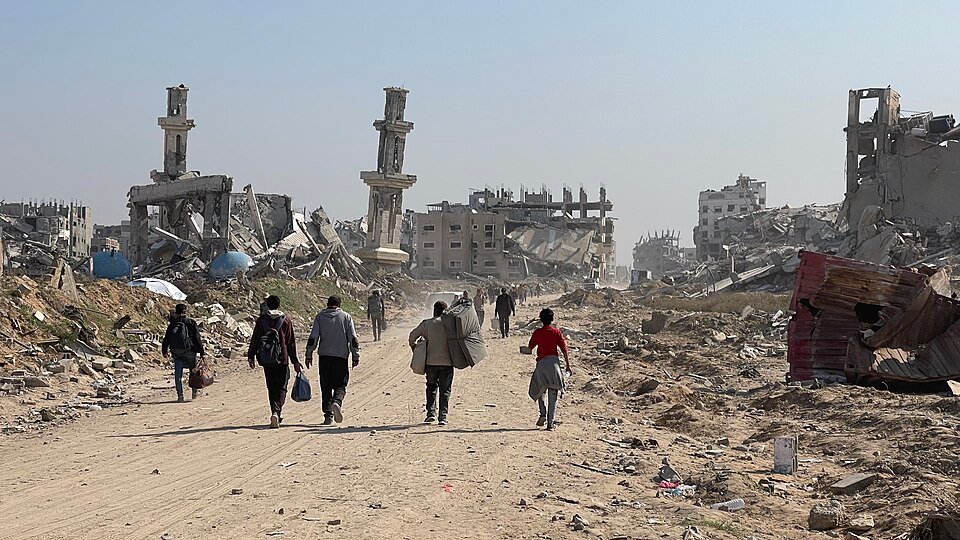
As the war enters its fourth year, Gaza is not simply a place where people have been killed. It is a place where the systems that make ordinary life possible have been dismantled—one neighbourhood, one water line, one classroom and one medical service at a time.
Gaza’s Health Ministry reported 74,237 Palestinian deaths and 175,206 injuries by October 4. Those figures are compiled by authorities in Gaza and are not independently verifiable in real time, but the United Nations and international health agencies use them as the principal casualty record.
The number continues to rise even after the ceasefire announced in October 2025. Between October 2025 and September 2026, Gaza’s Health Ministry reported 1,402 additional deaths and 4,881 injuries, according to the UN humanitarian office.
Behind every number is a second count: the dead still beneath the ruins. Palestinian Civil Defence reported recovering more than 630 bodies and human remains from destroyed buildings between November 2025 and September 2026.
The war’s true human toll will therefore remain unsettled for years. People missing under collapsed buildings, deaths from untreated illness and the long-term consequences of injury cannot be fully represented by the daily casualty bulletin.
Homes became the front line
The destruction of Gaza’s housing has turned displacement into a permanent condition.
About 80 percent of housing units have been damaged or destroyed, according to UN figures cited in a satellite analysis of the territory. An earlier UN assessment of inspected housing units found that 60 percent had been destroyed or suffered severe structural damage.
The figures are not merely architectural. A destroyed home means lost documents, medicines, family photographs, cooking equipment and the private space needed to recover from trauma. For many families, “return” now means going back to a street where the house has disappeared.
The shelter crisis is becoming more dangerous as winter approaches. The UN says 94 percent of Gaza’s population urgently needs shelter or basic household assistance, while 65 percent of households are living in tents or makeshift structures.
Those shelters offer little protection from cold, wind or flooding. UN agencies identified 451 displacement sites at high risk of flooding, together hosting an estimated 464,402 people.
This is not a temporary inconvenience. It is a public-health emergency waiting for rain.
Water is a daily calculation
Water infrastructure has been damaged, fuel is scarce and repairs are restricted by shortages of equipment, generators and spare parts.
During August, more than 73 percent of water samples collected by health partners failed to meet WHO-recommended chlorine levels, while 18 percent showed microbiological contamination.
The danger is familiar in every camp: diarrhoea, skin disease, respiratory infections and the constant risk that a child will drink water that looks clean but is not safe.
Gaza’s water crisis is also an energy crisis. Pumps, desalination plants, sewage systems and hospitals depend on generators. Without engine oil and replacement parts, a broken machine becomes a closed water line or a failed sanitation system.
At the same time, the territory’s only functioning cargo crossing leaves aid deliveries vulnerable to a single point of failure. In September, the UN reported that just 52 percent of authorised humanitarian truckloads were successfully offloaded at Kerem Shalom.
A generation outside school
For Gaza’s children, the war has become an interruption without an end date.
Nearly 98 percent of schools have been damaged or destroyed, according to UNICEF figures cited in recent reporting. More than 93 percent require major rehabilitation or complete reconstruction.
The new academic year began in September, but not in ordinary classrooms. Roughly 495,000 children were attending learning spaces supported by the UN and other partners, while about 200,000 remained without structured education.
The learning spaces themselves are fragile. Many operate in tents or temporary buildings, exposed to heat, rain and overcrowding. They provide more than lessons: they offer routine, protection and a place where children can briefly live outside the logic of war.
But a temporary classroom cannot replace a functioning education system. Every additional month without formal schooling widens the loss—of literacy, qualifications, social development and future work.
Hospitals without a health system
All 36 hospitals in Gaza have been damaged, and only 19 were functioning, according to the World Health Organization. None was operating at full capacity.
That leaves the health system trying to serve a population with extraordinary needs while losing the infrastructure required to do so.
Patients with amputations, burns, spinal injuries and chronic illnesses compete for limited beds, medicine and electricity. Cancer treatment, dialysis supplies and insulin remain in short supply. Diagnostic services have also been disrupted by shortages of fuel, equipment and maintenance materials.
The result is a health crisis that extends beyond war wounds. A patient with diabetes needs insulin. A cancer patient needs chemotherapy and radiotherapy. A person with kidney failure needs regular dialysis. When those services stop, the war continues inside the body.
The WHO estimates that roughly one in four people in Gaza may have acute or continuing healthcare needs, including people with severe injuries, amputations, head and spinal-cord injuries and burns.
An economy reduced to survival
Gaza’s economy has not merely contracted; it has been broken.
The UN Conference on Trade and Development estimated that 92 percent of economic establishments had been damaged or destroyed. The destruction has erased businesses, jobs, supply chains and the productive capacity needed for recovery.
Markets may reopen, but a market cannot function normally when roads are destroyed, banks are disrupted, electricity is unreliable and most consumers have lost homes and income.
Prices tell the story of scarcity. UN humanitarian monitoring put inflation at about 207 percent above pre-October 2023 levels.
For families, this means that even when food is available, it may be unaffordable. For shopkeepers, it means replacing stock is risky. For workers, it means that the old economy has vanished while a new one has not yet emerged.
Gaza is not simply waiting for reconstruction. It first needs the conditions that make reconstruction possible: security, access, materials, power, finance, functioning institutions and freedom of movement.
The map is shrinking
The geography of Gaza has changed as dramatically as its buildings.
After the 2025 ceasefire, Israeli forces withdrew to a designated “Yellow Line” while retaining control of approximately 53 percent of the Strip, according to reporting based on satellite analysis. Later Israeli statements and independent reporting indicated that control had expanded to roughly 60 percent or more.
The line is not an internationally recognised border. In practice, however, it determines where people may live, where aid agencies may move and which land remains accessible.
The consequences are immediate. Most Palestinians have been pushed into the western part of the enclave, where housing has already been destroyed and population density is extreme. Agricultural land east of the line is largely inaccessible to farmers, further weakening food production and livelihoods.
A map can make this appear administrative: one zone here, another zone there. For Palestinians, it is measured in homes abandoned, farms lost and roads that can no longer be used.
The number that matters now
The most important figure may not be the next casualty total, though that toll is still climbing.
It may be the number of people who can still return to a safe home. The number of children who can enter a real classroom. The number of hospitals that can provide full treatment. The number of water systems that can operate without emergency fuel. The amount of territory where civilians can move without fear.
In Gaza, the destruction is visible in satellite images and casualty tables. But its deepest impact is less easily counted: the conversion of normal life into a daily negotiation with rubble, hunger, illness, displacement and uncertainty.
Three years on, Gaza’s crisis is not only about what has been destroyed. It is about whether the foundations of civilian life can be restored before another generation grows up knowing nothing else.