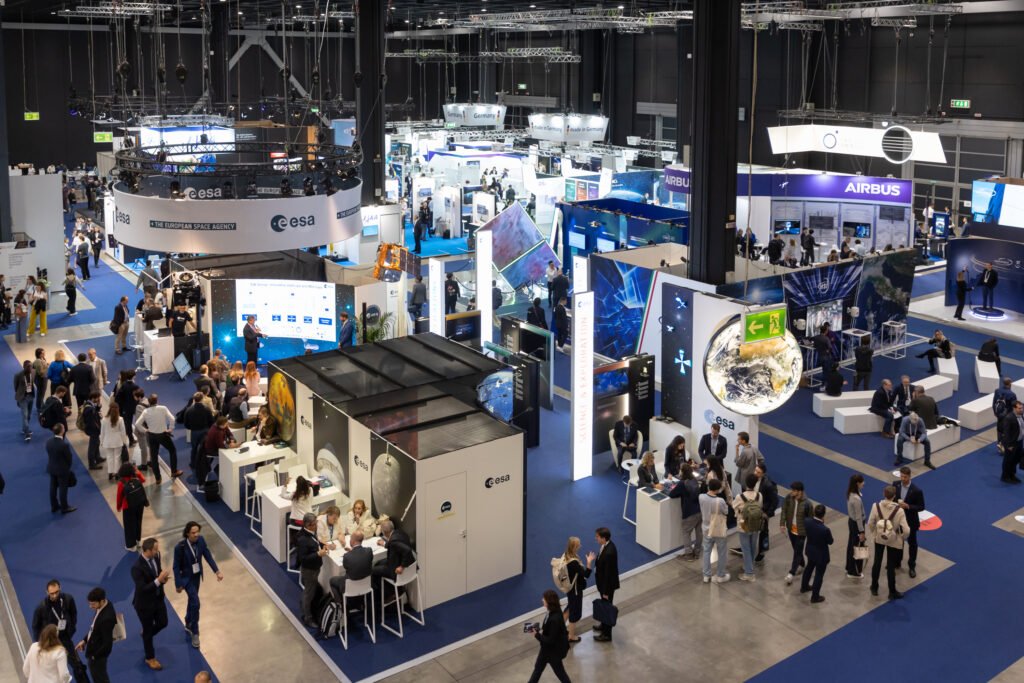
Delegates in Turkey are discussing NASA’s Artemis II mission, large satellite constellations, commercial space infrastructure, and the growing strategic competition in orbit. The IAC is meeting in the same country that on October 6 formally activated its Makkah Alliance collective-defence obligations. The convergence of space geopolitics and terrestrial geopolitics in Turkey on Day 60 is a documented coincidence ONYX names.
ARTEMIS II: THE MISSION
NASA’s Artemis II will be the first crewed lunar flyby since Apollo 17 in December 1972 — more than half a century. The specific mission profile:
▸ Crew: four astronauts — Commander Reid Wiseman, pilot Victor Glover (the first Black astronaut on a lunar mission), mission specialist Christina Koch (the first woman on a lunar mission), and Canadian Space Agency member Jeremy Hansen
▸ Trajectory: a free-return lunar flyby; the crew will travel approximately 8,900 kilometers beyond the Moon, the farthest humans have traveled from Earth since Apollo 17
▸ No lunar landing: Artemis II is the crewed test of the Orion spacecraft and Space Launch System before the Artemis III landing mission
▸ The geopolitical dimension: Artemis II occurs in a world where China’s Chang’e program aims to land on the Moon before 2030, and Russia’s Luna program is recovering after Luna-25 failed in 2023
LARGE SATELLITE CONSTELLATIONS: THE STRATEGIC COMPETITION
The IAC’s satellite constellation agenda reflects one of the most significant ongoing space geopolitics developments of 2026:
▸ Starlink: SpaceX has deployed more than 6,000 satellites; it is the world’s largest private satellite internet constellation and has been documented as operationally significant in Ukraine’s military communications
▸ China’s Guowang: China is building a competing mega-constellation; estimated 13,000 satellites planned; direct competition with Starlink for orbital slots and radio frequency spectrum
▸ Orbital slots: like radio spectrum, orbital positions are finite; the IAC is the primary international forum where the competition for those slots is formally documented
▸ The military dimension: in the Iran war arc, satellite intelligence, communications, and navigation have all been documented as critical military capabilities; the constellation competition is the infrastructure competition behind the conflict
The IAC is meeting in Turkey on the same day Turkey activated its Makkah Alliance commitments. In orbit, Starlink is running Ukraine’s battlefield communications. China is building a 13,000-satellite counter-constellation. Artemis II will send four humans farther from Earth than any human has been in 54 years. The space competition and the terrestrial competition are not separate. The satellites that document every ship in the Strait of Hormuz, every drone launched at Moscow, and every Houthi missile depot are the same infrastructure the IAC is discussing in Ankara. Orbit is a front line. October 6 is the day that becomes obvious.
WHAT HAPPENS NEXT
▸ Artemis II launch date — currently targeting 2026; the IAC discussion reflects preparation momentum
▸ Guowang deployment — China’s counter-constellation schedule and orbital slot competition
▸ IAC resolutions — whether the congress produces binding or advisory space governance outcomes
▸ Turkey IAC and Makkah Alliance — whether Turkey’s dual role as space governance host and collective defence activator on October 6 produces any formal documentation
| CONFIDENCE: HIGH | IAC delegates Turkey discussing NASA Artemis II mission, large satellite constellations, commercial space infrastructure, and growing strategic competition in orbit from AA.com.tr Morning Briefing confirmed October 6 2026 reporting. |
SOURCES
▸ AA.com.tr — Morning Briefing October 6, 2026