Berlin confirmed it would not follow Washington’s lead and ease restrictions on Russia following the Trump-Putin diesel agreement. The announcement was a sentence. What it signals is a paragraph.
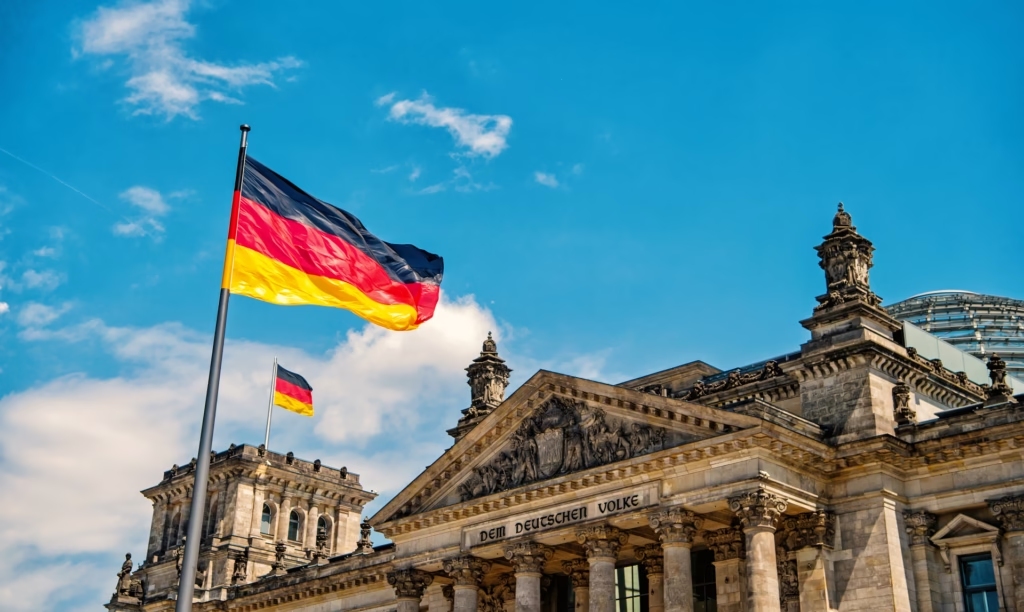
🇩🇪 BERLIN · OCTOBER 10, 2026 · GERMANY / RUSSIA SANCTIONS
When a government issues a statement confirming that it will continue doing what it has been doing, the statement is rarely about what it says it is about. Germany’s confirmation that it would maintain its own Russia sanctions in the wake of the Trump-Putin diesel agreement was framed as a continuity announcement — we are not changing course — but it was received, and intended to be received, as a positioning statement relative to Washington.
Berlin did not criticize the Trump-Putin deal directly. It did not call it a mistake or describe it as undermining the sanctions architecture. It said, through a Reuters-confirmed statement, that Germany’s own restrictions would remain in place. That choice — to confirm your own policy rather than comment on another country’s — is a specific kind of diplomatic communication. It says: we are aware of what you did, we are not doing the same, and we are not going to make a scene about it. It is the diplomatic equivalent of continuing to look straight ahead.
WHY GERMAN SANCTIONS MATTER
Germany is not simply another European country maintaining Russia sanctions. It is the largest economy in the European Union, the country most exposed to the energy disruption that Russian sanctions have produced, and the country whose political establishment spent years cultivating a special relationship with Moscow through the Nord Stream pipeline architecture that no longer exists. Germany’s decision to maintain sanctions despite high domestic economic cost has been the cornerstone of European sanctions solidarity. If Berlin had moved to ease restrictions following the American diesel deal, the European sanctions architecture would have faced an existential test.
It did not move. That matters. The German confirmation is a signal to other European capitals — Paris, Warsaw, Rome — that the EU sanctions consensus is not crumbling in response to Washington’s bilateral agreement with Moscow. Whether that consensus holds through the winter, when energy prices and German industrial concerns reassert themselves, is a separate and open question.
THE TRANSATLANTIC FRICTION
The Trump-Putin diesel deal has produced a specific kind of transatlantic friction: not the open confrontation that characterized some earlier US-European disagreements over Russia policy, but a quiet divergence in which American and European governments are formally pursuing different economic relationships with Russia while maintaining the fiction of allied unity. Germany holding its sanctions does not restore that unity. It simply slows the divergence.
“Germany confirmed it would keep doing what it was doing. In the week of the Trump-Putin diesel deal, that confirmation was one of the most significant diplomatic statements in Europe.”
WHAT HAPPENS NEXT
► EU coordination — whether the European Commission issues a formal statement on the diesel deal
► German winter energy — whether domestic pressure on sanctions intensifies as heating costs rise
► Other European capitals — whether France and Italy follow Germany’s hold or show more flexibility
| CONFIDENCE: HIGH | Reuters confirmed a German government statement maintaining Russia sanctions following a Trump-Putin diesel agreement. |
| BIAS CHECK | ASSESSMENT |
| Source weight | Reuters — strong wire provenance; single outlet but primary government statement |
| Diplomatic framing | German positioning described analytically; not presented as moral superiority over US |
| Sanctions analysis | Economic exposure and political significance of German position accurately characterized |
SOURCES
► Reuters — Germany Russia sanctions hold, Trump diesel deal response, October 10, 2026