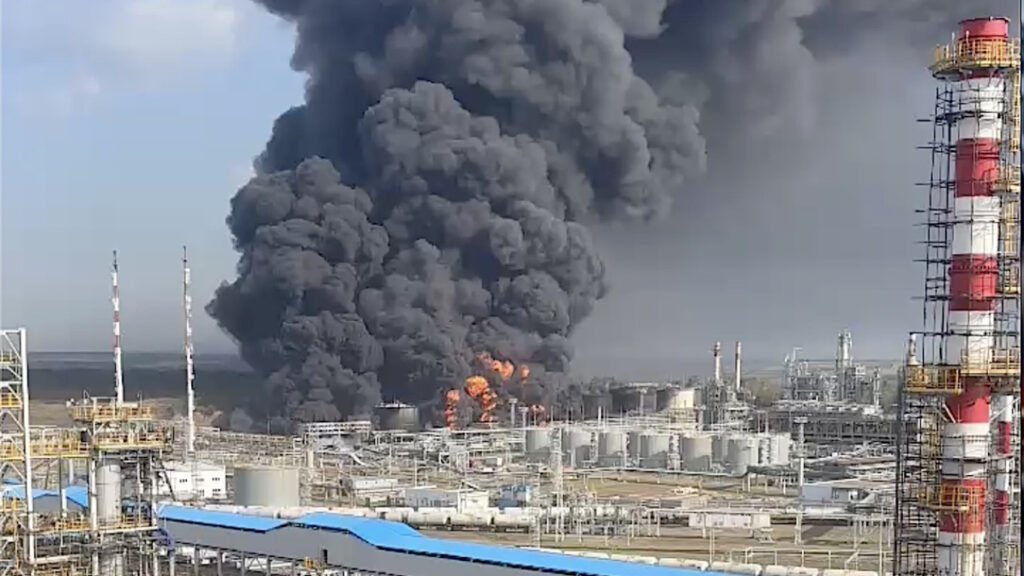
Hours after Trump announced a diesel supply agreement with Putin, Ukrainian officials said drone strikes on Russian energy infrastructure would continue. The message was precise: what America buys from Russia, Ukraine will keep trying to destroy.
🇺🇦 KYIV · OCTOBER 10, 2026 · UKRAINE / ENERGY STRIKES
The Trump-Putin diesel agreement created an immediate and specific question for the Ukrainian government: would Kyiv continue its drone campaign against Russian oil refineries and energy infrastructure, or would the American commercial deal create political pressure to pause? The answer arrived quickly. Ukrainian officials told the Financial Times, via Kyiv Post and other outlets, that drone strikes on Russian energy infrastructure would proceed. The campaign is not stopping.
The logic from Kyiv’s perspective is direct. Ukraine has been striking Russian refineries and oil facilities for the better part of a year, with two objectives: degrading Russia’s ability to fund the war through energy exports, and imposing economic costs on the Russian population in ways that might shift internal political calculations. The Trump-Putin diesel deal does not change either of those objectives. It does, however, create a new dimension to them: now, some of what Ukraine is attempting to degrade is the same infrastructure that will supply the American president’s bilateral fuel agreement.
THE STRATEGIC TENSION
There is a genuine strategic tension embedded in this situation, and it deserves to be stated plainly. The United States, through the Trump-Putin diesel agreement, has entered into a commercial arrangement that depends on Russian energy infrastructure remaining intact and operational. Ukraine, as part of its war strategy against Russia, is actively attempting to damage Russian energy infrastructure. These two things are not compatible, and the Biden-era US policy of simultaneously arming Ukraine and sanctioning Russian energy — which had its own contradictions — has been replaced by a Trump-era policy with a new and sharper contradiction.
American officials had not, as of Saturday, addressed this tension publicly. The diesel deal was announced by Trump as a domestic economic policy — lower fuel prices for Americans — and its implications for the Ukrainian energy strikes campaign were not discussed in the announcement or in immediately subsequent administration statements.
WHAT UKRAINE GETS FROM CONTINUING
Ukraine’s decision to continue the refinery strikes is also a signal. It tells Moscow — and Washington — that Kyiv does not consider itself bound by American commercial arrangements with Russia. It tells the American public that the diesel deal does not represent a Ukrainian endorsement of reduced pressure on Russia. And it tells Zelensky’s domestic audience that the government is not adjusting its war strategy to accommodate Trump’s midterm fuel prices. Each of these signals is intentional. Ukrainian officials communicate through actions in this war at least as much as through words, and the continuation of refinery strikes the day after the diesel deal is an action.
“Trump bought diesel from the country whose refineries Ukraine is drone-striking. Neither party has blinked. That is the foreign policy situation the United States is currently managing.”
WHAT HAPPENS NEXT
► US-Ukraine conversation — whether Washington asks Kyiv to pause strikes on infrastructure covered by the diesel deal
► Refinery damage — impact of continued Ukrainian strikes on the Russian energy export capacity
► Deal viability — whether continued strikes affect Russia’s ability to fulfill the diesel supply agreement
► Congressional response — whether US lawmakers raise the contradiction between the deal and the strike campaign
| CONFIDENCE: HIGH | Financial Times, via Kyiv Post, confirmed Ukrainian officials stated drone strikes on Russian energy infrastructure will continue despite US-Russia diesel arrangement. |
| BIAS CHECK | ASSESSMENT |
| Source weight | Financial Times via Kyiv Post — credible secondary citation; FT primary source noted |
| Strategic tension | Diesel deal vs. refinery strikes contradiction stated factually; no editorial position on whose policy is correct |
| Ukraine framing | Decision to continue strikes characterized accurately; signaling dimensions analyzed, not endorsed |
SOURCES
► Financial Times — Ukraine drone strikes Russian refineries continue despite diesel deal, October 10, 2026
► Kyiv Post — Ukrainian officials’ statement on energy infrastructure campaign, October 10, 2026