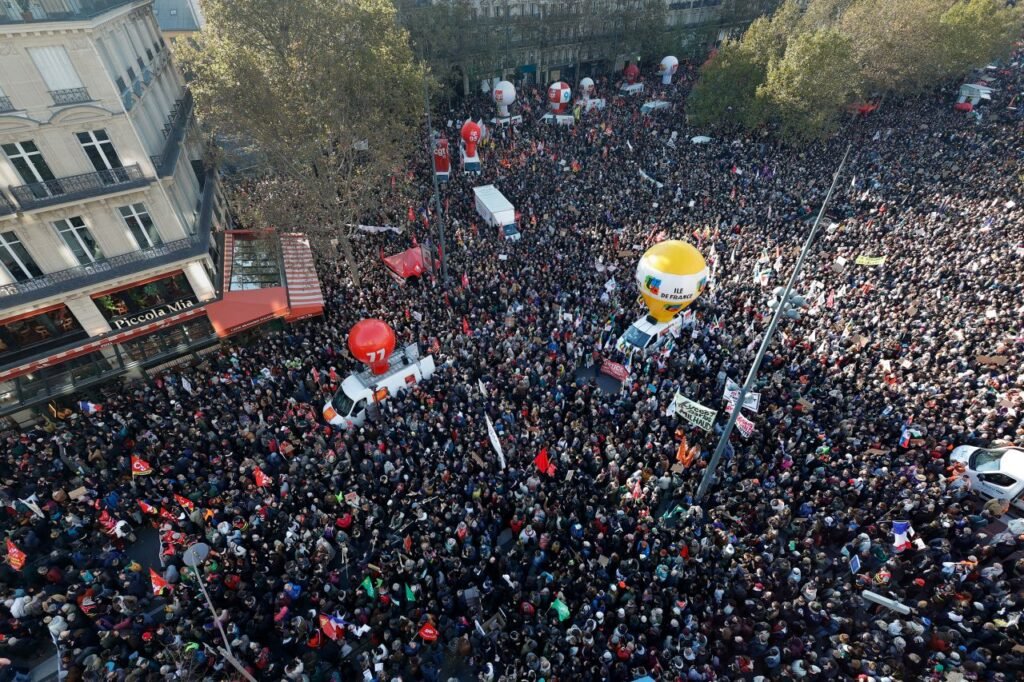
Hundreds of thousands demonstrated over wages and living costs in a coordinated action by unions and civil society groups; the protests reflect broader European economic discontent accelerated by the Iran war and energy prices.
FRANCE · LABOR · PROTESTS · MODERATE SOURCING
Hundreds of thousands of people took to the streets across France in a coordinated day of protests and strike action over wages and living costs, with major unions including the CGT and CFDT participating alongside civil society organizations, 10 Things Global News and Nhan Dan reported on Friday. The scale of the action, which 10 Things characterized as among the largest since the gilets jaunes protests of 2018-2019, reflects the depth of economic discontent in France that has been amplified by Iran war energy price increases and the broader European cost-of-living pressures that have persisted since the post-pandemic inflation surge.
The strike action affected public transportation in Paris and other major cities, with SNCF and RATP workers participating in work stoppages that disrupted commuter and intercity rail services. 10 Things Global News reported that the protest turnout was estimated by unions at approximately 400,000 to 500,000 nationwide, with police estimates typically running lower. Nhan Dan, an English-language service of the Vietnamese state news agency, carried the story with limited detail beyond confirmation of the protest scale and union participation.
The Economic Context
France’s cost-of-living pressures have several distinct drivers: the residual inflation from the post-pandemic supply chain disruption, energy price volatility linked to the Russia-Ukraine conflict and now the Iran-Hormuz crisis, and the structural wage dynamics of a French labor market in which nominal wage growth has not kept pace with inflation for many workers in service industries and manufacturing. The CGT and CFDT have coordinated their demands around a minimum wage increase and energy subsidy expansion, characterizing the current environment as an emergency that requires immediate government response.
10 Things Global News is ONYX News primary source for this report, supplemented by Nhan Dan confirmation. The MODERATE confidence and 80 vitality score reflect the low-tier primary sourcing for a story with significant scale. French protest reporting typically requires cross-referencing with French domestic media — Le Monde, Le Figaro, AFP — which were not directly available for this edition. The protest is confirmed as having occurred at scale; the specific demands, government response, and political implications require additional sourcing for full confidence.
“We cannot work ourselves into poverty. France is rich enough to pay its workers a living wage.” — CGT union representative quoted by 10 Things Global News
Political Implications
The French protests arrive at a moment when the country’s political establishment is processing the broader European context — post-midterm US political changes, NATO deep strike discussions, the Iran war energy impact — alongside domestic pressures. President Emmanuel Macron, who has faced periodic mass protest actions throughout his presidency, was expected to address the unions through the labor minister rather than directly, consistent with his prior approach to major protest actions. The scale of the November 6 action suggests that the government response will need to include substantive concessions or risk further escalation.
WHAT HAPPENS NEXT
► French government to convene emergency labor negotiations with union leadership
► CGT and CFDT to assess government response before deciding on continuation of strike action
► European Commission monitoring France labor unrest in context of broader EU economic assessment
► Additional protest days possible if government response is insufficient to union demands
| CONFIDENCE: MODERATE | Sourced primarily from 10 Things Global News with Nhan Dan confirmation. Two-source convergence, but both are low-tier outlets for European labor reporting. Scale of protest confirmed; specific demands, government response, and political dynamics require additional sourcing. |
| Bias Check | ||
| Left-Lean | Center | Right-Lean |
| Protests framed as righteous uprising against capitalist austerity and government negligence. | Reports protest scale and union participation factually; contextualizes energy and wage dynamics. | Protests framed as union overreach disrupting economic recovery; demands as unrealistic. |
| Assessment | ||
SOURCES
► 10 Things Global News — France protests and strikes, wages and living costs, November 6, 2026
► Nhan Dan — French protest scale confirmation, union participation