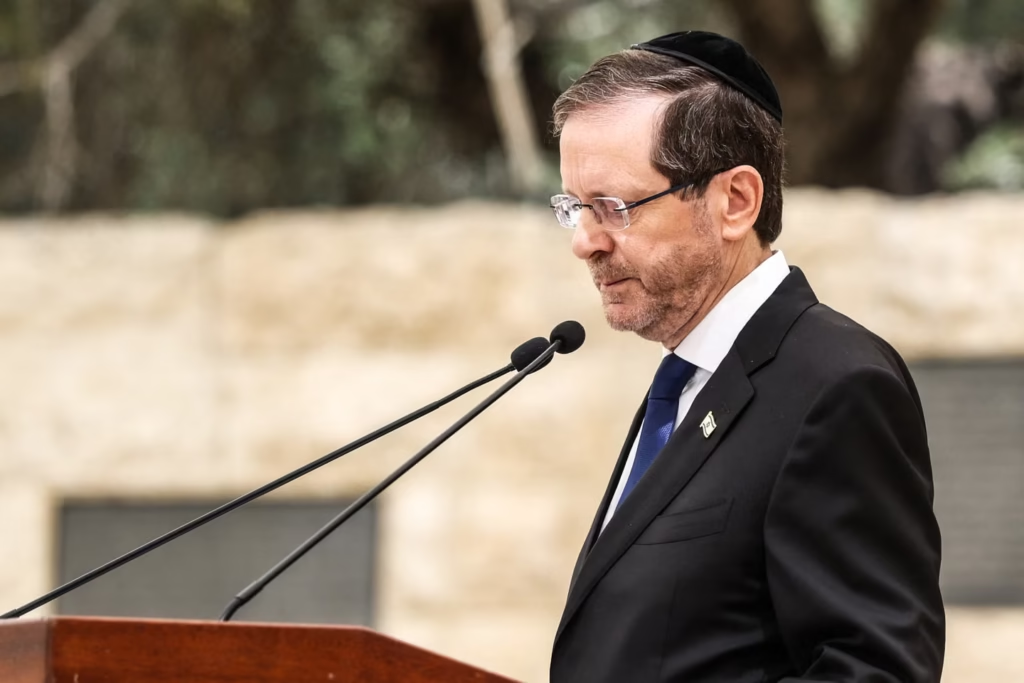
President Herzog will announce Sunday who receives the first chance to form a government; former IDF chief Gadi Eisenkot has gained ground as a consensus figure amid the post-war political landscape.
ISRAEL · COALITION · GOVERNMENT FORMATION
Israeli President Isaac Herzog will announce on Sunday which political figure receives the mandate to attempt government formation, Anadolu Agency and Nhan Dan reported on Friday. The announcement follows the conclusion of presidential consultations with Knesset party representatives, a constitutionally required process in which party leaders indicate their preferred candidate for prime minister. The leading candidate as of Friday’s reports is Gadi Eisenkot, the former IDF chief of staff who has emerged as a rare consensus figure capable of drawing support across the fractured Israeli political spectrum.
Eisenkot’s rise as a government-formation candidate reflects the particular dynamics of Israeli post-war politics in 2026. His military background — he served as IDF chief from 2015 to 2019 — provides credibility on security issues that the electorate has prioritized throughout the Iran war period. His political positioning, which has been characterized as center-right on security and more pragmatic on coalition-building than some of his rivals, has made him acceptable to a broader range of Knesset factions than the existing partisan alternatives.
The Coalition Arithmetic
Israeli coalition mathematics are notoriously complex. The 120-seat Knesset requires 61 seats for a governing majority, and the current Knesset configuration — following elections earlier in 2026 — left no single bloc with a clear path to 61 without crossing significant ideological divides. Anadolu Agency reported that Herzog consultations identified Eisenkot as capable of assembling a coalition of approximately 65 to 70 seats by drawing on centrist, center-right, and potentially some Arab party support, a combination that would have been unthinkable in earlier Israeli political configurations but that the pressures of the Iran war period have made conceivable.
Nhan Dan, citing diplomatic sources, noted that the government-formation process is being watched carefully by regional partners including the United States, Jordan, and Egypt, all of whom have specific interests in the composition and policy direction of the next Israeli government. The resolution of the Iran war, the status of the Gaza reconstruction process, and the normalization agenda with Saudi Arabia all depend in part on the governing coalition that emerges from the formation process.
“The president is expected to give the mandate to whoever can most credibly assemble 61 seats. That calculation currently favors Eisenkot.” — Israeli political analyst cited by Anadolu Agency
What Eisenkot Leadership Would Mean
An Eisenkot-led government would represent a significant shift from the Netanyahu era that preceded the current political transition. His stated positions have emphasized institutional integrity, military professionalism over political control of the security apparatus, and a more rules-based approach to coalition governance. His potential coalition partners span a range that would likely include the centrist National Unity bloc, elements of the traditional right, and potentially the Ra’am party representing Arab citizens, a configuration that would give the government a cross-community character unusual in recent Israeli history.
WHAT HAPPENS NEXT
► Herzog to announce formation mandate recipient on Sunday
► Eisenkot team to begin formal coalition negotiations if mandate is granted
► 28-day formation period begins from mandate date, with extension possible
► US State Department closely monitoring coalition composition for Iran war implications
| CONFIDENCE: MODERATE | Sourced from Anadolu Agency and Nhan Dan. Two-source convergence on a confirmed presidential process, but both are non-Israeli outlets covering Israeli domestic politics. The Anadolu Agency has strong regional coverage; Nhan Dan provides corroboration. MODERATE reflects the indirect sourcing for a domestic Israeli political story. |
| Bias Check | ||
| Left-Lean | Center | Right-Lean |
| Eisenkot framed as reformist break from Netanyahu corruption and militarism. | Reports government-formation process and Eisenkot position factually; contextualizes coalition math. | Eisenkot framed with skepticism; concern about insufficient hardline security posture post-Iran war. |
SOURCES
► Anadolu Agency — Israel presidential consultations, Eisenkot government formation, November 6, 2026
► Nhan Dan — Herzog mandate announcement Sunday, coalition arithmetic analysis