The 31st Conference of the Parties to the UNFCCC has stretched into a second extra day in Turkey without agreement, as final draft text that strips explicit fossil fuel phase-out language faces a united resistance from the European Union and vulnerable island-state blocs who refuse to accept what they characterize as a retreat from the Glasgow and Dubai commitments.
COP31 · CLIMATE DEADLOCK · FOSSIL FUEL PHASE-OUT · EU · SAUDI OPPOSITION · ISLAND NATIONS · TURKEY · OVERTIME
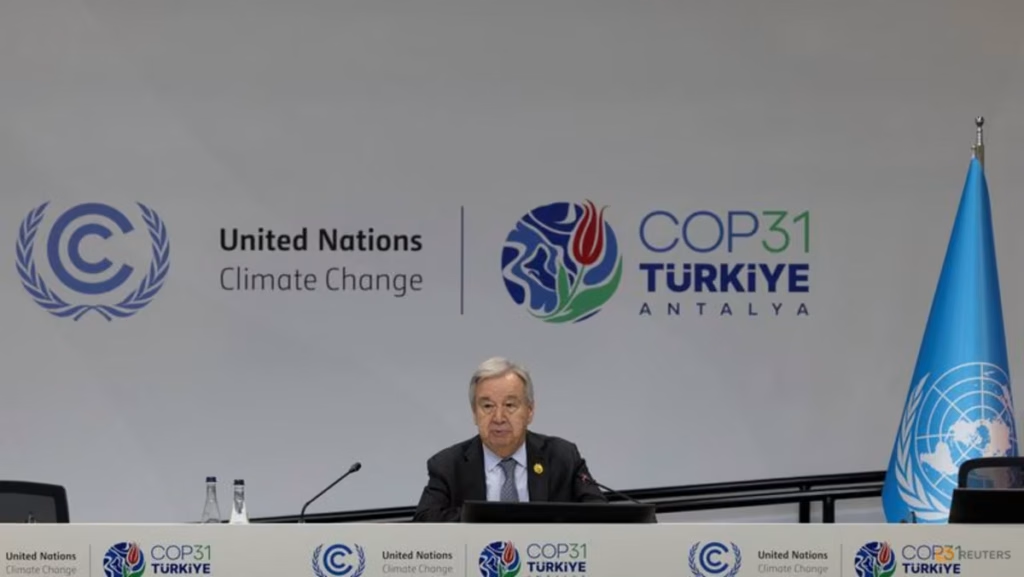
The 31st Conference of the Parties to the UN Framework Convention on Climate Change has stretched into a second extra day in its Turkish host city without a final agreement, after a draft text circulated late Friday night stripped explicit fossil fuel phase-out language from its core conclusions — triggering a united pushback from the European Union bloc and the Alliance of Small Island States that has thrown the talks into the most acute deadlock since the Dubai COP28 moment when the first-ever fossil fuel transition language was inserted; the Associated Press, BBC, The Guardian, and Al Jazeera all confirmed from the negotiating floor. The specific language at issue — whether the final COP31 text will include an explicit commitment to transition away from fossil fuels (the Dubai language), a commitment to phase down or phase out fossil fuels, or no explicit fossil fuel language at all — has been the central fault line of the entire COP31 process, with the EU and the island nations pushing for the most explicit commitment possible and the Saudi-led oil-producing nation bloc resisting any language that it argues prejudges the legitimate role of fossil fuels in a just energy transition.
The Associated Press documented the specific state of the negotiations at the moment the talks extended into overtime for a second day. The presidency text — the draft produced by the COP31 Turkish presidency to bridge the gap between the EU/island-state position and the Saudi-led position — had been circulated in the small hours of Saturday morning and was immediately rejected by the EU delegation, which described it as a step backward from Dubai and unacceptable as a basis for agreement. The island-state bloc — representing the most vulnerable nations in the world to climate change, including low-lying Pacific atoll states and Indian Ocean archipelagos where sea-level rise is an existential threat — joined the EU in rejecting the presidency text, with island-state negotiators describing the removal of explicit fossil fuel language as a betrayal of the commitment made in Dubai that had been their central demand. Al Jazeera confirmed that the Saudi-led bloc, which includes other major oil producers, was resisting restoration of the explicit language and had indicated it would not accept the Dubai formulation in a COP31 context.
The Dubai Baseline
The BBC and The Guardian provided essential context on the Dubai baseline that the EU and island nations are defending. COP28 in Dubai in 2023 was a historic moment in climate diplomacy: for the first time in the 30-year history of the UNFCCC process, a COP final agreement included explicit language calling for a transition away from fossil fuels. The language was not as strong as the EU and island nations had wanted — it called for a transition rather than a phase-out, and it included multiple qualifications — but it was the first time the words fossil fuels had appeared in a COP outcome document, and it was treated as a breakthrough by climate advocates. The Guardian noted that the specific fight at COP31 is therefore not over new ground but over the consolidation of Dubai: whether the fossil fuel transition language becomes a permanent feature of COP outcomes or whether it was a one-off achievement that oil-producing nations can erode at subsequent COPs by blocking its reaffirmation.
The Guardian analyzed the Turkish presidency role in the deadlock. The COP31 presidency is held by Turkey, which has its own complex relationship with the fossil fuel transition: Turkey is not a major oil producer but has been expanding coal power and has been cautious about ambitious climate commitments that it argues would disadvantage developing economies. The Guardian noted that the Turkish presidency text — in stripping explicit fossil fuel language from the draft — appears to be prioritizing a deal over ambition, reasoning that some agreement is better than no agreement. The EU and island-state blocs disagree: they argue that an agreement without fossil fuel phase-out language is not an adequate outcome and that accepting a weakened text would validate the Saudi-led strategy of using COP overtime pressure to dilute commitments. Al Jazeera reported that the negotiations were continuing through Saturday with no clear end in sight.
“We came to Turkey to build on Dubai, not to erase it. If the phase-out language goes, we do not have a deal. We have a document.” — EU chief climate negotiator cited by The Guardian
The Island Nation Dimension
Al Jazeera and the BBC provided extensive coverage of the island-nation dimension of the COP31 deadlock. For the small island developing states and least-developed nations whose territories face the most direct and severe consequences of climate change — rising seas, intensifying storms, coral bleaching, freshwater salinization — the COP31 outcome is not an abstract diplomatic question but a matter of existential survival. The island-state bloc at COP31 has been among the most vocal and emotionally powerful voices in the negotiations, with representatives from Tuvalu, Kiribati, Marshall Islands, and Maldives delivering floor speeches that have framed the fossil fuel language question in terms of their nations’ continued existence. Al Jazeera noted that the island-state negotiators are acutely aware that every COP that fails to strengthen fossil fuel commitments is a COP that leaves the trajectory of warming unchanged, and that for some of their nations the difference between 1.5 degrees and 2 degrees of warming is the difference between a future and no future.
The BBC analyzed the broader political dynamic of the Saudi-led opposition. Saudi Arabia and the OPEC+ oil-producing nation bloc have consistently and strategically resisted explicit fossil fuel phase-out language in COP outcomes, arguing that the transition must be just and that the pace and form of any transition must not be dictated by developed nations whose historical emissions created the climate problem. The BBC noted that the Saudi position has the support of a significant number of developing nations who are dependent on fossil fuel revenues or who argue that fossil fuel use is essential to their development paths, and that this coalition of opposition makes the Saudi-led bloc more politically durable than its critics often acknowledge. The Guardian noted that the specific COP31 moment is therefore a test of whether the Dubai breakthrough — built on a fragile coalition — can survive the first serious challenge from the opposition.
The Overtime Dynamic
The AP analyzed the overtime dynamic and what it means for the eventual outcome. COP negotiations routinely extend past their scheduled end date — the overtime is baked into the process because the final deals are made under maximum time pressure, and delegations know that the schedule extension is a feature, not a failure. However, the specific dynamic of the second extra day at COP31 is different from routine overtime: the gap between the blocs is not being bridged by presidency bridging text, and the EU and island nations have explicitly rejected the presidency draft. The AP noted that the possible outcomes at this point include: (a) the presidency produces a new text that restores some version of explicit fossil fuel language, which the Saudi-led bloc may accept in modified form; (b) the talks fail entirely, and no COP31 outcome is adopted, which would be an unprecedented breakdown; or (c) a deal is reached on significantly weakened language that the EU and island nations accept under protest to avoid a complete failure. The AP noted that most experienced climate negotiators consider option (b) extremely unlikely — the institutional pressure to produce some outcome is enormous — but that the specific form of option (c) or (a) remains genuinely uncertain.
WHAT HAPPENS NEXT
► Turkish presidency to produce a revised bridging text; whether explicit fossil fuel language is restored in some form
► EU and island-state blocs to assess any new text; whether a modified formulation is acceptable
► Saudi-led bloc to respond to any new language; the specific limits of what the opposition will accept
► Final plenary session to be convened when a deal is possible; whether a COP31 outcome can be adopted
► Climate advocates to assess the outcome against Dubai; whether COP31 represents progress, regression, or stasis
| CONFIDENCE: HIGH | Associated Press, BBC, The Guardian, and Al Jazeera all confirmed the overtime deadlock, the stripped fossil fuel language, the EU and island-nation rejection, and the Saudi-led opposition. Four-source confirmation across global wire, UK public broadcaster, premium broadsheet, and Qatari international on a confirmed diplomatic crisis at the most significant climate event of the year. |
| Bias Check | ||
| Left-Lean | Center | Right-Lean |
| Deadlock framed as oil-producing nations holding the planet hostage; Saudi Arabia is prioritizing petroleum revenue over the survival of island nations. | Reports the deadlock, the specific language dispute, the Dubai baseline context, and the bloc positions factually without prejudging the outcome. | Deadlock framed as developing nation resistance to developed-country climate colonialism; the transition must be just and cannot be dictated by historic polluters. |
SOURCES
► Associated Press — Deadlock confirmation, presidency text, overtime dynamic, outcome scenarios, November 22, 2026
► BBC — Dubai baseline context, island-nation dimension, Saudi opposition analysis
► The Guardian — Turkish presidency role, EU negotiator quotes, Dubai consolidation framing, Saudi bloc political durability
► Al Jazeera — Island-nation existential dimension, Saudi-led bloc detail, negotiations ongoing confirmation