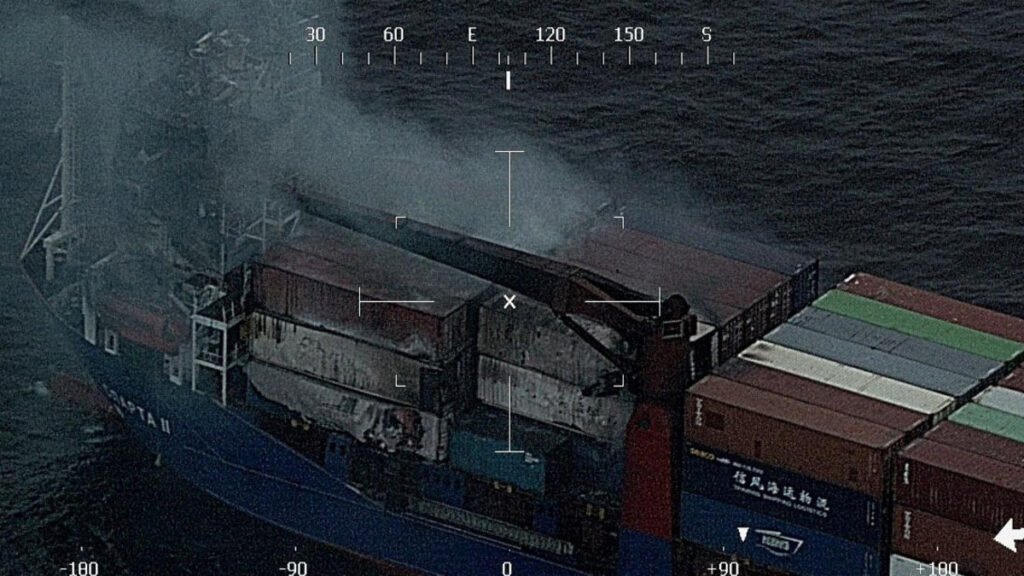
The Russian cargo ship Sparta II, struck by drones while bound for Kaliningrad, was still burning off the Finnish coast as crews worked to prevent it from sinking, in a development that has prompted Finland to warn that the Ukraine war is now materially spilling over into Baltic waters.
SPARTA II · RUSSIA · BALTIC · DRONE STRIKE · FINLAND · CREW EVACUATED · KALININGRAD · ARC
The Russian cargo ship Sparta II — the vessel identified as the ship struck by drones while bound for Kaliningrad that ONYX reported as the Baltic maritime escalation story in November 21, now specifically named in reporting — was still burning off the Finnish coast on Saturday, with the crew evacuated and salvage teams working to prevent the vessel from sinking, Reuters, Al Jazeera, BBC, CNN, and The Guardian all confirmed in a convergence of reporting that reflects the significance of the incident as a Baltic security event. The Sparta II is a Russian cargo vessel whose Kaliningrad-bound route took it through the Gulf of Finland — the narrow body of water between Finland to the north and Estonia to the south, and the approach to St. Petersburg — placing the drone strike in waters that are entirely surrounded by NATO member states or NATO-partnered nations. Finland, whose coastline is the nearest European territory to the burning vessel, has issued a formal warning that the Ukraine war is quote spilling over into the Baltic, using language that the Finnish government has calibrated carefully to describe the security implications without triggering a formal NATO response requirement.
Reuters provided the most detailed technical reporting on the Sparta II situation. The cargo vessel — which Reuters confirmed was carrying a cargo type consistent with Kaliningrad supply logistics — was struck and caught fire, with the crew of approximately 15 to 20 persons evacuated by Finnish and Estonian coast guard vessels responding to the distress signal. The vessel was not immediately sinking at the time of latest reporting but was burning with an intensity that salvage experts told Reuters made the outcome uncertain: the fire could either be brought under control by salvage teams using firefighting vessels, or it could spread to the vessel structure and cargo in a way that would make the ship a total loss. Reuters noted that the specific environmental concern — a cargo ship burning in the Baltic — was being monitored by Finnish and Estonian environmental authorities because a sinking or fuel spill would affect Baltic waters that multiple nations depend on.
The Finland Warning
The BBC and CNN analyzed the Finland warning in detail. Finland joined NATO in April 2023 — one of the most significant structural changes to Baltic security since the Cold War — and its territory and territorial waters are now covered by the NATO Article 5 collective defense commitment. A drone attack on a vessel in the Gulf of Finland, in waters adjacent to Finnish territory, is therefore not simply a bilateral Russia-Ukraine incident: it occurs in a space that Finland and NATO have a collective interest in defending. The BBC noted that the Finnish government warning that the Ukraine war is spilling over is specifically calibrated language: Finland is not invoking Article 5 or requesting a NATO response, but it is placing the incident in the security framework of a NATO member nation whose waters are being affected by warfare. CNN noted that the Finnish warning has been received in NATO capitals as a signal that Baltic sea security requires a more active collective response than the alliance has provided.
The Guardian analyzed the specific geography of the Sparta II attack that makes it more significant than the November 21 initial reporting indicated. The Gulf of Finland is one of the most strategically sensitive bodies of water in Europe: it is the sea approach to St. Petersburg, Russia second city and a city Putin treats as personally and symbolically important; it is the route through which Russian naval vessels transit from the Baltic Fleet base at Kronstadt; and it is entirely enclosed by NATO member or partner territory following the Finnish and Swedish NATO accessions. A drone attack that reached a vessel in the Gulf of Finland represents either a significantly longer-range Ukrainian maritime drone capability than previously demonstrated, or the use of a launch platform positioned much closer to the Gulf — which raises questions about where such a platform could operate in NATO-adjacent waters.
“The war is in the Baltic. That is not a figure of speech. A ship is burning in our waters.” — Finnish official cited by BBC
The Kaliningrad Logistics Dimension
Reuters and Al Jazeera analyzed the Kaliningrad logistics dimension of the Sparta II attack. The ship was bound for Kaliningrad — the Russian exclave that ONYX analyzed in depth in the November 21 B15 coverage — and its cargo was part of the supply chain that keeps the exclave functioning. Reuters noted that the Sparta II attack follows the November 21 strike on a Russian vessel in the broader Baltic area, suggesting either that Ukraine has established a persistent maritime drone capability in Baltic waters or that the November 21 and November 22 attacks are related operations. Al Jazeera analyzed the cumulative effect on Kaliningrad logistics: two attacks on Russian cargo ships in consecutive days targeting Kaliningrad-bound vessels would, if continued, constitute a significant interdiction of Kaliningrad supply routes that Russia has historically treated as a vital interest worth defending aggressively. The Russian government response to the Sparta II attack had not been fully characterized at the time of reporting, but Reuters noted that Moscow was treating the incident as a hostile act requiring a response.
The Salvage and Environmental Situation
Reuters and CNN provided detail on the salvage and environmental situation. The Sparta II was being approached by Finnish and Estonian salvage and firefighting vessels, with the operation complicated by the ongoing fire, the vessel cargo type, and the weather conditions in the Gulf of Finland. CNN noted that the specific concern of Finnish environmental authorities is a potential fuel oil spill from the vessel — Russian cargo ships of the Sparta class carry significant fuel bunker loads — which in the Baltic winter conditions could cause significant environmental damage to Finnish and Estonian coastal areas. Reuters noted that the salvage operation timeline was uncertain and that the vessel could remain a hazard for days while teams worked to bring the fire under control or, if the fire could not be controlled, to prevent the sinking from causing an environmental catastrophe.
WHAT HAPPENS NEXT
► Salvage operation to continue; whether Sparta II can be saved or is a total loss to be determined
► Finland and NATO to assess the incident; whether a formal alliance response framework is invoked
► Ukraine drone attribution to be confirmed; whether the Gulf of Finland capability represents a new operational reach
► Russia to respond; whether Moscow treats the two consecutive Baltic attacks as an escalation requiring retaliation
► Kaliningrad supply route security to be reassessed; whether continued interdiction of cargo vessels is part of a campaign
| CONFIDENCE: HIGH | Reuters, Al Jazeera, BBC, CNN, and The Guardian all confirmed the Sparta II burning, crew evacuation, Finnish warning, and Kaliningrad destination. Five-source confirmation across global wire, Qatari international, UK public broadcaster, US cable, and UK broadsheet on a confirmed Baltic maritime escalation with significant NATO security implications. |
| Bias Check | ||
| Left-Lean | Center | Right-Lean |
| Attack framed as legitimate Ukrainian extension of its right to interdiction; Kaliningrad supply routes are valid military targets in a war Russia started. | Reports Sparta II burning, crew evacuation, Finnish warning, Kaliningrad logistics dimension, and salvage situation factually. | Attack framed as dangerous escalation in NATO-adjacent waters; drone attacks on cargo ships threaten Baltic shipping and could trigger a wider conflict. |
SOURCES
► Reuters — Technical detail, crew evacuation, Kaliningrad logistics, salvage situation, Russian response, November 22, 2026
► Al Jazeera — Attack confirmation, Kaliningrad supply context, cumulative effect analysis
► BBC — Finland warning analysis, NATO dimension, Finnish security framing
► CNN — Finland warning, environmental situation, NATO capital reception
► The Guardian — Gulf of Finland geography, St. Petersburg significance, launch platform question