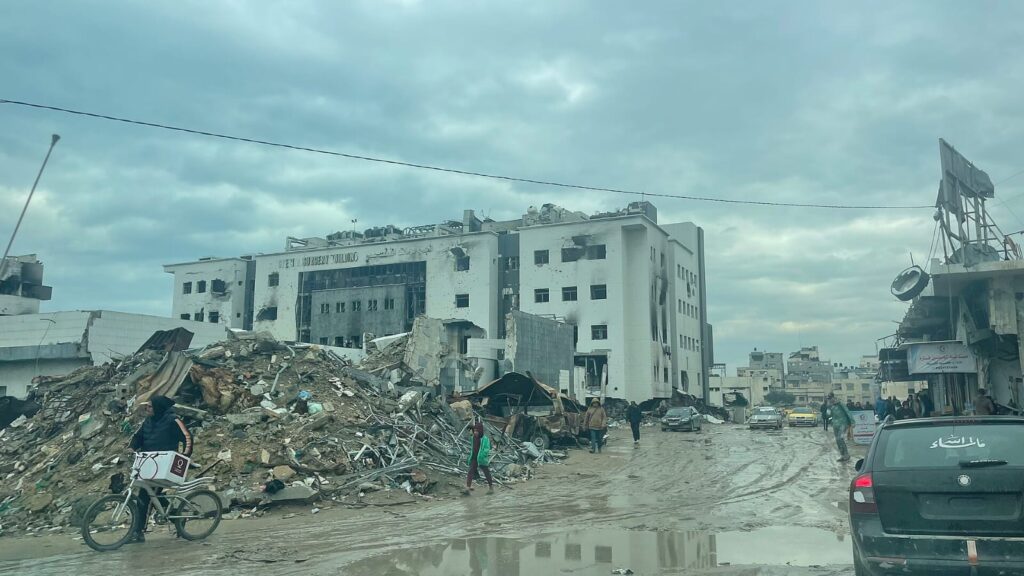
CNN confirmed that Israeli strikes hit Hamas weapon storage facilities in overnight operations across Gaza Saturday — the same night Trump was weighing, and ultimately canceling, a major bombing campaign against Iran. One strike left “a huge crater at a hospital in central Gaza,” according to CNN reporting. The hospital strike is the kind of incident that, in any other week, would be the defining international news story. On Saturday night, it competed for attention with a potential US attack on Iranian infrastructure, a Saudi Crown Prince phone call, and the biggest wildfire crisis in Washington State’s history.
2-MINUTE CONTEXT — WHAT ISRAEL SAYS IT WAS TARGETING
Israel’s military has consistently maintained that Hamas uses hospital complexes and civilian infrastructure to store weapons and command infrastructure, citing this as the legal basis for strikes on or near medical facilities under international humanitarian law. Israel claims the strikes targeted Hamas weapon storage — not the hospital itself.
This claim is disputed by Palestinian health authorities, humanitarian organizations, and international observers. Under international humanitarian law, attacking a protected medical facility requires: (1) confirmation the facility has lost its protected status by being used for military purposes, (2) a warning when feasible, and (3) proportionality — the military advantage must outweigh civilian harm. Each of these conditions is disputed in virtually every incident of this type.
CNN’s specific description — “a huge crater at a hospital in central Gaza” — does not itself resolve the legal question. A crater at a hospital could result from a strike on adjacent infrastructure that damaged the facility, from a strike inside the hospital compound, or from Hamas weapon storage exploding under Israeli strike. The physical evidence, without independent verification access, is genuinely ambiguous.
THE COVERAGE PROBLEM THIS STORY ILLUSTRATES
Saturday night — August 2, 2026 — was one of the highest news-density moments of the entire year. The Trump-Iran cancellation, the MBS phone call, the Spokane wildfire, and the Gaza hospital strike all happened simultaneously. The result is that the hospital strike received a fraction of the coverage it would have received had it occurred on a quieter news night.
This is not a conspiracy or a deliberate editorial choice. It is what happens when multiple major news events compete for attention simultaneously. But the practical effect is real: a strike leaving a crater at a hospital in Gaza — a category of incident that draws ICC attention, UN Security Council statements, and humanitarian organization reports — was a tertiary story on the night it occurred.
ONYX covers this story because the coverage gap is itself significant. The conflict in Gaza has not paused while the US and Iran manage their own escalation dynamics. People are continuing to die in Gaza. The news cycle’s attention is elsewhere.
| 🔍 ONYX REALITY CHECK VERDICT: UNVERIFIED WHY? CNN’s “huge crater at a hospital” description is reported from sourced observation. Israel’s claim that the target was Hamas weapon storage — not the hospital itself — is Israel’s stated justification, not independently confirmed. Palestinian health ministry death toll and injury figures are documented but not independently verifiable given access constraints. The specific legal question — whether the strike met IHL standards — requires a level of investigation access that does not currently exist publicly. |
WHY THIS MATTERS
The hospital strike is the kind of incident that accumulates in the documentary record of a conflict. The ICC prosecutor investigating the Gaza conflict has jurisdiction over exactly this category of incident. Every hospital strike, crater, and casualty figure is potential evidentiary material for proceedings that may unfold years from now.
For the families of people in the hospital on Saturday night, this is not a documentation question — it is their lives. But for the international accountability architecture that is supposed to create deterrence against future such incidents, documentation matters. And on Saturday night, documentation was in competition with a dozen other stories.
WHAT HAPPENS NEXT
▸ UN OCHA and WHO will document the hospital strike; their reports are typically published within 48–72 hours of incidents
▸ The ICC prosecutor’s office is tracking Gaza hospital incidents; this will be added to their investigation record
▸ Israel will provide military spokesperson explanation of the targeting decision and claimed military purpose
▸ If the “weapon storage” claim is accurate, Hamas will have lost military assets; if it is not, international pressure on Israel will intensify
| CONFIDENCE: MODERATE | CNN reporting on the crater and strike is documented. Israel’s weapon storage justification is their stated position. Independent verification of either claim is not possible from public information. The coverage gap observation is ONYX editorial analysis. |
| ⚖️ BIAS CHECK — WHO IS SAYING WHAT | |
| Israel / IDF | Targeting Hamas weapon storage is a legal military operation under IHL; hospital being used for military purposes loses protected status |
| Palestinian Health Authorities | Documenting attack on civilian medical infrastructure; calling for international intervention |
| CNN | Reporting what is visually evident — “huge crater at a hospital” — without reaching legal conclusions |
| UN / WHO | Will document and provide independent assessment; their reports carry significant weight in ICC proceedings |
| ICC | Tracking all Gaza hospital incidents in ongoing investigation; this incident will be reviewed |
| International Media | Coverage on Saturday night was significantly reduced by competing Iran and wildfire stories — this is itself noted as a coverage problem by media critics |
SOURCES
▸ CNN — “huge crater at a hospital in central Gaza” report, August 2, 2026
▸ Israel Defense Forces — weapon storage targeting justification
▸ UN OCHA — ongoing Gaza conflict documentation
▸ ICC — Gaza investigation public status reports
QUESTIONS YOU MAY STILL HAVE
Q: How many people were in the hospital at the time of the strike?
A: Not confirmed in available reporting. CNN’s report describes the physical damage but not casualty figures inside the hospital at the time.
Q: Is Israel allowed to strike hospitals under international law?
A: Under IHL, hospitals are protected facilities. They lose that protection if they are being used for military purposes (weapon storage, command operations) — but the state claiming military use bears the burden of establishing that the facility lost protected status before striking it. This burden standard is not consistently applied and is consistently disputed in the Gaza conflict.
Q: Why did this story get less attention?
A: Because it happened simultaneously with the Trump-Iran cancellation announcement, the MBS phone call reporting, and the Spokane wildfire crisis. News attention is not infinite. Multiple simultaneous major events produce coverage displacement. This is documented media behavior, not a conspiracy.