
The Center for Strategic and International Studies confirmed the US Patriot interceptor stockpile has fallen from more than 2,300 before Trump launched the Iran war on February 28 to roughly 800 today — a 65% depletion in five months. Russia and Iran are firing ballistic missiles faster than America can produce the interceptors to stop them. Each Patriot missile costs roughly $4 million. Raytheon and Lockheed Martin together manufacture fewer than 1,000 a year. Defense Secretary Pete Hegseth called shortage reports a “manufactured story” in June — then his own April statement acknowledging replenishment could take “months and years” became public. The production math and the war’s consumption rate are now in direct, documented contradiction.
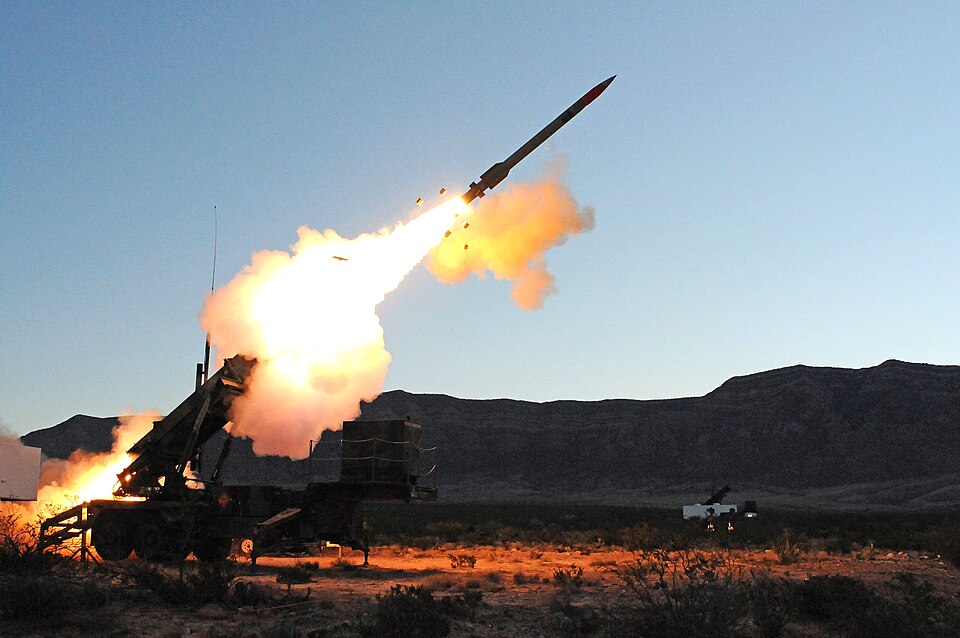
2-MINUTE CONTEXT — WHAT IS A PATRIOT MISSILE AND WHY DOES IT MATTER?
The Patriot missile defense system is America’s primary theater-level ballistic missile interceptor — the weapon system that stands between incoming ballistic missiles and the targets they are aimed at. Originally developed in the 1980s and used with mixed success in the 1991 Gulf War, the Patriot has been significantly upgraded and is now the backbone of air defense for US forward-deployed forces, NATO allies, and US partners across the Middle East and Europe.
The interceptor itself — the missile that destroys an incoming threat — is called the PAC-3 MSE (Missile Segment Enhancement). It is technically sophisticated, expensive to manufacture, and requires precision components with specialized supply chains. It cannot be produced quickly in the way that simpler artillery shells can be ramped up. Each unit requires months of production time from component manufacturing through final assembly and quality control.
The Patriot system is the single most important non-nuclear missile defense capability the United States possesses for protecting its forces and allies. It is what stands between an Iranian ballistic missile and a US base in Qatar, Bahrain, or Kuwait. It is what stands between a Russian missile and a Ukrainian city. When its stockpile falls by 65% in five months, everything in that protection chain becomes more exposed.
THE NUMBERS — AND WHY THEY CANNOT BE WISHED AWAY
| Patriot stockpile: pre-Iran war 2,300+ CSIS confirmed baseline, Feb 28, 2026 | Patriot stockpile: today ~800 CSIS confirmed current, August 5, 2026 |
| Depletion in 5 months 65% from 2,300+ to ~800 | Combined annual production <1,000 Raytheon + Lockheed Martin combined |
| Cost per interceptor $4M approximately, PAC-3 MSE | Months to replenish at current rate 15+ at <1,000/yr production vs. wartime consumption |
THE PRODUCTION PROBLEM IS NOT A SHORT-TERM FIX
Raytheon’s Andover, Massachusetts facility and Lockheed Martin’s Camden, Arkansas plant are the two primary Patriot interceptor manufacturers in the United States. Their combined output of fewer than 1,000 interceptors per year represents the maximum current capacity. Both companies have publicly committed to ramping up production — but “ramping up” precision missile manufacturing is categorically different from increasing steel production. The supply chain constraints include specialized propellant chemistry, electronic components that require months-long lead times, and workforce expertise that cannot be trained overnight.
When Hegseth said in April that restoring stockpiles could take “months and years,” he was accurately describing the industrial reality. When he called shortage reports a “manufactured story” in June, he was contradicting that reality — presumably for political reasons related to managing public perception of the war’s costs. The CSIS figures released this week document the gap between the two statements.
“Months and years.”
— Defense Secretary Pete Hegseth, describing the timeline for replenishing Patriot stockpiles — April 2026 (two months before he called shortage reports “manufactured”)
THE CONSUMPTION RATE PROBLEM
A Patriot battery typically fires multiple interceptors at a single incoming threat to maximize the probability of a kill. Against a sophisticated ballistic missile — like the Iranian Shahab-3 or the Russian Iskander — a single interceptor may not be sufficient. Two or three interceptors per threat is a realistic operational assumption. At scale, during an active conflict, the math compounds rapidly.
Russia has been firing ballistic missiles at Ukraine at documented rates ranging from dozens to over a hundred per week during heavy offensive periods. Iran has demonstrated similar sustained ballistic missile capability. A conflict in which both adversaries are firing simultaneously, against US-supplied Patriot systems protecting both Ukraine and Gulf allies, creates a consumption rate that current production simply cannot match.
The 800 interceptors remaining are not solely available for any single front. They must be allocated across Ukraine’s existing Patriot batteries, US forward-deployed forces in the Gulf, US forces in NATO Europe, and the US homeland defense reserve. 800 divided across those demands is a genuinely constrained number.
| 🔍 ONYX REALITY CHECK VERDICT: FALSE WHY? Hegseth’s June characterization of Patriot shortage reports as a “manufactured story” is directly contradicted by his own April statement (“months and years”) and by the CSIS documented stockpile figures. The shortage is not manufactured. The CSIS is a credible, non-partisan security research institution. The figures of 2,300+ pre-war and ~800 current are documented. The production capacity of under 1,000/year is a confirmed industry figure. The Defense Secretary’s June denial rates as False against the public record. |
WHY THIS MATTERS
Air defense is not abstract. The 800 Patriot interceptors remaining are the concrete, physical answer to the question: “how many incoming Iranian or Russian ballistic missiles can the United States stop today?” Every one fired at an incoming threat is one fewer available for the next one. The stockpile does not replenish at combat tempo. It depletes.
For Ukraine specifically: the country has been dependent on Patriot batteries for city-level air defense since 2023. A US decision to reduce interceptor allocations to Ukraine to preserve domestic reserves would directly affect Ukrainian cities’ ability to survive ballistic missile attacks. That is not a budget line item. It is a question of whether people in Kyiv live or die.
For Gulf allies: Saudi Arabia, the UAE, Qatar, and Kuwait all operate Patriot systems and depend on US restocking. If Iranian escalation resumes and the US stockpile is at 800, the practical question of who gets interceptors first — US forward forces, Ukraine, or Gulf allies — becomes a genuine strategic triage decision with no good answer.
For the defense industrial base: this shortage demonstrates a structural failure in US defense planning that goes beyond this specific war. The production model built around steady-state peacetime production rates has collapsed under wartime demand. Correcting it requires multi-year industrial investment that neither party has seriously funded.
POLITICAL IMPACT
| WHO FACES PRESSURE | WHO BENEFITS FROM ATTENTION |
| Hegseth — his own statements are now documented contradictions | Congressional Democrats — finally have hard numbers for oversight hearings |
| Trump administration — managed a war that consumed 65% of critical air defense stockpile | Defense industry — production ramp justification for increased contracts |
| NATO allies — concerned about US commitment to European air defense | Ukraine advocates — concrete argument for sustained US support |
| GOP defense hawks — their production-ramp calls are now vindicated by the data | CSIS — as credible source whose numbers are now center of national security debate |
WHAT HAPPENS NEXT
▸ Watch for congressional requests to Raytheon and Lockheed Martin to accelerate production timelines — formal letters expected within weeks
▸ DoD budget amendment to fund Patriot production acceleration will likely be attached to upcoming supplemental spending legislation
▸ Ukraine allocation decision: with 800 interceptors and Ukrainian demand ongoing, a decision about Ukraine’s next allotment will reveal priorities
▸ Gulf allies will increase bilateral pressure for interceptor commitments — Saudi and UAE diplomatic activity on this issue will intensify
▸ Hegseth’s contradiction will be the centerpiece of the next defense oversight hearing — watch for a Senate Armed Services Committee request
GLOBAL IMPACT
For oil markets: if Gulf ally air defense gaps become public knowledge, Iranian escalation risk premium rises. Every percentage point of US Patriot depletion that Iran’s IRGC can calculate gives Tehran a different strategic calculus.
For NATO: Europe has already been running its own air defense stockpile down supporting Ukraine. A US Patriot shortage compounds European anxiety about the adequacy of alliance-wide air defense if a major Russian escalation occurs.
For China: the PLA is watching the rate at which US high-end missile stockpiles deplete under sustained wartime pressure. Any Taiwan contingency planning in Beijing is updated by the data point that five months of conflict consumed 65% of one of America’s most critical weapons systems.
| CONFIDENCE: HIGH | CSIS stockpile figures (2,300+ to ~800) are from a named, credible institution. Hegseth April “months and years” quote is documented. Hegseth June “manufactured story” quote is documented. Raytheon/Lockheed combined production figure (<1,000/year) is from industry reporting. PAC-3 MSE cost (~$4M) is from public defense procurement records. |
| ⚖️ BIAS CHECK — WHO IS SAYING WHAT | |
| DoD / Hegseth | Calling the shortage “manufactured”; not yet addressing the CSIS figures directly; managing perception |
| CSIS | Neutral, credible institution; publishing documented figures; not offering policy recommendations in the specific report |
| Congressional Democrats | Using as evidence of war mismanagement; demanding production ramp funding and oversight hearings |
| Congressional Republicans (defense hawks) | Alarmed; calling for production increase; quietly uncomfortable with Hegseth’s messaging |
| Defense Industry (Raytheon, Lockheed) | Publicly committed to ramp; privately managing supply chain constraints; politically benefiting from the urgency narrative |
| Ukraine advocates | Using the shortage figures to argue against any reduction in Ukraine’s interceptor allocation |
| Iran / Russia | Not publicly commenting; both have intelligence visibility on US stockpile status; both adjust targeting strategy accordingly |
📅 NEWS EVOLUTION
Pre-Feb 28, 2026: US Patriot stockpile: 2,300+ interceptors
Feb 28, 2026: Iran war begins; Patriot consumption accelerates across multiple theaters
April 2026: Hegseth acknowledges replenishment could take “months and years”
June 2026: Hegseth calls shortage reports “manufactured story” — contradicting his own April statement
August 5, 2026: CSIS confirms stockpile at ~800 — 65% depleted in 5 months
SOURCES
▸ Center for Strategic and International Studies (CSIS) — stockpile figures: 2,300+ to ~800
▸ Defense Secretary Pete Hegseth — April 2026: “months and years” to replenish
▸ Defense Secretary Pete Hegseth — June 2026: shortage reports are “manufactured story”
▸ Raytheon / Lockheed Martin — combined annual production under 1,000 units (industry reporting)
▸ PAC-3 MSE unit cost: ~$4 million (DoD procurement records)
▸ NPR — Gulf allies’ concerns and Ukraine prioritization reporting
QUESTIONS YOU MAY STILL HAVE
Q: Does the US having 800 interceptors left mean it can’t defend itself?
A: No — 800 interceptors are still a significant defensive capability, particularly for focused, single-theater operations. The concern is the depletion rate: if the current conflict continues at the same consumption pace for five more months, the stockpile could reach levels where allocation choices become genuinely agonizing.
Q: Can’t the US just buy more from allies?
A: Some allies (Germany, Netherlands) operate Patriot systems, but their own stockpiles are also under pressure supporting Ukraine. The PAC-3 MSE is US-manufactured; there is no allied supplier to buy from. The only production pipeline is Raytheon and Lockheed.
Q: Why wasn’t the US producing more before the war started?
A: Pre-war production was calibrated to peacetime replacement rates and planned procurement for sales to allies. The assumption was that no conflict would demand sustained wartime consumption. That assumption was wrong. Production scale-up takes 2–3 years to fully materialize.
Q: What would happen if the stockpile reached zero?
A: This is the scenario that keeps air defense planners awake. At zero, US forward forces and allies dependent on Patriot would be undefended against ballistic missile attack until the production pipeline delivers new interceptors. This is why even at 800 the alarm is genuine — the margin is narrower than anyone comfortable with would prefer.