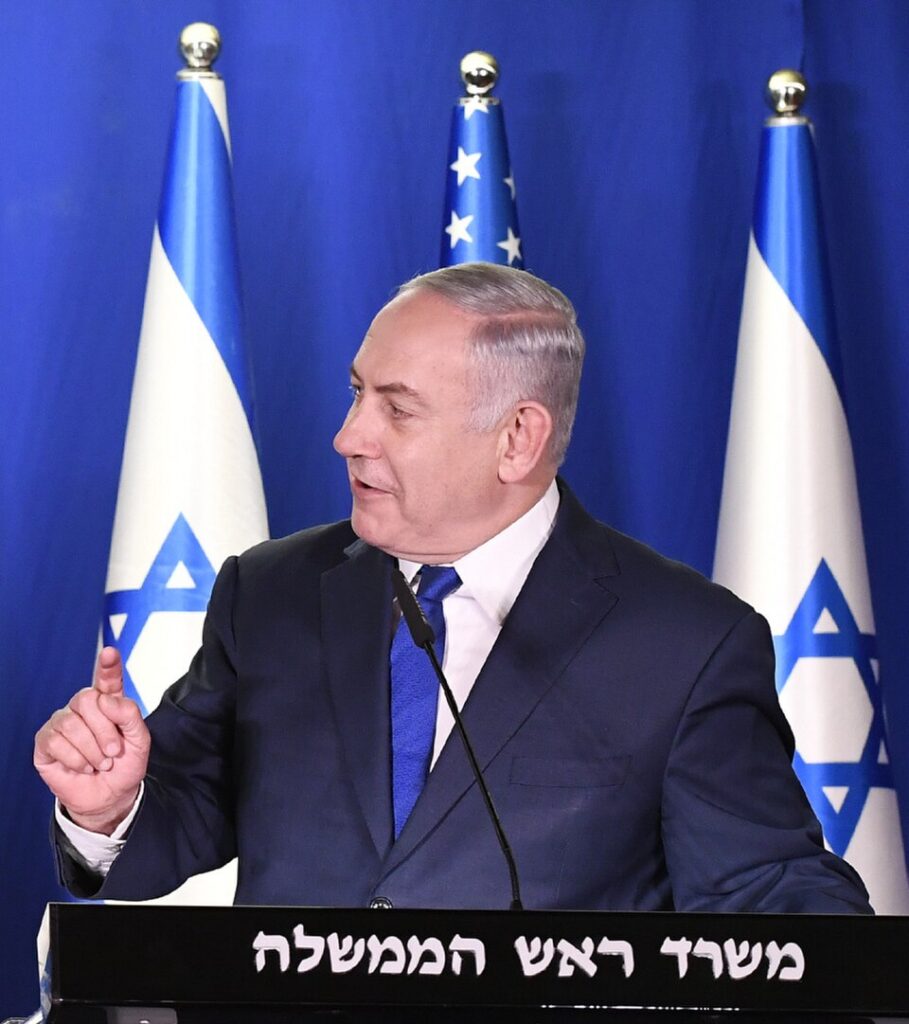
After more than 24 hours of silence, Israeli Prime Minister Benjamin Netanyahu issued a statement on Saturday evening responding to the US-Iran ceasefire deal. He conditionally accepted the framework — then immediately issued a reservation that functioned as a threat: Israel explicitly reserves the right to take military action against Iran’s nuclear program if the 20% enrichment cap is violated or if Iran is found to be making progress toward a nuclear weapon through any other pathway. Netanyahu called the deal “insufficient but a starting point” and demanded a specific, named condition: that the 90-day nuclear dialogue framework must include “complete cessation of all uranium enrichment, not merely a level reduction.” Israel is accepting the deal while simultaneously announcing it will reject the deal if it does not produce more than the deal actually committed to.
2-MINUTE CONTEXT — WHY THIS STATEMENT IS STRUCTURALLY AMBIGUOUS
Netanyahu’s statement is carefully constructed to do two contradictory things at once. First, it accepts the ceasefire — meaning Israel will not immediately collapse the deal with a unilateral strike, and Netanyahu will not face the diplomatic cost of being seen to torpedo a deal the entire rest of the world welcomed. Second, it reserves the right to strike — meaning Netanyahu has publicly pre-authorized Israeli military action against Iran’s nuclear facilities if he judges the nuclear dialogue track to be failing.
The pre-authorization matters because it is now public. Iranian intelligence knows Israel has reserved this right — which Iran already knew privately, but public articulation changes the diplomatic dynamics. US officials now know that Israel has publicly reserved the right to act — which means any future Israeli strike is something the US was warned about, making the diplomatic fallout from that strike more manageable for Israel.
The demand for “complete cessation of all enrichment” is the escalation embedded in the acceptance. The deal agreed to a suspension of enrichment above 20%. Netanyahu has now publicly demanded the 90-day nuclear dialogue produce zero enrichment — a demand Iran has stated repeatedly it will not accept as a condition of any agreement. Netanyahu is accepting the deal while publicly setting a condition for continuing to accept it that Iran will almost certainly not meet.
THE THREE INTERPRETATIONS
| INTERPRETATION | WHAT IT MEANS PRACTICALLY |
| Netanyahu is genuinely trying to strengthen the deal | He will apply pressure on the US during nuclear dialogue to push for a zero-enrichment outcome; collapse only as last resort |
| Netanyahu is building a public justification for a future strike | The statement creates a record: “I warned them; they didn’t deliver; I acted.” Pre-authorization for later action. |
| Netanyahu is managing his own coalition | Ben Gvir and Smotrich needed something; “we reserve the right” keeps them in the coalition without collapsing the deal today |
TRUMP’S POSITION — AND THE TENSION IT CREATES
Trump has described the deal as Iran agreeing to “all major demands.” Netanyahu’s statement implicitly contradicts this: if all major demands were met, Israel would not need to reserve the right to strike over the nuclear terms. The gap between Trump’s “all demands met” and Netanyahu’s “insufficient but a starting point” is a public contradiction between the two leaders that the White House will need to manage.
The US is now in the position of having guaranteed a deal that its primary regional ally has conditionally accepted with an explicit threat of unilateral military action if the deal fails to produce more than it committed to. This is not a stable diplomatic configuration.
“Insufficient but a starting point. Israel reserves all rights to defend itself if Iran’s nuclear program advances by any pathway.”
— Netanyahu — Saturday evening statement on the Iran ceasefire deal, August 8, 2026
WHY THIS MATTERS
The deal’s Failure Mode 1 — identified in yesterday’s ONYX August 7 analysis — was an Israeli unilateral strike as the highest-probability risk. Netanyahu’s statement today does not eliminate that failure mode. It institutionalizes it: Israel has now publicly stated the conditions under which it will act, and those conditions are ones Iran will predictably not meet in the 90-day dialogue.
Whether this is a genuine threat or a diplomatic performance — and in Israeli strategic communication, those are often the same thing — the public statement itself changes the environment. Every day of the 60-day clock now runs against the background of Israel’s explicit reservation of the right to collapse it.
The nuclear dialogue track is now the most important diplomatic process in the world. It is not a process the US controls unilaterally. It is a three-way negotiation (US, Iran, Israel-as-veto-holder) in which any party can blow it up, and one of them has just publicly said what will cause it to blow it up.
POLITICAL IMPACT
| WHO IS UNDER NEW PRESSURE | WHO BENEFITS FROM NETANYAHU’S STATEMENT |
| Trump — gap between “all demands met” and Netanyahu’s “insufficient” is a public contradiction | Netanyahu — coalition preserved; Ben Gvir and Smotrich can stay; reservations are on the record |
| Iran — must decide if “zero enrichment” demand will kill the dialogue | Israeli hawks — got the public reservation without having to collapse the deal today |
| Oman — its mediated deal is now explicitly conditional on Netanyahu’s satisfaction | Iranian moderates — now facing harder domestic argument for any nuclear concession |
| US diplomacy — must manage US-Israel gap while simultaneously running nuclear talks with Iran | Russia/China — watching; Israeli reservation creates ambiguity that benefits both as strategic actors |
WHAT HAPPENS NEXT — THE CRITICAL 30 DAYS
▸ WEEK 1: Nuclear dialogue formal launch via Oman — whether Iran and the US can agree on an agenda without Netanyahu’s demand immediately collapsing it
▸ WEEK 2: IAEA inspection access — if Iran cooperates, Israel’s stated concern about enrichment progress is addressed; if not, Israeli threat becomes more credible
▸ WEEK 3-4: First substantive nuclear talks — whether “complete cessation” or a different formulation can bridge US-Israeli and Iranian positions
▸ WATCH: Ben Gvir and Smotrich statements — if they publicly endorse Netanyahu’s response as “enough,” coalition holds; if they call it “insufficient,” Netanyahu faces internal collapse pressure
▸ WATCH: Tanker traffic — if Hormuz is flowing normally, Iran has an incentive to keep the deal alive; if Iran slows traffic for any reason, the deal is in danger
| CONFIDENCE: HIGH | Netanyahu’s statement is documented from Israeli government communications, Saturday August 8. “Insufficient but a starting point” phrasing is attributed. The reservation of military action right is documented. The “complete cessation” demand is documented. Analysis of the three interpretations is ONYX editorial, clearly labeled. |
| ⚖️ BIAS CHECK — WHO IS SAYING WHAT | |
| Netanyahu | Managed the impossible: accepted without endorsing; reserved without acting; gave coalition partners something; avoided diplomatic isolation |
| Ben Gvir / Smotrich | Will evaluate whether the reservations are sufficient to stay in coalition; their public statements are the next signal |
| Trump / White House | Will downplay the Netanyahu-Trump gap; will characterize the conditional acceptance as Israeli endorsement |
| Iran | Will parse the “complete cessation” demand carefully; will likely describe it as Israeli provocation designed to collapse a deal Iran wants to work |
| Democrats | Will use the Netanyahu-Trump gap to question whether the deal was as complete as Trump claimed |
| International Observers | Noting that the deal survived Day 1 with Netanyahu’s qualified acceptance — that is a better outcome than many expected |
SOURCES
▸ Netanyahu — Saturday August 8 statement (documented from Israeli government)
▸ Prior ONYX coverage — Five failure modes, Failure Mode 1 (Israeli unilateral strike as highest-probability risk)
▸ Ben Gvir / Smotrich prior statements on nuclear deal terms
QUESTIONS YOU MAY STILL HAVE
Q: Is “insufficient but a starting point” a rejection or an acceptance?
A: It is neither a full rejection nor a full endorsement. It is a qualified acceptance — Israel will not immediately collapse the deal, but has stated conditions under which it will. In diplomatic terms, this is the most ambiguous possible response, which is exactly what Netanyahu needed.
Q: What does “complete cessation of all enrichment” actually mean as a demand?
A: Iran has been enriching uranium at 60%; the deal capped it at 20%. Netanyahu is demanding the 90-day nuclear dialogue produce zero enrichment. Iran has stated that any civilian nuclear program requires enrichment. The gap between Netanyahu’s demand (zero) and Iran’s minimum (some level) is the entire distance of the nuclear dispute. Netanyahu has demanded that a 90-day dialogue close a gap that has been open for 25 years.
Q: Could the US broker a deal that satisfies both Netanyahu and Iran?
A: Theoretically — if Iran agreed to very low levels of enrichment (below 5%, with stringent verification) and Netanyahu agreed to accept that as adequate, there is a theoretical middle ground. In practice, neither party has ever accepted those terms simultaneously. That is why this has been unresolved for 25 years.