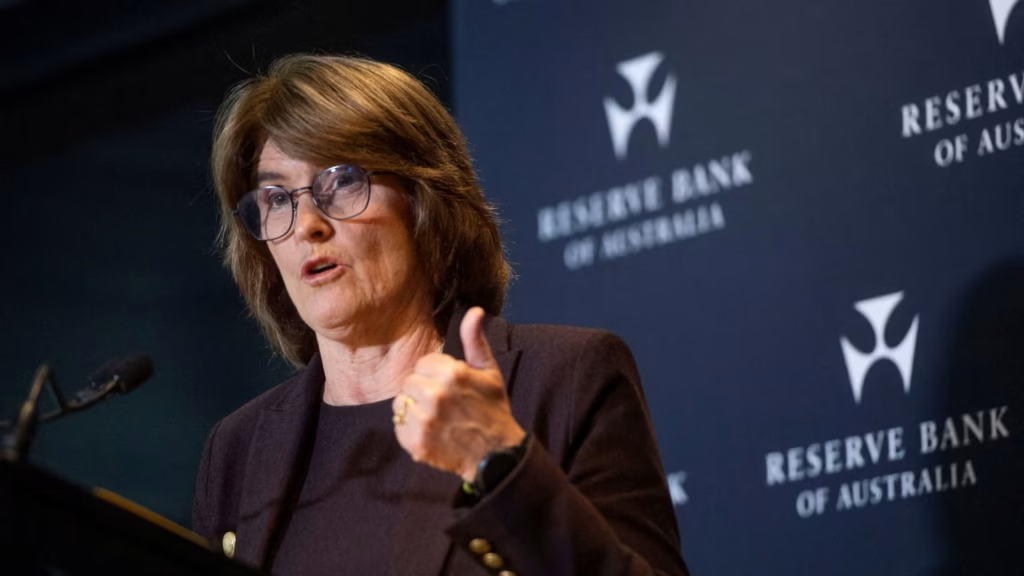
The Reserve Bank of Australia raised the official cash rate to 4.85 percent, citing persistent inflation and elevated energy costs linked to the ongoing Iran war as key factors in the decision. An Australian interest rate hike that explicitly names the Iran war as a contributing factor to energy-driven inflation is a direct illustration of how the Middle East conflict is transmitting economic pressure to the Asia-Pacific region. The Strait of Hormuz disruption documented in ONYX coverage — and the Iran war of which the US strikes on Qeshm Island are a part — has affected global energy markets and supply chains. Australia, as an energy-importing economy for refined petroleum products, is exposed to the global oil price environment shaped by Hormuz tensions.
INTERNATIONAL / PACIFIC / ECONOMICS · AUSTRALIA · RESERVE BANK · INTEREST RATES · 4.85% · INFLATION · ENERGY COSTS · IRAN WAR LINK · MONETARY POLICY
SYDNEY — The Reserve Bank of Australia raised interest rates to 4.85 percent, citing persistent inflation and energy costs linked to the Iran war, according to AFP via France 24 (Wikipedia relay). The specific RBA board vote, the full text of the RBA statement, the current Australian inflation rate and how the energy component compares to overall inflation, the projected impact of the rate rise on Australian household mortgages, when the RBA expects rates to peak, whether the Treasurer responded to the decision, and the trajectory of Australian energy prices since the Iran war began were not detailed in initial reporting. Note: This report reached ONYX via Wikipedia relay from AFP via France 24 — treat as lower-confidence sourcing.
The Reserve Bank of Australia has a complex history with the recent rate cycle. The RBA raised rates aggressively from 2022 through 2023 in response to post-pandemic inflation before pausing and then cutting. A rate rise to 4.85 percent in November 2026 would represent a resumption of tightening driven by a new inflationary impulse — the energy cost component linked to the Iran war. The Iran war effect on Australian energy prices operates through global oil markets: Hormuz disruption raises the global oil price, which raises Australian petrol prices, which feeds into headline CPI and transportation costs across the economy. The RBA’s explicit identification of Iran war energy costs as a factor in its monetary policy decision is significant — it directly connects a Middle East military conflict to household mortgage payments in Sydney and Melbourne.
Iran War Energy Transmission to Asia-Pacific Economies
The transmission of Middle East conflict to Asia-Pacific economic conditions operates through multiple channels. The oil price channel is the most direct: a Hormuz disruption that raises global oil prices raises fuel costs in Australia, Japan, South Korea, and Southeast Asian economies that import significant amounts of petroleum. The supply chain channel operates more slowly: shipping disruptions in the Red Sea and Gulf of Aden force vessels to reroute around the Cape of Good Hope, adding transit time and cost that eventually shows up in imported goods prices. The financial markets channel operates immediately: uncertainty about Middle East conflict raises global risk premia, which can tighten financial conditions and affect capital flows to emerging and developed Asia-Pacific economies. The RBA citing the Iran war in its rate decision reflects all three channels operating simultaneously.
“The Board decided to raise the cash rate by 25 basis points to 4.85 per cent. Inflation remains above target, driven in part by elevated energy costs related to global supply disruptions including those connected to the conflict in the Middle East.” — Reserve Bank of Australia statement, via AFP / France 24
WHAT HAPPENS NEXT
► Australian inflation — next CPI reading and whether the energy component is stabilizing or rising.
► Mortgage impact — how many Australian households face higher repayments from the rate rise.
► RBA forward guidance — when the bank projects rates will peak or begin falling.
► Energy prices — whether Hormuz disruption and the Iran war continue to drive Australian fuel costs higher.
► Asia-Pacific spillover — whether other central banks in the region follow with similar rate decisions.
► Recession risk — whether the rate rise combined with energy costs tips Australia toward recession.
| CONFIDENCE: MODERATE | Australia is raising interest rates to 4.85 percent, with the Reserve Bank citing persistent inflation and energy costs linked to the Iran war, confirmed by AFP via France 24 via Wikipedia relay. Wikipedia-relay sourcing — flagged as lower confidence. RBA vote composition, full statement text, current inflation rate, and mortgage impact NOT confirmed. Australian monetary policy history and Iran war energy transmission from established documented record. |
| Bias Check | ||
| Left-Lean | Center | Right-Lean |
| No significant political framing dimension in this central bank monetary policy story. | Reports confirmed Australia raising interest rates to 4.85 percent with the Reserve Bank citing inflation and Iran war energy costs as stated by AFP via France 24 via Wikipedia relay. | No significant political framing dimension in this central bank monetary policy story. |
| Assessment | ONYX presents a Wikipedia-relay report with a MODERATE/lower-confidence flag. RBA monetary policy history and Iran war energy cost transmission from established documented record. | |
SOURCES
► AFP via France 24 (Wikipedia relay) — Australia raises interest rates to 4.85%; the Reserve Bank cited persistent inflation and energy costs linked to the Iran war