China’s coast guard entered Taiwan’s restricted waters near Itu Aba for the first time. Here’s what triggered it and what experts say comes next.
| AT A GLANCE | |
| Reading Time | 7 minutes |
| Topic | China–Taiwan maritime tensions, South China Sea |
| What’s New | Chinese government ships entered Taiwan’s restricted waters near Itu Aba on June 11 — what Taipei calls a first. |
| Why It Matters | Tied to a separate Japan-Philippines boundary dispute, the incident tests China’s gray-zone tactics and regional alliance responses. |
| Status | Developing |
| Confidence | Medium — The incursion itself is confirmed by Taiwan’s coast guard, but its “first-ever” framing is disputed by independent ship-tracking data, and China’s broader intentions remain unconfirmed. |
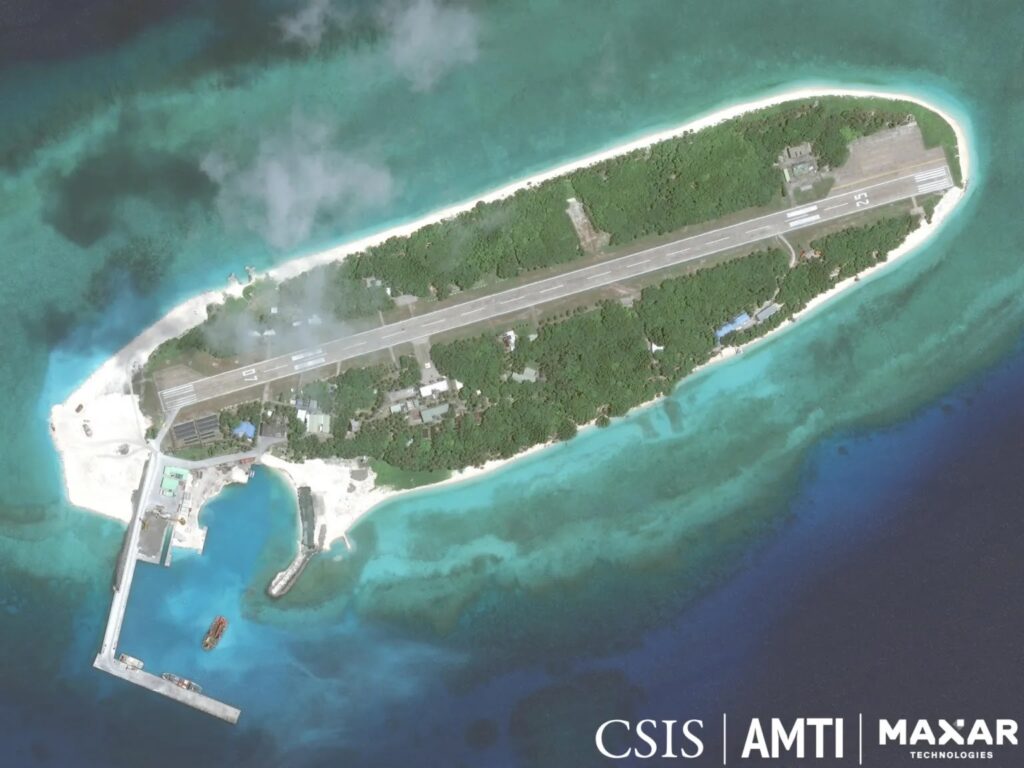
Satellite image of Itu Aba (Taiping Island), Taiwan’s coast guard and military outpost in the disputed Spratly Islands, South China Sea.” Credit line: Image courtesy of the Asia Maritime Transparency Initiative, Center for Strategic and International Studies (CSIS). Credit as: “Satellite imagery via AMTI/CSIS.”
Two Chinese government ships entered restricted waters around Itu Aba, Taiwan’s only outpost in the disputed Spratly Islands, on June 11. Taiwan’s Coast Guard Administration called it the first such incursion and condemned it as a violation of the island’s sovereignty, according to the agency’s own statement.
The incident is the latest escalation in a maritime dispute that began on May 28, when Japan and the Philippines announced they would hold formal talks to delimit overlapping maritime boundaries in waters east of Taiwan. China, which claims Taiwan as its own territory, responded by launching what it called a “special maritime law enforcement operation” in the same waters, according to Reuters.
Taiwan’s foreign ministry says China has no authority to act on its behalf in the boundary talks. China’s coast guard says its patrols are lawful enforcement of territory it considers its own, according to a statement carried by the South China Morning Post.
Independent analysts at the Institute for the Study of War and the American Enterprise Institute say the operation reflects a broader Chinese strategy to normalize control over waters that could be used to enforce a future blockade or quarantine of Taiwan.
| Key Fact Itu Aba, also called Taiping Island, is the largest natural island in the Spratly archipelago and Taiwan’s only administered feature there, home to a Taiwanese military and coast guard base, according to the Institute for the Study of War. |
Quick Summary
- Two Chinese government ships briefly entered Taiwan’s restricted waters near Itu Aba on June 11, which Taiwan’s coast guard called a first-ever incursion there.
- The dispute traces back to May 28, when Japan and the Philippines announced maritime boundary talks in waters China claims through its ties to Taiwan.
- China calls its patrols lawful law enforcement; Taiwan calls them a violation of sovereignty and “cognitive warfare,” according to Taiwanese officials.
- Independent defense analysts say the operation tests capabilities China could use in a future blockade of Taiwan.
- A Dutch warship separately transited the Taiwan Strait in early June, prompting China to track and protest the move.
- Taiwan’s opposition KMT party and Beijing’s Taiwan Affairs Office have both criticized the governing party’s response, for different reasons.
What We Know / What We Don’t Know
What We Know
- Two Chinese vessels, the law enforcement ship Sansha Zhifa 301 and supply ship Sansha 2 Hao, entered Itu Aba’s restricted waters on June 11, according to Taiwan’s Coast Guard Administration.
- China’s Ministry of Transport ran a broader “special maritime law enforcement operation” east of Taiwan from June 6 to 10, confirmed by Chinese state media and tracked independently by the ship-monitoring service Starboard.
- The operation was launched in direct response to the Japan-Philippines announcement of maritime boundary talks, according to both Chinese and Japanese officials.
- A Dutch frigate, the HNLMS De Ruyter, transited the Taiwan Strait in early June after operating near the Paracel Islands, which China’s military says it tracked and monitored.
What We Don’t Know
- Whether the June 11 Itu Aba incursion was truly unprecedented. Ship-tracking data reviewed by the Institute for the Study of War shows the same supply vessel has sailed near Itu Aba on past annual voyages, sometimes escorted by a law enforcement ship, which complicates Taiwan’s “first-ever” characterization.
- Whether Japan and the Philippines will include Taiwan or China in their boundary talks. Neither country has clarified this, and both maintain “One China” policies that complicate direct engagement with Taipei.
- How far China intends to escalate. Beijing has not stated whether further patrols, larger vessels, or military assets will be used if the Japan-Philippines talks proceed.
- Whether this signals a near-term shift in Chinese strategy or a continuation of the gray-zone pressure campaign Taiwan has faced for several years.
How the Standoff Escalated
The trigger was a joint announcement on May 28 by Japanese Prime Minister Sanae Takaichi and Philippine President Ferdinand Marcos Jr. The two countries said they would begin formal talks to delimit the maritime boundary between their exclusive economic zones in an area east of Taiwan, citing international law.
China’s Ministry of Foreign Affairs condemned the move as “illegal and invalid,” saying it bypassed Beijing and infringed on what China considers its sovereign rights, including its claim over Taiwan, according to a ministry statement cited by the Institute for the Study of War.
China’s Ministry of Transport launched a coast guard and maritime safety patrol in the disputed waters from June 6 to 10, involving multiple agencies including the Fujian and Guangdong Maritime Safety Administrations. Two China Coast Guard ships continued patrolling the area after the formal operation ended, according to ship-tracking data.
On June 11, two of the same category of Chinese vessels entered restricted waters near Itu Aba for what Taiwan’s coast guard called the first time, prompting a formal condemnation from Taipei the same day, Reuters reported.
Why China and Taiwan Dispute These Waters
China claims Taiwan as its own territory and has never ruled out the use of force to bring it under Beijing’s control, despite Taiwan’s democratically elected government rejecting that claim. Taiwan has governed itself separately since 1949.
Itu Aba, known in Taiwan as Taiping Island, sits in the Spratly Islands, a chain claimed in whole or in part by China, Taiwan, Vietnam, the Philippines, Malaysia, and Brunei. It is Taiwan’s only administered feature in the chain and hosts a coast guard and military base.
China has steadily increased coast guard activity around Taiwan-controlled islands in recent years, including the Kinmen, Matsu, Pratas, and Dongsha areas, often describing the patrols as routine law enforcement. Taiwan’s coast guard logged 11 separate incursions near Dongsha Island in 2025 alone, according to Taiwan’s Central News Agency.
The current episode is distinct because it involves waters claimed in connection with a dispute between two other countries, Japan and the Philippines, rather than a direct Taiwan-China confrontation. Analysts say China is using the moment to assert that any boundary decision involving these waters requires Beijing’s involvement.
How This Compares With Past Coast Guard Standoffs
China’s coast guard has confronted Taiwan and the Philippines in these waters before, most notably in repeated clashes with Philippine vessels near Second Thomas Shoal and Scarborough Shoal over the past several years. Those incidents typically involved water cannons, ramming, or blocking resupply missions.
The Itu Aba incident differs in tactics. Rather than direct confrontation, China used what the Institute for the Study of War describes as civilian-styled law enforcement and survey vessels to assert jurisdiction, lending the operation what analysts call “a veneer of legitimacy” rather than overt military pressure.
It also differs in novelty. China has “generally ignored” Itu Aba in the past, according to the Institute for the Study of War, focusing its gray-zone pressure instead on Taiwan’s Kinmen, Matsu, Pratas, and Dongsha areas, all closer to mainland China or more central to disputes with the Philippines.
| Location | Primary Dispute | Typical Chinese Tactic |
| Kinmen / Matsu | Taiwan sovereignty, proximity to mainland China | Routine coast guard patrols, boarding incidents |
| Pratas / Dongsha | Taiwan sovereignty, South China Sea access | Repeated incursions, AIS-disabled “gray zone” ships |
| Second Thomas Shoal | Philippines vs. China sovereignty claim | Water cannons, ramming, blocking resupply missions |
| Itu Aba (new) | Tied to Japan-Philippines boundary talks | Law enforcement and supply ships, first reported incursion |
What Each Side Is Saying
Taiwan’s Coast Guard Administration says its sovereignty “cannot be violated” by what it calls Chinese efforts to create a false impression of jurisdiction, according to a statement reported by Reuters. Taiwan’s foreign ministry separately said China has no right to speak on Taipei’s behalf in the Japan-Philippines talks.
China’s coast guard describes its actions as legitimate law enforcement. A spokesperson said the patrols were a “necessary action” in response to what Beijing called an illegal infringement on its territorial sovereignty by Japan and the Philippines, according to the South China Morning Post.
China’s Taiwan Affairs Office went further, calling Taiwan’s governing party “traitors to the nation” for not objecting more strongly to the Japan-Philippines talks, according to the Institute for the Study of War. Notably, Taiwan’s opposition Kuomintang party also criticized the governing party’s response, though for the opposite reason: demanding Taiwan be included in the boundary talks rather than aligning with Beijing’s framing.
Independent defense analysts at the Institute for the Study of War and the American Enterprise Institute say China is also using the episode to position itself as the “only effective defender” of waters near Taiwan, in contrast with Taipei’s government, a messaging effort aimed partly at Taiwanese public opinion.
Japan and the Philippines have not detailed whether their boundary talks will address China’s or Taiwan’s claims directly. Both countries maintain “One China” policies that complicate formally involving Taipei, according to Japan’s foreign ministry.
What Defense Analysts and Allies Are Watching
The Institute for the Study of War and the American Enterprise Institute, which jointly track Chinese military and gray-zone activity around Taiwan, assess that the operation served a strategic purpose beyond the immediate boundary dispute. Analysts say the patrols rehearsed tactics China could later use to restrict commercial shipping in a blockade or quarantine scenario, noting that one Chinese vessel hailed three passing commercial ships by radio during the operation.
The same analysts flagged a related pattern: a Chinese coast guard ship and a Chinese research vessel coordinated for the first time in patrols around Taiwan’s Pratas Island in early June, which they describe as an unusual fusion of paramilitary and ostensibly civilian scientific activity.
The Netherlands conducted a rare Taiwan Strait transit with the frigate HNLMS De Ruyter in early June, its first such passage in two years. China’s Eastern Theater Command said it tracked and monitored the ship, while the Dutch government said the transit complied with international law. The United States and allied nations regularly conduct similar freedom-of-navigation passages through the strait’s international corridor.
Taiwan’s defense ministry has separately struggled to fund a planned expansion of its domestic drone industry, after opposition lawmakers stripped related funding from a special defense budget in May, according to Taiwan’s Central News Agency. Analysts argue that gap could limit Taiwan’s ability to respond to exactly the kind of gray-zone and blockade-style tactics on display in the Itu Aba incident.
Why This Matters Beyond Taiwan
For regional stability, the incident adds another flashpoint to a maritime environment already strained by disputes between China and the Philippines, China and Japan, and China and Taiwan. A miscalculation in any one of these overlapping disputes carries risk of wider escalation.
For global shipping and trade, the South China Sea and waters east of Taiwan carry a significant share of global container traffic. Analysts have long warned that Chinese coast guard activity capable of monitoring or restricting commercial vessels could affect shipping costs and insurance risk well beyond the immediate region.
For US alliance commitments, the episode tests how Washington and allies like Japan and the Netherlands respond to gradual, civilian-styled pressure rather than overt military confrontation, a tactic analysts call “gray-zone” coercion specifically designed to avoid triggering mutual defense commitments.
For Taiwan’s domestic politics, the incident has become a point of contention between the governing Democratic Progressive Party and the opposition Kuomintang, with Beijing’s own statements adding pressure on Taipei from outside.
For ordinary consumers and businesses, sustained tension in these waters factors into long-term shipping insurance costs and supply chain risk assessments for companies operating across the Indo-Pacific, even without any direct disruption to date.
Fact vs. Claim
Confirmed by Taiwan’s coast guard: two Chinese vessels entered restricted waters near Itu Aba on June 11. Confirmed by Chinese state media and independent ship-tracking data: China ran a broader patrol operation east of Taiwan from June 6 to 10.
Disputed: whether the June 11 incursion was truly unprecedented. Taiwan’s coast guard called it a first; ship-tracking data reviewed by the Institute for the Study of War shows the same supply vessel has approached Itu Aba’s restricted waters on prior annual voyages, sometimes with an escort.
Disputed: the legal characterization of China’s patrols. China calls them lawful law enforcement over its own territory; Taiwan calls them a violation of its sovereignty and an act of “cognitive warfare.”
Independent verification has not confirmed: China’s long-term intentions for the area. Analysts assess the operation likely supports a broader strategy, but China has not publicly stated plans for further patrols or escalation.
Timeline
- May 28, 2026 — Japan and the Philippines announce plans for formal maritime boundary talks in waters east of Taiwan.
- May 31–June 1, 2026 — China’s coast guard begins patrols east of Taiwan in response, per Reuters; Taiwan says it spotted only two ships that did not enter restricted waters.
- June 3, 2026 — Taiwan’s foreign ministry formally asks Japan and the Philippines to respect Taiwan’s rights in their talks.
- June 5–6, 2026 — A Chinese coast guard ship and research vessel coordinate patrols near Taiwan’s Pratas Island for the first time, according to Taiwan’s coast guard.
- June 6–10, 2026 — China’s Ministry of Transport runs a multi-agency “special maritime law enforcement operation” east of Taiwan.
- June 11, 2026 — Two Chinese vessels briefly enter Itu Aba’s restricted waters; Taiwan’s coast guard condemns the move as a first-ever incursion.
Three Questions That Will Shape What Happens Next
Will Japan and the Philippines proceed with their boundary talks despite Chinese objections? If they do, analysts expect China to continue or expand its patrol presence in the disputed waters rather than scale back.
Will China repeat or escalate the Itu Aba approach? Since China has historically left Itu Aba alone, a single incursion may not signal a permanent shift, but a second or third visit would suggest a deliberate new pressure point.
Can Taiwan secure funding for its domestic drone and defense industry in time to respond to expanding gray-zone tactics? Legislative gridlock over Taiwan’s defense budget remains unresolved, according to Taiwan’s Central News Agency, even as the maritime pressure campaign continues.
What Happens Next
- Japan and the Philippines are expected to begin formal delimitation talks following their May 28 announcement, though no date has been confirmed publicly.
- Taiwan’s coast guard says it will continue to monitor and “expel” any Chinese vessels entering its restricted waters, consistent with its standard practice at Kinmen, Matsu, Pratas, and Dongsha.
- Analysts at the Institute for the Study of War expect China to continue rehearsing coordinated coast guard, research vessel, and maritime safety operations around Taiwan as part of its long-term pressure campaign.
- Taiwan’s legislature continues to debate funding for a domestic drone industry bill introduced June 5, with opposition parties seeking to route funding through a more constrained general budget process.
- Additional allied freedom-of-navigation transits through the Taiwan Strait, following the Dutch frigate’s passage, remain possible in the coming weeks.
Bottom Line
China sent government ships into Taiwan’s restricted waters near Itu Aba for what Taipei calls the first time, an escalation tied to a separate Japan-Philippines maritime boundary dispute rather than a direct China-Taiwan confrontation. Both sides describe the same patrols in starkly different legal terms, and independent ship-tracking data complicates Taiwan’s claim that the incursion was unprecedented.
The biggest unanswered question is intent: independent analysts say the operation likely rehearses tactics for a future blockade scenario, but China has not stated how far it plans to take this pressure campaign. Whether Japan and the Philippines proceed with their talks, and whether China repeats the Itu Aba approach, will signal whether this was an isolated incident or a new front in Beijing’s long-running pressure campaign against Taiwan.
Sources Used
- Reuters
- South China Morning Post
- Taipei Times
- Taiwan Central News Agency (CNA)
- Institute for the Study of War (ISW) and American Enterprise Institute (AEI), “China & Taiwan Update, June 12, 2026”
- Taiwan Coast Guard Administration (CGA), official statements
- China Coast Guard and China Ministry of Transport, official statements via Chinese state media
- Taiwan Ministry of Foreign Affairs, official statements
- China Ministry of Foreign Affairs and Taiwan Affairs Office, official statements
- Japan Ministry of Foreign Affairs
- Starboard Maritime Intelligence, ship-tracking data (via ISW/AEI reporting)
- US News (Reuters wire republication)