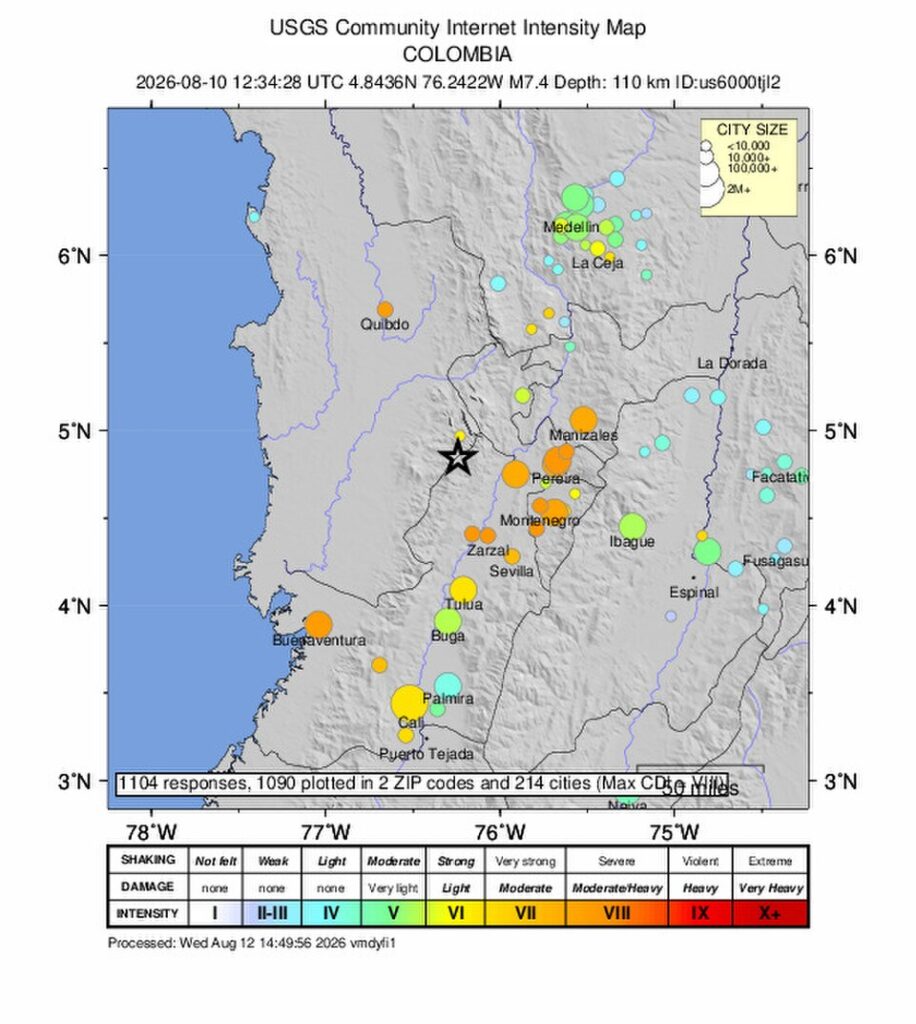
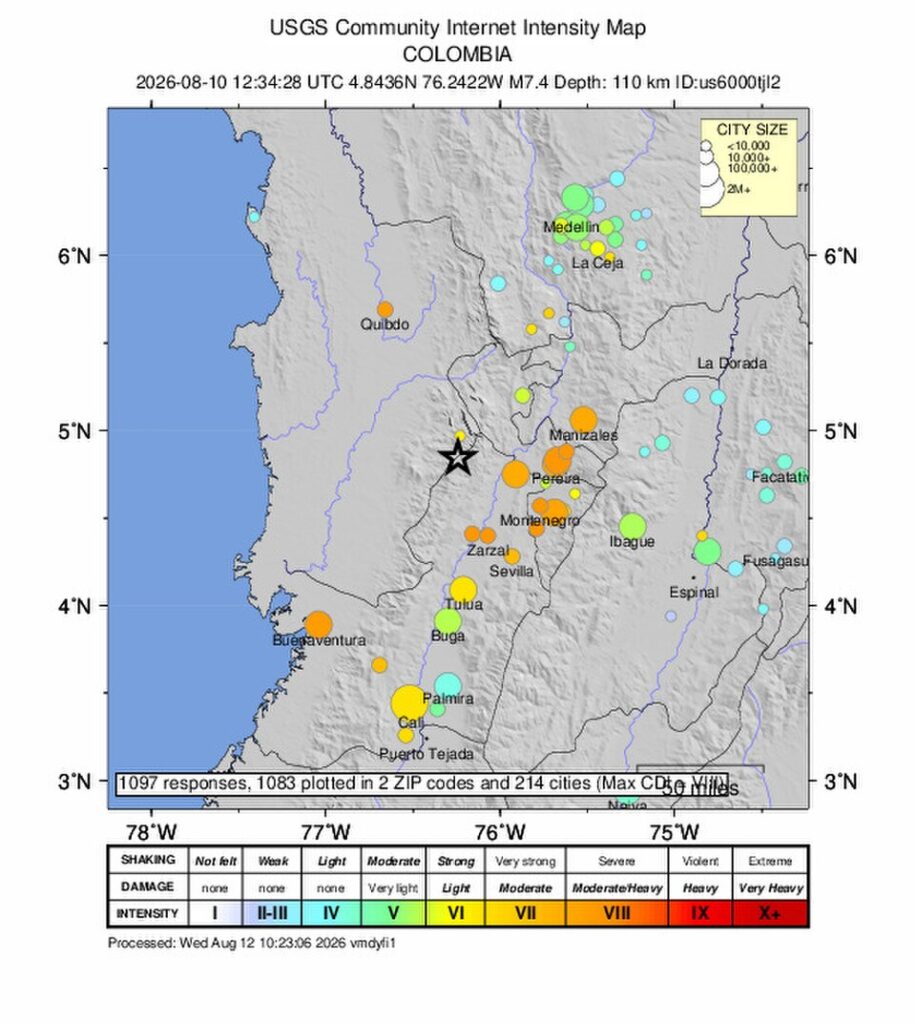
A magnitude 7.4 earthquake struck western Colombia’s Chocó department Monday — the country’s strongest recorded seismic event of the 21st century — with the confirmed death toll climbing from 111 to at least 224 within 24 hours, more than 1,200 people injured, and over 3,700 still reported missing. Colombian President Abelardo De La Espriella said as many as 5,000 homes were damaged or destroyed. Seven airports suspended operations. The cities of Pereira, Cali, Quibdó, Manizales, and Armenia remain under the nation’s highest-level red alert. Much of the hardest-hit Chocó region is accessible only by boat or plane, complicating rescue operations and threatening to leave the true toll significantly undercounted for days.
2-MINUTE CONTEXT — WHY CHOCÓ IS ESPECIALLY VULNERABLE
Chocó is one of the most biodiverse and simultaneously most underserved departments in Colombia. It sits on the Pacific coast, is majority Afro-Colombian and Indigenous in population, and has been characterized by chronic underdevelopment, limited infrastructure, and historical marginalization from national development investment. Roads are few; much of the region moves by river. The earthquake’s location in Chocó means the population most affected is also the least connected to emergency response infrastructure.
Colombia sits at the convergence of the Nazca, South American, and Caribbean tectonic plates — one of the world’s most seismically active convergence zones. The country has experienced multiple destructive earthquakes, including the 1999 Armenia earthquake (6.2 magnitude, over 1,000 dead) and the 1906 Ecuador-Colombia earthquake (estimated 8.8 magnitude, one of the largest ever recorded). The August 11 event is described as the strongest since records of this century began — a statement about documented instrumented records rather than geological history.
THE MISSING — WHY 3,700 IS THE MOST ALARMING NUMBER
The death toll (224) will continue rising, but the missing figure (3,700+) is the most alarming indicator. In the immediate aftermath of a major earthquake, the missing figure captures everyone whose whereabouts are unconfirmed by family or community members — some are unreachable due to communication outages, some are trapped, some are dead and not yet counted. In a region where access requires boats or planes, and where both infrastructure and communication are limited, the resolution of the missing figure — which individuals are safe, which are trapped, which are dead — will take significantly longer than in an urban area with roads and telecommunications.
The gap between 224 confirmed dead and 3,700+ missing suggests the confirmed figure is the lower bound of a much larger toll. Historically, earthquake disasters in remote and access-limited regions produce confirmed death tolls that grow for weeks as rescue operations reach isolated communities. The 3,700 missing is the number to watch.
THE PHYSICAL SCOPE
| Confirmed dead 224+ as of August 12; continuing to rise | Injured 1,200+ hospitals at capacity in multiple cities |
| Missing 3,700+ most alarming figure; access limits accounting | Homes damaged/destroyed 5,000 President De La Espriella estimate |
| Airports suspended 7 Pereira, Cali, Quibdó, Manizales, Armenia under red alert | Magnitude 7.4 Colombia’s strongest 21st-century recorded event |
THE ACCESS PROBLEM
Chocó’s geography is the disaster’s primary compounding factor. Rivers are the primary transportation arteries. Air access is limited to small aircraft and helicopter. The earthquake has damaged or disrupted both. Rescue teams, medical supplies, emergency food, and water treatment equipment must all move through a network of access routes that the earthquake itself may have disrupted. This is the specific reason the 3,700 missing figure will be slow to resolve: the people most likely to be missing are those in communities most difficult to reach.
The humanitarian response will require sustained aerial supply operations — similar in logistics, if not in scale, to the Haiti earthquake response in 2010. Colombia’s own civil defense and military have the closest access but limited capacity; international humanitarian organizations are mobilizing.
INTERNATIONAL RESPONSE
▸ Chilean President José Antonio Kast pledged assistance, noting Chile ‘knows the pain and the challenge left by earthquakes’
▸ Israeli foreign minister offered disaster assistance to Colombian counterpart (documented from prior reporting)
▸ US State Department issued condolences; USAID disaster response protocol initiated
▸ UN OCHA is coordinating international humanitarian response; satellite imagery analysis of affected area underway
▸ Regional neighbors (Ecuador, Panama, Venezuela) all within response range; diplomatic and logistical channels being activated
WHAT HAPPENS NEXT
▸ Death toll will continue rising for days as access improves and missing persons are accounted for
▸ The 3,700 missing figure will be the primary daily tracking indicator — how fast it resolves toward confirmed dead or confirmed safe is the earthquake’s true human accounting
▸ International humanitarian airlift operations will be the primary near-term response given road infrastructure damage
▸ Colombia’s national disaster declaration — which triggers specific federal resource allocation — is expected to be expanded beyond the current red alert designation
▸ Long-term reconstruction needs for Chocó will be in the billions; the department’s chronic underdevelopment means pre-earthquake baseline infrastructure was already inadequate
| CONFIDENCE: HIGH | Death toll (224+), injured (1,200+), missing (3,700+), homes (5,000), airports (7), cities under red alert are all from documented wire reporting and Colombian government statements. Chocó geography and access limitations are from established geographical record. Seismic context is from USGS and Colombian geological survey documentation. |
| ⚖️ BIAS CHECK — WHO IS SAYING WHAT | |
| Colombian Government | Managing emergency response and public communication; De La Espriella personally leading crisis messaging |
| International Relief Organizations | Mobilizing rapidly; Chocó’s access challenges are well-known; pre-positioning supplies for airlift |
| Chilean Government | Solidarity response grounded in Chile’s own seismic history; genuine regional peer response |
| Global Media | Covering the death toll trajectory; Chocó’s remoteness will challenge sustained coverage as access improves slowly |
| Colombian Civil Society | Chocó has long-documented claims of marginalization; advocates will connect the earthquake response to the pre-existing underdevelopment that made the impact worse |
SOURCES
▸ Colombian President De La Espriella — red alert, homes damaged, airports suspended
▸ Wire reporting — death toll 224+, missing 3,700+, injured 1,200+
▸ Chilean President Kast — assistance pledge, quoted statement
▸ Prior ONYX August 10 — initial earthquake report (7.4, Colombia, preliminary figures)
Q: Why is the missing count so much higher than the confirmed dead?
A: Confirmed dead requires physical identification and documentation. Missing means unaccounted for — family or community members cannot confirm the person’s safety. In a region accessible only by boat or plane, where communication infrastructure was damaged by the earthquake, many people are simply unreachable. Some will be confirmed safe as communications are restored; others will be found in collapsed structures as rescue teams arrive; others will not be found alive.
Q: What is the Colombian government’s capacity to respond?
A: Colombia has a professional civil defense and military with earthquake response capability, deployed in prior events. The specific challenge is Chocó’s geography and the seven airport suspensions, which limit the airlift capacity that is the primary access route. National capacity is being supplemented by international assistance.
Q: How does this compare to the 1999 Armenia, Colombia earthquake?
A: The 1999 earthquake (6.2 magnitude, Armenia city) killed over 1,000 people in a relatively accessible urban area. The current earthquake is larger (7.4) and in a more remote region. The comparative death toll will depend on how quickly rescue operations can reach isolated Chocó communities — the 3,700 missing figure suggests the final toll could be significantly higher than 1999.