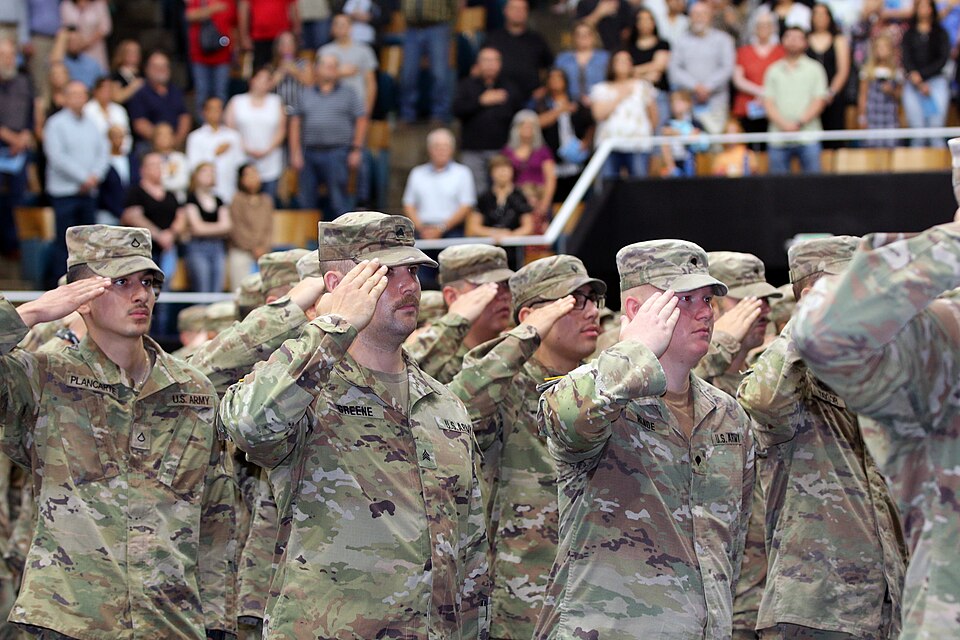
Tuesday marks exactly one year since President Trump deployed the National Guard to Washington, DC — initially described as a response to a temporary crime emergency. The deployment has since grown to more than 5,000 troops from over a dozen states and been extended through Inauguration Day 2029, making it a sustained, years-long military presence in the nation’s capital. Sen. Elizabeth Warren’s office obtained an estimate showing the deployment will cost an additional $1.4 billion between October 2026 and January 2029. Free DC organized 11 days of action honoring Julian Bailey and Nolberto Meza — two DC residents killed by federal agents during the deployment — culminating in an anniversary rally at Black Lives Matter Plaza. Retired Maj. Gen. Lepper warned the deployment sets a precedent that ‘makes it much easier for the government to attempt to deploy troops in other communities’ ahead of the midterm elections.
2-MINUTE CONTEXT — HOW A TEMPORARY DEPLOYMENT BECAME PERMANENT
Trump’s August 2025 National Guard deployment to Washington, DC was announced as a response to elevated crime conditions in the District. The original framing — ‘temporary crime emergency’ — established a specific expectation: a time-limited response to a measurable problem that would end when conditions improved. What happened instead is documented: the deployment expanded in scope, the troop count grew to 5,000+, the mission broadened beyond crime response, and the timeline was extended to January 2029.
The extension to January 2029 is specifically notable. That is the date of the next presidential inauguration. A deployment ‘extended through Inauguration Day 2029’ is not a crime-response deployment; it is a sustained military presence in the capital through the end of the current presidential term, potentially covering an election and its aftermath. That timeline is what Maj. Gen. Lepper is calling a ‘normalized, ongoing, years-long deployment’ — and what he argues creates precedent for similar deployments elsewhere.
JULIAN BAILEY AND NOLBERTO MEZA — THE HUMAN COST
Julian Bailey and Nolberto Meza are the two DC residents killed by federal agents during the National Guard deployment’s first year. Their deaths — and the organizing by Free DC to memorialize them at the anniversary — represent the direct human cost that aggregate deployment statistics do not capture. Two people are dead. Federal agents killed them during a military deployment to their city. Their families and communities are organizing around that fact.
ONYX does not have full details on the specific circumstances of each death from available reporting. What is documented: they occurred during the deployment, federal agents were responsible, and their names are being specifically honored at the anniversary action. The circumstances deserve investigation and disclosure that appears not yet to have fully occurred.
The deployment was described as temporary. It is now two years and growing. Two people are dead. The cost for the remaining three years is $1.4 billion. At what point does a temporary crime emergency become a permanent military occupation of the nation’s capital?
THE $1.4 BILLION FIGURE — WHAT IT COVERS
Senator Warren’s office obtained the $1.4 billion estimate specifically for the October 2026 through January 2029 period — the remaining deployment period. This is the forward cost, not the total cost including what has already been spent. The total cost of the deployment from August 2025 through January 2029 will be significantly higher than $1.4 billion. The per-day cost of maintaining 5,000+ National Guard troops from multiple states in Washington, DC — with housing, equipment, pay, logistics, and inter-state deployment costs — is the accounting basis for the estimate.
The $1.4 billion figure is significant for two reasons. First: it is money committed to a military deployment in the nation’s capital through 2029 — a policy choice with an enormous opportunity cost. Second: it came from Senator Warren’s office obtaining the estimate, which means the administration is not publishing this figure proactively. Congressional oversight of the deployment’s cost appears to be operating through information requests rather than administrative transparency.
THE LEPPER WARNING — THE PRECEDENT ARGUMENT
Retired Maj. Gen. Lepper’s warning is the most institutionally significant element of the anniversary story. A retired general officer warning that a National Guard deployment normalizes ‘the government’s attempt to deploy troops in other communities’ is not a protest statement — it is a professional military judgment about how precedent works in civil-military relations.
The specific concern: once it is established that a president can deploy National Guard forces to a major American city for an extended period — years, not days — framed as a response to domestic conditions, the legal and political barrier to doing so in other cities is lower. Chicago, Los Angeles, New York, Houston — any city with elevated crime statistics that a future or current administration characterizes as an emergency could be subject to similar deployment. That is the precedent Lepper is warning about.
POLITICAL IMPACT
▸ DC residents — DC is not a state and its residents have no voting representation in Congress; the deployment is being managed without the consent of elected representation that residents of states would have
▸ Midterm election implications — Lepper explicitly connects the deployment precedent to the midterm elections; sustained military presence in a city through an election cycle raises specific civil-military questions
▸ Sen. Warren’s oversight role — obtaining cost estimates that the administration does not publish is a specific accountability function
▸ Free DC and civil rights organizations — the anniversary organizing represents sustained community accountability pressure over two deaths that have not produced public accountability
WHAT HAPPENS NEXT
▸ The anniversary action at Black Lives Matter Plaza and the 11 days of organizing by Free DC will generate political attention to the deployment’s human cost
▸ Senator Warren’s $1.4 billion cost figure will be used in appropriations debates — Democrats will cite it in arguments about military spending priorities
▸ Full accounting of the deployment’s cost from August 2025 through the October 2026 reporting period is expected to be requested in appropriations hearings
▸ The Bailey and Meza deaths deserve and may receive further investigative journalism attention given the anniversary
| CONFIDENCE: HIGH | One-year anniversary date, 5,000+ troops, dozen-plus states, extension through January 2029 are all documented. Warren $1.4 billion estimate is from her office’s documented acquisition. Julian Bailey and Nolberto Meza deaths are documented by Free DC organizing. Lepper quote on precedent is on record. ‘Temporary crime emergency’ original framing is from documented August 2025 deployment announcement. |
| ⚖️ BIAS CHECK — WHO IS SAYING WHAT | |
| Trump Administration | Will not characterize it as permanent; maintaining the mission-essential framing; not proactively publishing costs |
| Sen. Warren / Democrats | Using the cost figure as an oversight and appropriations argument; connecting the deployment to the 2026 midterm environment |
| Free DC / Civil Rights Organizations | Centering the human cost — Bailey and Meza — that institutional accountability processes have not addressed |
| Maj. Gen. Lepper | Professional military judgment about civil-military precedent; not a partisan statement — a structural warning from institutional expertise |
| DC Residents | Subject to a military deployment for which they have no congressional representation; the democratic legitimacy question is specific to DC’s non-state status |
| Republican Congress | Largely quiet; some members express support for the deployment on crime-reduction grounds; few have engaged the cost or precedent dimensions |
SOURCES
▸ Sen. Elizabeth Warren’s office — $1.4 billion cost estimate, October 2026–January 2029
▸ Free DC — 11 days of action, anniversary organizing documentation
▸ Retired Maj. Gen. Lepper — precedent warning, quoted statement
▸ Trump deployment announcement — August 2025, temporary crime emergency framing (documented)
Q: Why does DC have no congressional representation?
A: The District of Columbia is not a state. Its residents do not have voting representation in the Senate (they have a non-voting delegate in the House). This means the National Guard deployment in DC is governed by federal authority without the consent mechanism that would apply if the same deployment occurred in a state, where the governor would have a role in National Guard deployment decisions.
Q: What is the legal authority for a multi-year National Guard deployment to DC?
A: The District of Columbia is federally administered, and the president has direct authority over DC National Guard deployment that does not exist for state National Guard deployments. This is the specific legal structure that makes the DC deployment possible without gubernatorial involvement.
Q: What were the circumstances of the Bailey and Meza deaths?
A: The specific circumstances are not fully detailed in available reporting for this article. ONYX notes their deaths as documented by Free DC organizing and explicitly flags that full public accounting has not yet occurred.