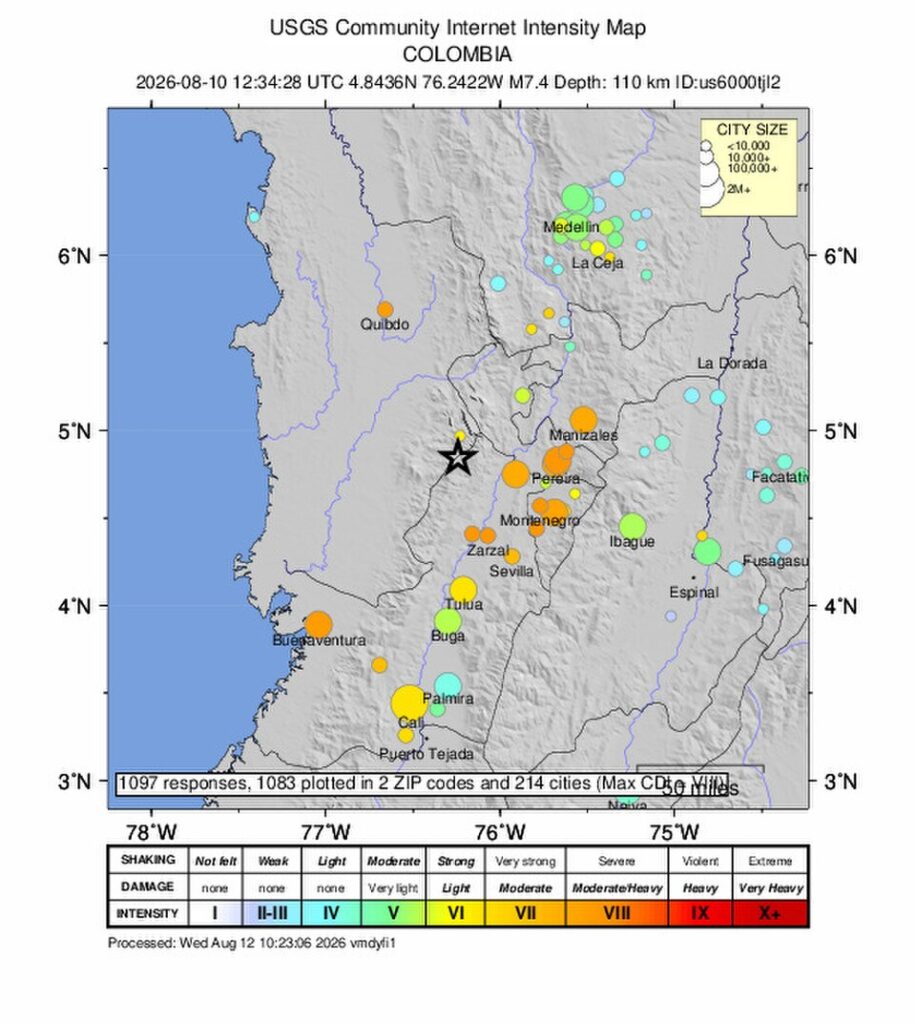
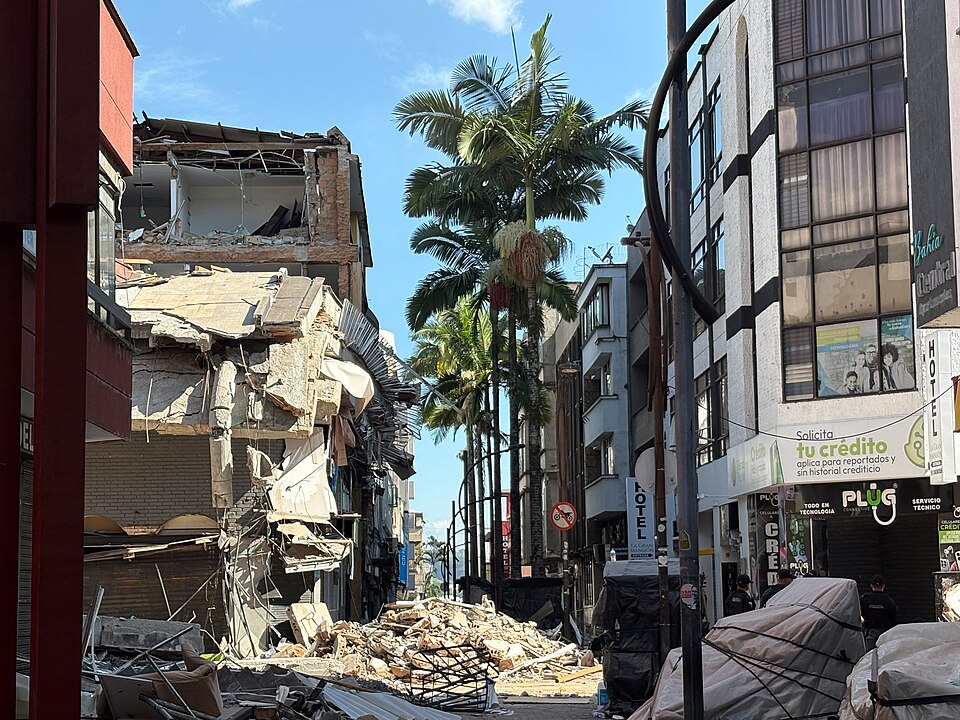
Four days after the 7.4-magnitude earthquake struck western Colombia’s Chocó department, the official confirmed death toll has risen to 231 — a figure that continues to be reconciled against the civilian-database missing count that ONYX has tracked since August 12. Rescue teams are at or past the 72-to-96-hour survival window, which means the operational character of the response is beginning to shift from rescue (finding survivors) to recovery (accounting for the missing). President de la Espriella is managing the immediate humanitarian response, the longer-term reconstruction commitment, and the growing scrutiny of the discrepancy between official and civilian missing counts.
THE TOLLS — AND WHAT THEY REVEAL
| Official confirmed dead 231 Day 4 — up from 224+ (Day 1), reconciling upward as expected | Official missing 195 Government formal count — still significantly below civilian databases |
| Civilian database missing ~3,800+ continuing to be reconciled; communications slowly restoring | Injured 1,200+ hospitals in Pereira, Cali, Manizales at or near capacity |
| Homes damaged/destroyed 5,000+ de la Espriella estimate; formal assessment ongoing | Manizales damage assessment queue Thousands Mayor Rojas confirms one-month timeline to work through |
THE TRANSITION FROM RESCUE TO RECOVERY
The 72-to-96-hour survival window that ONYX identified on August 13 as the critical rescue timeline has elapsed. This does not mean search operations have ended — they continue — but the probability of finding living survivors in collapsed structures drops sharply after this window. The operational character shifts: resources that were oriented toward live extractions begin to shift toward accounting for the missing and toward debris removal to assess what is beneath.
This is one of the hardest transitions in disaster response: for families waiting for news of missing relatives, the transition from rescue to recovery is the moment hope becomes formally constrained. Communities that have been waiting for a survivor to emerge have to begin processing the possibility that what emerges will be different. This transition is occurring now in Chocó and across the affected municipalities.
Rescue ends. Recovery begins. The number that tells that story is not the death toll — it is how many of the 3,800 missing are accounted for as the days pass.
THE MISSING COUNT RECONCILIATION — DAY 4 STATUS
ONYX has tracked the 195-official vs. ~3,800-civilian gap since August 13. Four days in, the reconciliation process is underway but incomplete. Communications are slowly restoring in remote Chocó communities; as they do, some of the civilian database entries are resolving to ‘safe but unreachable’ — people who were alive but could not be contacted. Others are resolving to confirmed deaths, which pushes the official toll upward. The gap will narrow over days to weeks; the final reconciled figure will be the earthquake’s true human toll.
The Puerto Rico Hurricane Maria parallel (official initial count: 64; independent study: 2,975) that ONYX cited on August 13 is the appropriate scale reference for what reconciliation can reveal. ONYX is not projecting that Colombia’s final toll will approach 2,975; it is noting that official initial counts are regularly significant undercounts in access-limited disasters, and Colombia should be understood on those terms.
DE LA ESPRIELLA’S GOVERNANCE CHALLENGE
President Abelardo de la Espriella is managing his first major national disaster with simultaneous challenges: the immediate emergency (rescue/recovery operations, humanitarian supply, infrastructure assessment); the medium-term commitment (reconstruction funding, housing for displaced families, agricultural support for the coffee region); and the accountability dimension (the missing count discrepancy, the adequacy of pre-disaster preparedness in Chocó, the transparency of official communications).
His coffee region tour and relief package announcement (ONYX August 13 coverage) represented the medium-term commitment dimension. Whether his government’s transparency on the missing count discrepancy satisfies the accountability dimension will be assessed in the weeks ahead as the reconciliation produces a truer toll figure.
THE INTERNATIONAL RESPONSE — WHAT’S ARRIVED AND WHAT’S NEEDED
▸ Search and rescue teams: multiple international teams have been deployed; as the window closes, some teams are transitioning to technical recovery support
▸ Medical supplies: airlifted to remote Chocó communities by military helicopter; the seven-airport suspension has constrained logistics
▸ Water delivery: bottled water and portable purification units delivered to communities with no water infrastructure; La Italia and similar epicenter communities are receiving priority
▸ Shelter: emergency tents and materials deployed; the 5,000+ damaged/destroyed homes represent a shelter gap that will take months to address
▸ International funding gap: WFP and OCHA funding appeals have produced partial responses; full humanitarian need coverage requires sustained donor commitment beyond the immediate response
| CONFIDENCE: HIGH | Day 4 death toll (231) is from confirmed government reporting. Missing counts (195 official, ~3,800 civilian database) are from prior ONYX tracking with Day 4 update. 72-96 hour window transition is from established search-and-rescue protocols. De la Espriella governance analysis is ONYX editorial based on documented actions. |
| ⚖️ BIAS CHECK — WHO IS SAYING WHAT | |
| Colombian Government | Managing official communications carefully; the missing count gap is politically sensitive |
| International Rescue Teams | Transitioning from rescue to recovery orientation; this is standard protocol, not failure |
| Chocó Communities | Most directly affected; the survival window has passed for those still unaccounted for |
| International Media | Coverage declining as the emergency acute phase ends; this is when sustained reporting matters most |
| ONYX | Committed to continuing Colombia coverage through the accountability dimension, not only the acute response |
SOURCES
▸ Colombian government — Day 4 official death toll (231) and injured (1,200+)
▸ ONYX August 12-14 coverage — missing count discrepancy and civilian database tracking
Q: Are rescuers still finding survivors?
A: It is extremely rare but not impossible to find survivors after 96 hours. The probability drops sharply. Operations continue because even low-probability events matter when human lives are at stake, and because clearing debris is necessary for the recovery accounting regardless.
Q: When will the final death toll be known?
A: It typically takes weeks to months for a final toll to be established in a disaster of this geographic complexity. Colombia’s 1999 Armenia earthquake final toll took several weeks to fully document. The Chocó access challenges suggest a longer timeline for complete accounting.