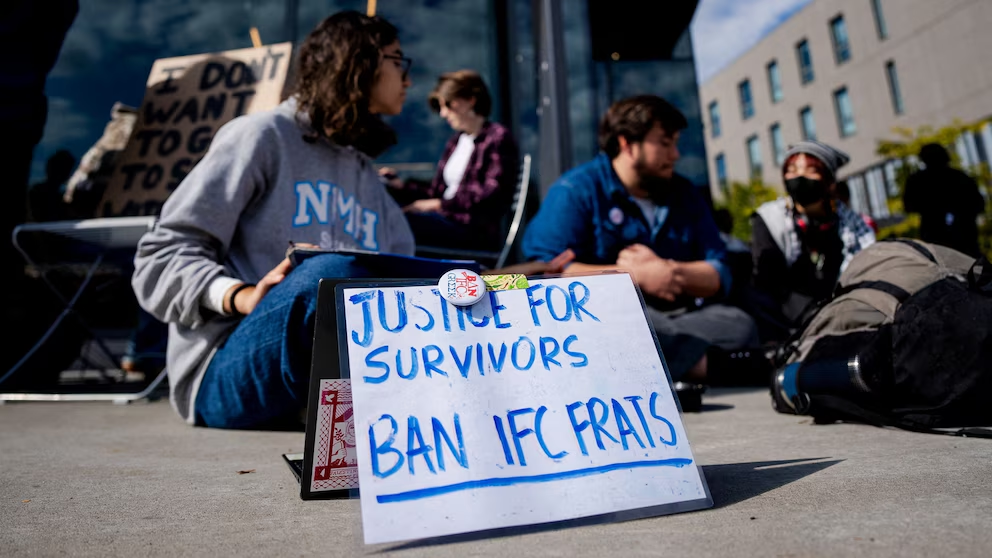
Cornell University imposed a ban on fraternity parties following national attention to sexual assault allegations at a Cornell fraternity. The faculty is now debating whether to hold a no-confidence vote in the university administration over its handling of the allegations and the broader culture they reflect. The NYT confirmed both the ban and the no-confidence discussions. The incident has moved from a disciplinary matter to an institutional crisis.
🎓 ITHACA, NEW YORK · OCTOBER 15, 2026 · CORNELL FRATERNITY BAN
Cornell University imposed a ban on fraternity parties following the national spread of sexual assault allegations at a Cornell fraternity that generated significant media coverage and campus organizing. The NYT confirmed both the fraternity party ban and the ongoing faculty debate about whether to hold a no-confidence vote in the university administration. What began as a specific allegation — or set of allegations — against a specific fraternity chapter has expanded into a broader institutional reckoning about how Cornell handles sexual misconduct, what the university knew or should have known about the fraternity environment, and whether the administration response is adequate.
No-confidence votes in university administrations are unusual. They are statements by the faculty — the body whose academic expertise and institutional standing give them a particular kind of authority — that the leadership of the institution has failed in a significant enough way to warrant formal public censure. They are rarely binding; most university governance structures give the board of trustees rather than the faculty final authority over presidential and administrative appointment and removal. But a no-confidence vote changes the politics of an administration significantly: it makes continuing in office a public fight, it emboldens critics, and it tends to produce either meaningful policy change or eventual departure.
THE ALLEGATIONS AND THE RESPONSE
The specific allegations against the fraternity have not been fully adjudicated as of available reporting. Sexual assault allegations in a university context are addressed through Title IX processes, which run parallel to any criminal investigation and have their own evidentiary and procedural standards. The university response to the allegations — and the timeline of that response — is what the faculty is evaluating in its no-confidence discussion. The question is not whether the allegations are true; it is whether the administration took the allegations seriously enough, moved quickly enough, and created the conditions in which this kind of harm was predictable and preventable.
The party ban is an administrative response that is simultaneously a concrete action and an acknowledgment of institutional failure. If parties needed to be banned now, the implicit question is: why were conditions permitted to exist that make the ban necessary? A university that discovers, following serious allegations, that its fraternity party environment is dangerous enough to warrant a comprehensive ban has also discovered that it failed to prevent a dangerous environment from developing. The no-confidence debate is about who is accountable for that failure.
THE LARGER PATTERN
Cornell is not the first elite university to face this combination of sexual assault allegations, fraternity culture controversy, and faculty-administration conflict. Yale, Harvard, Duke, and dozens of other institutions have navigated similar cycles. The pattern — allegation, public attention, administrative response, faculty pressure, policy change — is sufficiently established that universities now have crisis communication playbooks. Whether following the playbook produces genuine institutional change or manages the crisis back to a prior equilibrium without addressing root causes is the question that students, alumni, and faculty at every institution in this situation eventually ask.
“Cornell banned fraternity parties after sexual assault allegations went national. Now the faculty is debating whether to tell the administration they have no confidence in it. The ban is the response. The no-confidence discussion is the verdict on the response.”
WHAT HAPPENS NEXT
► No-confidence vote — whether the faculty formally calls and holds the vote
► Title IX proceedings — outcome of formal sexual misconduct processes for the specific allegations
► Criminal investigation — whether law enforcement pursues criminal charges in connection with the allegations
► Administration response — how Cornell leadership responds to the faculty pressure
► Greek life policy — whether the party ban leads to broader review of fraternity system at Cornell
| CONFIDENCE: HIGH | NYT confirmed Cornell University fraternity party ban following sexual assault allegations and ongoing faculty debate about no-confidence vote in administration. |
| BIAS CHECK | ASSESSMENT |
| Source weight | NYT — authoritative for higher education and campus policy reporting |
| Allegations framing | Sexual assault allegations characterized as described in reporting; adjudication status noted as pending |
| No-confidence framing | No-confidence vote characterized from governance context; binding or non-binding distinction noted |
| University framing | Administration response characterized analytically; not editorialized as adequate or inadequate |
SOURCES
► NYT — Cornell University bans fraternity parties, faculty no-confidence debate, sexual assault allegations, October 15, 2026