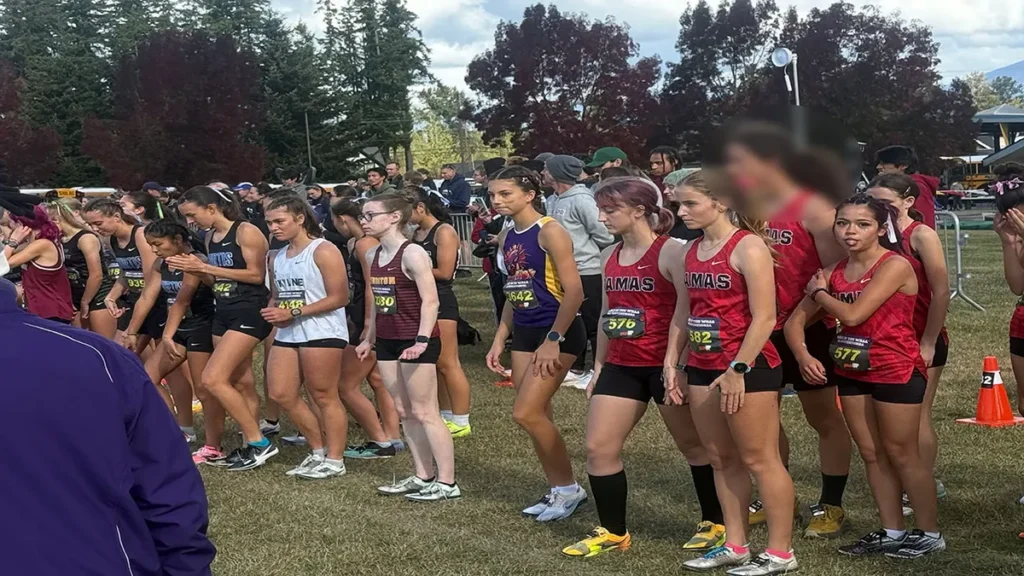
Female high-school cross-country runners in Washington State refused to compete in a race that included a transgender female athlete — one who was born male — walking off the course rather than running alongside her. WORLD Radio confirmed the incident. The event is local, but it has become a national story because it is a concrete illustration of a policy debate that has been conducted almost entirely in the abstract: what happens when girls who object decide to act, rather than litigate.
🏃 WASHINGTON STATE · OCTOBER 15, 2026 · CROSS-COUNTRY WALKOUT
Female high-school cross-country runners in Washington State walked off their starting line rather than compete in a race that included a transgender female athlete. WORLD Radio confirmed the incident. The girls declined to run; their decision is a concrete act of protest in a policy debate that has generated enormous political and legal activity but relatively few examples of individual athletes making public decisions to withdraw rather than compete. The walkout puts faces and a specific place on a controversy that the Supreme Court, Congress, and state legislatures have been addressing through policy frameworks that abstract the question away from the individuals involved.
Washington State has been a focal point of transgender athlete policy debates at the high-school level. The state athletic association policies have generally followed inclusion guidelines, permitting transgender athletes to compete in the gender category consistent with their identity, subject to various procedural requirements. Opponents of those policies argue that transgender female athletes who went through male puberty retain physiological advantages in sports that require speed, strength, and endurance that compromise fair competition for female athletes. Supporters of inclusion argue that social exclusion causes serious harm to transgender youth and that policy should be guided by the well-being of all students.
WHAT THE WALKOUT DOES
A walkout is legally and procedurally different from a formal challenge to the policy. The girls did not sue; they did not file a formal objection through the athletic association process; they walked off the course. That is a direct action that produces a story, a photograph, and a data point — athletes choosing forfeiture over competition — that the policy debate has not previously had in this form. Whether their walkout will influence the policy process, produce legal consequences for the athletes or their school, or simply become a news cycle story that passes without institutional effect depends on the response from the Washington State athletic association, the school district, and the political figures who have been looking for exactly this kind of concrete example.
The story is being covered primarily by conservative-aligned outlets including WORLD Radio, which reflects the political valence of the issue in current American media. That does not change what happened — the walkout is a documented event. It does mean that the framing of what the walkout represents, what it demands in response, and what it says about policy will be contested along the same lines as the underlying policy debate. Both the girls who walked off and the transgender athlete who competed are real individuals whose experiences matter; the policy question of what is fair to each group of people is genuine and remains unresolved.
THE NATIONAL POLICY CONTEXT
The Trump administration has taken executive action on transgender athlete policy in federal contexts, and Congress has been debating various versions of legislation that would restrict transgender participation in female sports categories. The Supreme Court has addressed related questions about gender identity and school policy. The Washington State walkout is a local school event that lands in that highly charged national context. It will be cited by those who want to restrict transgender athlete participation as evidence that the current policy causes real harm to real female athletes. It will be characterized by those who support inclusion as an act of discrimination against a vulnerable young person.
“Girls in Washington walked off rather than race alongside a transgender athlete. That is not a Supreme Court case or a legislative debate. It is a high-school meet and a starting line nobody ran from. Now everybody is talking about it.”
WHAT HAPPENS NEXT
► School district response — whether the district disciplines the athletes who walked off
► Athletic association response — whether Washington State reconsiders its transgender participation policy
► Legal action — whether any party files a formal legal challenge arising from the incident
► National legislation — whether Congress cites the incident in ongoing federal sports policy debate
► Athlete wellbeing — support available for both the transgender athlete and the girls who walked off
| CONFIDENCE: HIGH | WORLD Radio confirmed high-school girls in Washington State walked off cross-country race rather than compete alongside a transgender female athlete. |
| BIAS CHECK | ASSESSMENT |
| Source weight | WORLD Radio — conservative-aligned outlet; incident confirmed as documented; framing noted |
| Both sides framing | Both the walkout athletes and the transgender athlete characterized as real individuals; policy debate characterized as genuinely contested |
| Policy framing | State and federal policy positions described from documented record; editorial conclusion on correct policy withheld |
| Legal framing | Legal implications characterized as possibilities; no legal outcome predicted |
SOURCES
► WORLD Radio summaries — Girls walk off Washington State cross-country race, transgender athlete, October 15, 2026