Addis Ababa reported repelling an Eritrean incursion into Tigray with drone strikes. If accurate, it marks a dangerous new chapter in a conflict the world has largely stopped watching.
🌍 HORN OF AFRICA · OCTOBER 9, 2026 · ETHIOPIA-ERITREA
The Tigray War officially ended with the Pretoria Agreement in November 2022. The agreement was real in the sense that the large-scale fighting stopped and that its provisions have been partially implemented. It was not real in the sense that the underlying tensions it was supposed to resolve — the position of Eritrean forces in Tigray, the disarmament of the Tigray People’s Liberation Front, the return of occupied territories — were mostly deferred rather than resolved. On Thursday, some of what was deferred arrived.
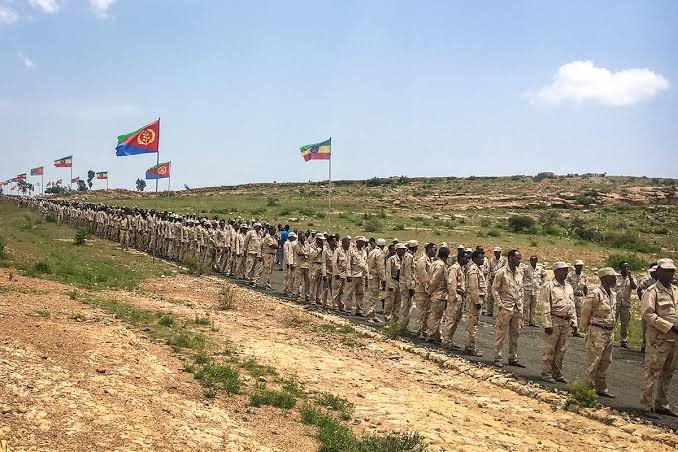
Ethiopia’s government reported that Eritrean forces had crossed into the Tigray region and that Ethiopian military assets, including drones, had struck those forces in response. If the Ethiopian account is accurate, it represents the most serious cross-border military incident in the Horn of Africa since the Pretoria Agreement, and one that the international community — which devoted enormous diplomatic energy to ending the Tigray War and then largely turned its attention elsewhere — was not positioned to prevent.
WHAT ETHIOPIA IS CLAIMING
Addis Ababa characterized the Eritrean movement as an incursion — a deliberate border crossing by Eritrean military forces into Ethiopian sovereign territory. The use of drones to strike the crossing forces indicates that Ethiopia responded with significant military assets rather than ground forces alone. The choice of drone strikes over ground engagement suggests a preference for precision and escalation control, though in a region with the history of Tigray, the line between control and escalation is rarely stable.
Reuters and The Guardian reported the incident from Ethiopian government and regional sources. Eritrean official response was not immediately available — Asmara has historically been among the least communicative governments in the world when it comes to military activity, and its media environment offers essentially no independent verification of anything that crosses its border.
WHY THIS MOMENT
The Pretoria Agreement left Eritrean forces in positions inside Tigray that the agreement’s framework required them to vacate. Those forces never fully left. The TPLF was required to disarm; that process has been incomplete. Ethiopian federal authority over Tigray has been reasserted in some areas and contested in others. All of this has simmered for two years while international attention moved to Ukraine, Gaza, Sudan, and the Iran situation.
When the world stops watching a conflict, the parties to that conflict are still there. They are still making calculations. They are still testing what they can get away with while attention is elsewhere. Thursday’s reported incursion is either a test or an error — and in the Horn of Africa, the difference between those two things has historically been determined by what happens in the days that follow.
“The Pretoria Agreement ended the war. It did not end the conditions that produced the war. Those conditions are still present in Tigray, on the Eritrean border, in every unresolved clause of an agreement that the world celebrated and then moved past.”
WHAT HAPPENS NEXT
► Eritrean response — official Asmara statement, which may not come quickly or at all
► African Union monitoring — whether AU peace monitors report on the incident
► TPLF position — how Tigrayan leadership characterizes the incursion and Ethiopian response
► International attention — whether the incident draws diplomatic engagement or remains a regional story
| CONFIDENCE: MODERATE | Reuters and The Guardian reported the Ethiopian government account of the Eritrean incursion and drone response. MODERATE: Eritrean account unavailable; single-side sourcing on military claims. |
| BIAS CHECK | ASSESSMENT |
| Source weight | Reuters, Guardian — both Ethiopia-government-sourced; Eritrea side absent |
| Single-source risk | Military claims from one party only; characterized as Ethiopian account throughout |
| Conflict history | Pretoria Agreement context accurate and documented |
SOURCES
► Reuters — Ethiopia Eritrea incursion Tigray, October 9, 2026
► The Guardian — Horn of Africa conflict reporting, October 9, 2026