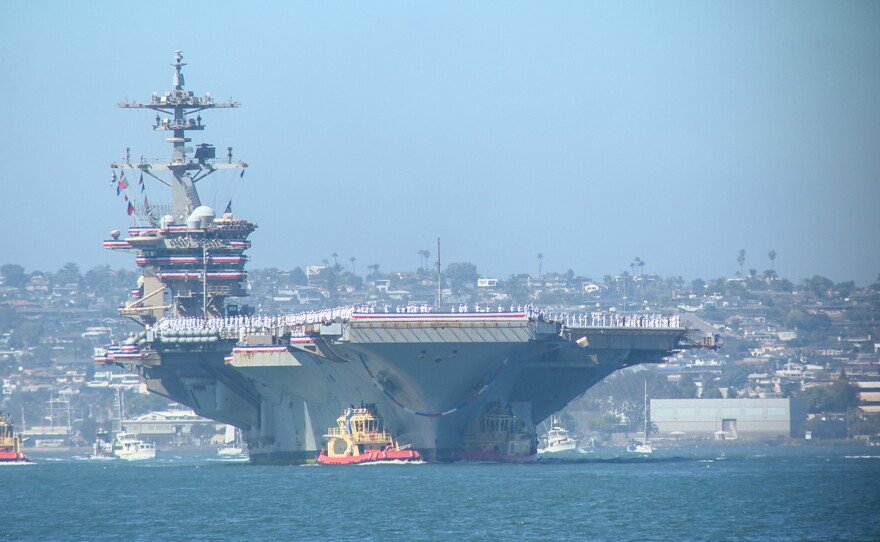
The Lincoln returned to San Diego, nearly setting a post-Vietnam deployment record. The Navy calls it a mission complete. The crew calls it something longer.
⚓ US NAVY · OCTOBER 9, 2026 · IRAN ARC
Aircraft carriers are the most visible symbol of American military power, and they are also, when you look at them long enough, a measure of strain. A carrier deployed too long is not a sign of strength. It is a sign that the Navy has run out of options for rotating it home. The USS Abraham Lincoln — CVN-72, homeport San Diego — returned from a deployment of extraordinary length this week, one that nearly set a post-Vietnam duration record and that was directly linked to the Iran-related operations that have reshaped US naval posture in the region since the ceasefire expired.
The Lincoln had been forward deployed in the waters around the Arabian Peninsula and the Red Sea corridor, operating as a deterrent platform and, when necessary, a strike asset. That mission did not end cleanly. The ceasefire expiration, the Houthi escalation, and the Iranian naval blockade all conspired to keep the ship on station past every projected return date. When it finally sailed through the Golden Gate approach and into San Diego Bay, the crew had been at sea for a period that most of them will spend years processing.
THE NUMBERS BEHIND THE DEPLOYMENT
Post-Vietnam US Navy carrier deployments have generally been kept to seven to nine months, a constraint driven partly by personnel welfare, partly by maintenance requirements, and partly by the institutional lesson that equipment and people degrade in predictable ways when either is pushed past design parameters. The Lincoln’s deployment exceeded that envelope significantly.
The logistical strain was not merely anecdotal. NPR and Just Security reporting noted that the deployment length reflected not a deliberate strategic choice to extend but a capacity problem: the Navy did not have a replacement carrier ready to take the Lincoln’s station. That gap — between the operational requirement the Iran-related crisis created and the force structure available to meet it — is the story underneath the homecoming.
WHAT THIS SAYS ABOUT US NAVAL CAPACITY
The United States Navy operates eleven nuclear-powered aircraft carriers, a number that sounds like a lot until you account for the fact that at any given moment, roughly a third are in extended maintenance cycles, a third are working up toward deployment, and a third are actually deployable. The actual number of carriers available for immediate tasking at any given crisis is smaller than the eleven-carrier fleet implies.
The Iran ceasefire expiration and the subsequent operational requirements tested that math in real time. The Lincoln stayed because there was nothing to replace it with, not because the Navy judged an extended deployment to be optimal. The difference between those two explanations is significant: one describes strategic depth, the other describes a gap.
FOR THE CREW
What gets lost in force-structure analysis is that the Lincoln is a ship with roughly five thousand people on it. Those people have families. They have children who grew several inches while their parent was at sea. They have relationships that went through a deployment twice as long as anyone planned for. The homecoming footage — sailors running down gangplanks, children hoisted into arms on pier — is real and earned and should not be instrumentalized into a policy argument. It should simply be noted: these people were asked to give an extraordinary amount, and they did.
“The carrier didn’t set a record because the mission demanded it. It set a record because there was nothing to replace it with. That distinction is the one the Navy needs to explain.”
WHAT HAPPENS NEXT
► Maintenance cycle — Lincoln begins an extended maintenance period; next deployment timeline unclear
► Force-structure review — whether the deployment exposes a formal gap in carrier availability that drives budget or construction decisions
► Congressional oversight — whether the Senate Armed Services Committee calls a hearing on deployment length and crew welfare
| CONFIDENCE: HIGH | NPR, Just Security confirmed Lincoln return and near-record deployment duration. Force structure analysis reflects documented Navy capacity reporting. |
| BIAS CHECK | ASSESSMENT |
| Source weight | NPR, Just Security — verified reporting on deployment duration and Iran context |
| Military framing | Capacity gap described analytically; no anti-military editorial slant |
| Crew framing | Human element included; not sentimentalized or weaponized for policy argument |
SOURCES
► NPR — USS Abraham Lincoln return, deployment duration, October 9, 2026
► Just Security — Iran operations and carrier deployment context, October 9, 2026