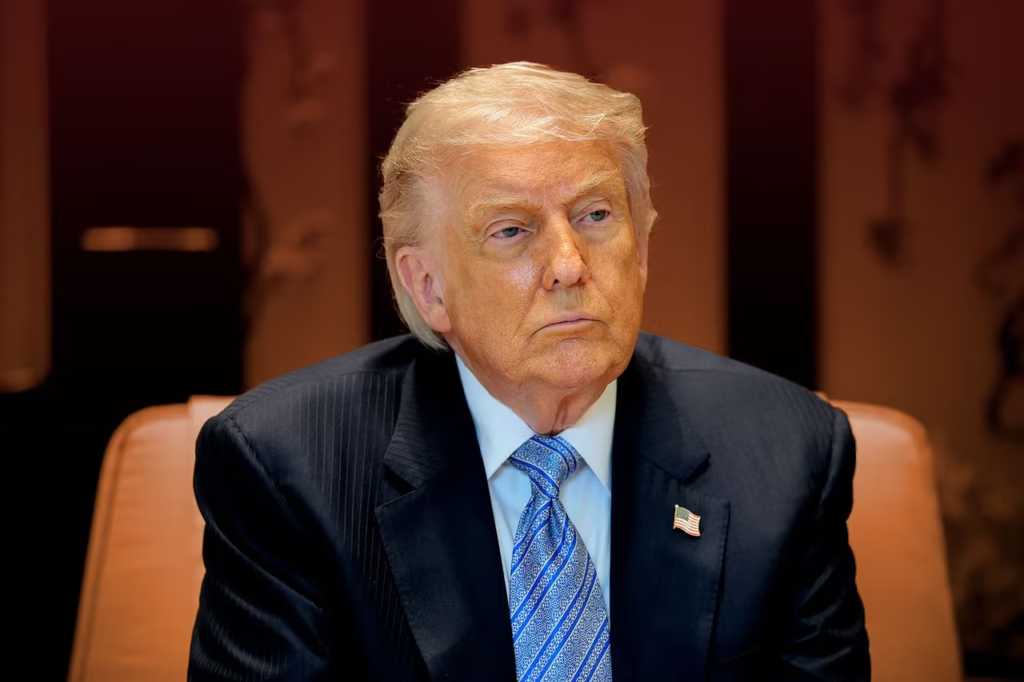
David Richardson led FEMA for six months in 2025 with what he describes as an explicit mandate to dramatically reduce or eliminate the agency. He has now written a book in which he states the Trump administration has abandoned that goal. His specific account: ‘I quickly realized that I would not be the one to transform FEMA or shut it down.’

WHY THE ADMINISTRATION GAVE UP
Richardson’s account, as summarized by NPR, identifies several factors that made the FEMA elimination goal politically and operationally untenable:
▸ The Texas floods: major flooding disasters during Richardson’s tenure demonstrated the operational necessity of federal emergency coordination; the political cost of being seen as dismantling disaster response capacity during active disasters was prohibitive
▸ Congressional resistance: FEMA’s statutory authority requires Congressional action to eliminate; the legislative pathway for elimination is complex and politically toxic
▸ Operational complexity: the specific federal functions FEMA performs — disaster declarations, federal assistance coordination, hazard mitigation — cannot be simply devolved to states without creating specific operational gaps
▸ Public opinion: disaster response is among the federal government’s most visible and valued functions; the political cost of FEMA elimination was higher than anticipated
THE ACCOUNTABILITY DIMENSION
Richardson’s account reveals a specific governance pattern: the administration announced an intention to eliminate a federal agency, appointed someone to execute that intention, found the intention politically and operationally impossible to execute, quietly abandoned it, and has not publicly acknowledged the abandonment. The public has received no formal notification that the FEMA elimination mandate has been dropped.
The man sent to shut down FEMA says he realized he could not. He resigned. He wrote a book about it. FEMA still exists. The administration has not publicly said it changed course. The agency it was going to eliminate is the one managing the disaster response this year.
THE DISASTER SEASON CONTEXT
The FEMA Richardson attempted to eliminate has been managing: Indiana flooding (Day 30+); Hawk Fire (Reno, Nevada); Hawaii compound storms (Lala and Moke); Grand Canyon flash floods; and coordination support for the Nepal disaster and Americans abroad. The Disaster Relief Fund’s adequacy — documented as depleted throughout the arc — would be even more acute if FEMA had been eliminated or substantially reduced during this disaster season.
WHAT HAPPENS NEXT
▸ Congressional inquiry — whether Richardson’s book produces questions about what the FEMA elimination mandate actually entailed
▸ FEMA leadership — who leads FEMA now and what their mandate is
▸ DRF adequacy — whether Congress acts on supplemental FEMA funding before December 11
| CONFIDENCE: HIGH | David Richardson FEMA six months 2025, explicit mandate to reduce or eliminate, administration abandoned goal, ‘quickly realized I would not be the one,’ resignation, new book are from NPR confirmed reporting. |
| ⚖️ BIAS CHECK — WHO IS SAYING WHAT | |
| Richardson | Has every incentive to characterize his tenure sympathetically; a book is a self-interested account; the specific policy claim (administration gave up on FEMA elimination) is the factual accountability basis |
| Trump Administration | Has not publicly acknowledged abandoning the FEMA elimination mandate; the gap between announced intention and actual policy is the accountability question |
| FEMA employees | The people who work at an agency they were told was being eliminated but then was not; their institutional experience during this period is its own accountability dimension |
SOURCES
▸ NPR — David Richardson FEMA shutdown book administration gave up, September 4, 2026