
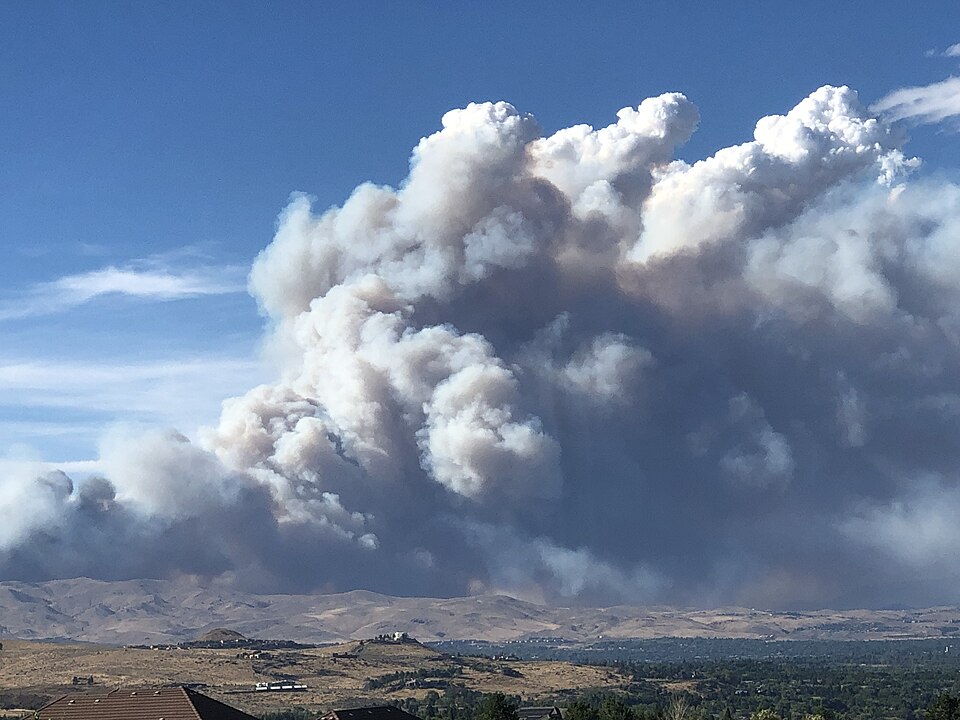
The Hawk Fire has burned more than 15,000 acres and remained at zero percent containment as of Sunday evening, forcing approximately 42,000 Reno-area residents to evacuate and warning another 45,000 to prepare, according to NPR. Nevada Governor Joe Lombardo declared a state of emergency for Washoe County. Flames advanced toward the University of Nevada, Reno campus; two medical centers evacuated patients. Officials confirmed the fire was human-caused but have not released further details. NPR’s Kirk Siegler noted the Hawk Fire is the third major wildfire to strike the same stretch of northern Nevada in barely three weeks — following the nearly 94,000-acre Bug Fire and the over-40,000-acre Stallion Fire — in a year that has already seen 7.7 million acres burn nationwide, the largest year-to-date total in a decade.
THE THREE-FIRE-IN-THREE-WEEKS PATTERN
The specific editorial point in today’s Hawk Fire coverage is not the fire alone; it is the pattern of three major fires hitting the same geographic area in less than three weeks. The Bug Fire (94,000 acres), the Stallion Fire (40,000+ acres), and now the Hawk Fire (15,000+ acres and growing at zero containment) represent a sustained, overlapping emergency in a single region.
The compounding effects: firefighting resources that have been deployed to the Bug and Stallion fires are not fully rested or resupplied before the Hawk Fire demands them again; air tankers and helicopters cycle between fires; incident commanders rotate personnel that are already fatigued; and the communities that were warned to evacuate or watched neighbors evacuate for two prior fires are now doing it again, with the specific psychological and material costs of repeated emergency mobilization.
THE UNIVERSITY OF NEVADA DIMENSION
Flames advancing toward the University of Nevada, Reno campus adds a specific dimension: the campus, with its approximately 21,000 students and hundreds of buildings, is both a major evacuation challenge and a significant state asset. The campus calendar at late August means some students are returning for fall semester while the fire is active. University administration, student housing, and emergency management are managing an active fire threat during move-in period.
MEDICAL CENTER EVACUATIONS
Two medical centers evacuated patients. Medical center evacuation is among the most operationally complex emergency management challenges: patients in intensive care, post-surgical recovery, labor and delivery, and psychiatric care require continuous clinical monitoring during transport; specialized equipment must move with patients; and receiving facilities must have capacity. Medical center evacuations from wildfire are not routine; they represent a genuine emergency operation with direct patient safety implications.
THE 7.7 MILLION ACRE NATIONAL CONTEXT
The Hawk Fire is one data point in a national 2026 wildfire season that has already burned 7.7 million acres — the largest year-to-date total in a decade. The August peak of the western fire season coincides with the August 24 peak of the Atlantic hurricane season (18 days to September 10 statistical peak). FEMA is managing simultaneous demands from: the Indiana flooding (Day 18 of recovery), Hawaii’s tropical storm, the Reno wildfire complex, and pre-positioning for hurricane season. The resource compression that ONYX documented in the August 22 hurricane season story is the specific operational context for the Hawk Fire response.
THE CLIMATE CONTEXT
Northern Nevada’s Washoe County in late August faces the specific combination of factors that produce the most dangerous wildfire conditions: low humidity from summer heat; dry fuels from a below-average precipitation year; and strong winds from the Great Basin’s terrain-influenced patterns. ‘Extreme red flag conditions’ — the most severe wildfire weather designation — combine these factors. The same area’s third major fire in three weeks is not bad luck; it is the result of landscape conditions that make ignitions more likely and suppression harder.
Ninety thousand people displaced. Zero percent containment. The third major fire in the same area in three weeks. The Bug Fire, the Stallion Fire, and now the Hawk Fire. The landscape is telling us something specific.
WHAT HAPPENS NEXT
▸ Containment — zero percent at time of reporting; aerial and ground resources working overnight
▸ Evacuation progression — whether the 45,000 warning residents are ordered to evacuate
▸ University of Nevada campus — whether fire threatens campus buildings and whether fall semester opening is affected
▸ Medical center patients — the welfare of evacuated patients at receiving facilities
▸ Human cause investigation — officials confirmed human cause but have not released specifics
▸ FEMA resource coordination — federal fire suppression support under the Lombardo emergency declaration
| CONFIDENCE: HIGH | 15,000+ acres, zero containment, 42,000 evacuated, 45,000 warned, Governor Lombardo emergency declaration, University of Nevada and medical center evacuations, human cause confirmation, Bug Fire (94,000 acres) and Stallion Fire (40,000+ acres) prior fires in same area, and 7.7 million national acres burned are all from NPR confirmed reporting by Kirk Siegler. |
| ⚖️ BIAS CHECK — WHO IS SAYING WHAT | |
| Nevada Governor Lombardo | Emergency declaration triggers federal assistance; his characterization of the emergency reflects the operational reality |
| Firefighting Incident Command | Managing third major fire in three weeks with potentially fatigued resources; their assessment of conditions drives evacuation decisions |
| Reno-Sparks Metropolitan Area | 90,000 residents displaced; repeat emergency for a community that has already experienced two major fires in three weeks |
| University of Nevada, Reno | Managing fire threat during fall semester opening; their operational decisions affect student and faculty safety |
| FEMA | Coordinating federal fire suppression resources within the broader simultaneous-disaster context |
SOURCES
▸ NPR / Kirk Siegler — Hawk Fire Reno Nevada, Bug Fire, Stallion Fire, evacuation, Governor Lombardo emergency declaration, August 24, 2026
▸ Reuters — Hawk Fire injuries, six total, August 24, 2026
Q: What is zero percent containment?
A: Zero percent containment means firefighters have not yet established a perimeter (a line of cleared fuel or natural barrier) around any portion of the fire’s edge. The fire can spread in all directions without any established defensive line. Containment percentage measures the proportion of the fire’s perimeter that has been secured, not whether the fire is being fought.
Q: How do medical center evacuations work?
A: Medical center evacuations involve triage of which patients can safely be transported immediately and which require more complex planning. ICU patients, those on ventilators, premature infants in NICUs, and patients immediately post-surgery present the highest transport risk. Receiving hospitals are contacted and capacity confirmed before patients move. Ambulances, medical transport vehicles, and sometimes helicopters are used for the most critical patients. The process can take hours for a large facility.
Q: What is a red flag warning?
A: A red flag warning is issued by the National Weather Service when a combination of conditions creates critical wildfire danger: typically low relative humidity (below 15-25%), wind speeds above 15-25 mph, and dry fuels. “Extreme” red flag conditions indicate the most severe tier. These conditions significantly increase the probability that any ignition will produce a rapidly spreading fire and that existing fires will become harder to control.