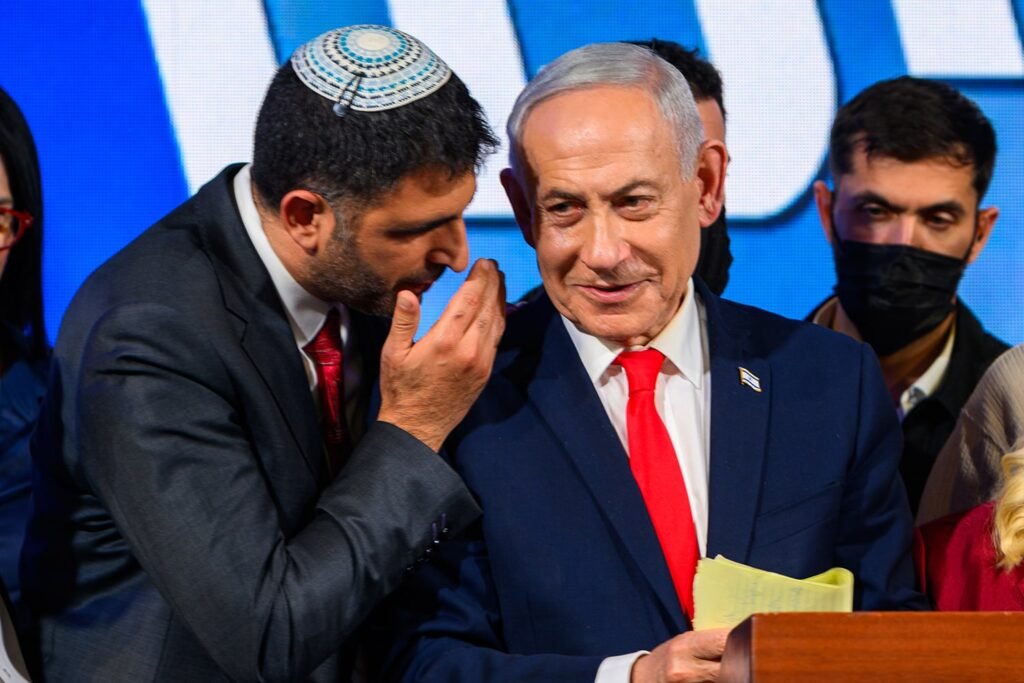
Israel’s final election results confirmed that neither Prime Minister Netanyahu coalition bloc nor the opposition secured a clear majority in the Knesset, leaving the country once again in coalition negotiation uncertainty. Ultra-Orthodox allies are reportedly weighing their options, suggesting the coalition arithmetic is in flux. Israel has faced repeated electoral cycles without decisive outcomes — the country held four elections between 2019 and 2021 before Netanyahu eventual return to power in December 2022 at the head of the most right-wing government in Israeli history. A failure by either bloc to immediately secure a majority raises the prospect of extended coalition negotiations, potential new elections, or a minority government.
INTERNATIONAL / POLITICS · ISRAEL · ELECTION RESULTS · NO CLEAR MAJORITY · NETANYAHU · COALITION · ULTRA-ORTHODOX · KNESSET
TEL AVIV / JERUSALEM — Israel’s final election results confirmed that neither Prime Minister Benjamin Netanyahu coalition bloc nor the opposition secured a clear majority sufficient to immediately form a government, according to NBC News, CNN, Times of Israel, and Reuters. Ultra-Orthodox coalition allies are reportedly weighing their options in the coalition formation process. The specific Knesset seat distribution between Netanyahu bloc and the opposition, the total seats won by each party, the specific ultra-Orthodox parties involved and their stated demands, the timeline for coalition negotiations, and whether the president has formally tasked anyone with forming a government were not detailed in initial reporting.
Israel’s Knesset has 120 seats. A coalition government requires a majority of at least 61 seats. Netanyahu Likud-led bloc in the previous government included Haredi ultra-Orthodox parties — notably United Torah Judaism and Shas — along with far-right parties Otzma Yehudit and Religious Zionism. The opposition includes Yesh Atid, the National Unity party, and center-left parties. Netanyahu has faced ongoing legal proceedings on corruption charges throughout his time in office, a factor that has been central to Israeli political polarization. The ongoing Gaza war and Iran confrontation provide a backdrop of acute security stakes to any coalition negotiation — defense and security policy commitments will be central to coalition talks regardless of which bloc has the arithmetic advantage.
Ultra-Orthodox Leverage
Ultra-Orthodox parties have wielded disproportionate coalition leverage in Israeli politics for decades, extracting policy concessions on military draft exemptions, religious law, and budget allocations for yeshiva education in exchange for coalition support. In the current political environment, the ultra-Orthodox parties are under pressure from Israeli public opinion over their draft exemption status — the October 7 attacks and subsequent Gaza war intensified secular Israeli resentment of Haredi men who do not serve in the IDF. The ultra-Orthodox parties weighing their options in the aftermath of this election are doing so in a context where their traditional demands face public resistance and where the security situation creates pressure for a broad coalition rather than an ideologically narrow one.
“The results are clear: Israel needs a stable government that can lead the country through this period. Coalition talks will begin immediately, and we will reach an agreement.” — Netanyahu, post-result statement, via Reuters
WHAT HAPPENS NEXT
► Presidential mandate — Israeli president formally tasks bloc leader with coalition formation.
► Ultra-Orthodox demands — what Shas and UTJ are asking for in exchange for coalition support.
► Coalition timeline — 28-day initial period for coalition formation, extendable by 14 days.
► Opposition talks — whether center-right opposition parties consider crossing blocs.
► New election possibility — whether neither bloc can form within the constitutional timeline.
► Security policy — how the Gaza war and Iran escalation arc affect coalition negotiations.
| CONFIDENCE: HIGH | Israel’s final election results confirming no clear majority confirmed by NBC News, CNN, Times of Israel, and Reuters. Specific seat counts, coalition demands, presidential mandate, and timeline NOT confirmed in initial reporting — flagged. Israeli coalition system, Knesset seat threshold, and ultra-Orthodox political role from established documented record. |
| Bias Check | ||
| Left-Lean | Center | Right-Lean |
| Frames Netanyahu inability to form a majority as a political consequence of Gaza war failures. | Reports confirmed Israel election results showing no clear majority for Netanyahu bloc or opposition as stated by four independent outlets. | Frames no-majority result as opposition failure to present a credible governing alternative to Netanyahu. |
| Assessment | ONYX presents confirmed four-source election result. Israeli coalition system and ultra-Orthodox political leverage from established documented record. Neither Netanyahu-consequence nor opposition-failure framing adopted editorially. | |
SOURCES
► NBC News, CNN, Times of Israel, Reuters — Israel final election results confirm no clear majority; neither Netanyahu bloc nor opposition can immediately form a government; ultra-Orthodox allies weighing options