
The jury found Lindsay Clancy not guilty by reason of mental illness — specifically postpartum psychosis — in connection with the deaths of her three children in Duxbury, Massachusetts, in January 2023. The verdict accepted the defense’s central argument: that at the time of the killings, Clancy was suffering from postpartum psychosis severe enough to render her not criminally responsible for her actions under Massachusetts law’s standard for the insanity defense.
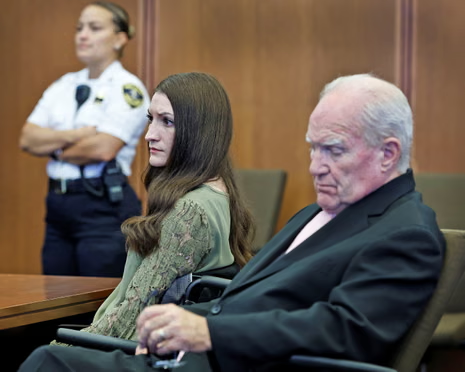
WHAT THE VERDICT DOES AND DOES NOT MEAN
A not-guilty-by-reason-of-mental-illness verdict is not the same as a not-guilty verdict:
▸ It is not an acquittal in the ordinary sense: the jury did not find that Clancy did not commit the acts; it found that she was not criminally responsible for them because of her mental state at the time
▸ It is not freedom: Massachusetts law requires that a defendant found not guilty by reason of mental illness be committed to a secure psychiatric facility; Clancy is not returning home
▸ It is a legal determination: the jury applied the specific legal standard for criminal responsibility — whether Clancy understood the nature and wrongfulness of her actions at the time — and found she did not meet that standard
▸ It is not a scientific determination: the verdict does not authoritatively resolve the medical question of whether Clancy had postpartum psychosis; it reflects the jury’s assessment of the expert testimony presented on both sides
THE POSTPARTUM PSYCHOSIS DEFENSE — WHAT THE JURY ACCEPTED
The defense’s postpartum psychosis argument asked the jury to accept a specific medical and legal framework: postpartum psychosis is a documented, severe psychiatric condition; Lindsay Clancy had it; it prevented her from understanding the nature or wrongfulness of her actions; therefore she is not criminally responsible. The jury accepted this framework. The six-day deliberation that preceded the verdict — and the two deadlock reports before the emergency SJC application — reflect how difficult the jury found the question of applying that framework to the specific evidence.
THE THREE CHILDREN
Clancy’s three children — Cora, 5; Dawson, 3; and Callan, 8 months — are the specific human accountability of this case. The verdict does not address what they experienced. It addresses Lindsay Clancy’s mental state and criminal responsibility. The two questions are different. The jury’s verdict on criminal responsibility does not resolve the grief of the Clancy family or of Cora, Dawson, and Callan’s father Patrick, who has supported Lindsay Clancy throughout the proceedings.
THE PSYCHIATRIC COMMITMENT
Massachusetts law provides that a person found not guilty by reason of mental illness is committed to a secure psychiatric facility for evaluation and treatment. The length of commitment is not fixed at sentencing; it is determined by ongoing psychiatric evaluation and the standard of whether the person remains a danger to others. Lindsay Clancy will be committed; the duration is to be determined by that ongoing process.
Not guilty. Not free. Not the end. The verdict finds that postpartum psychosis — a documented, severe psychiatric condition — prevented Lindsay Clancy from understanding what she was doing to her children. The jury deliberated for six days before accepting that. The children are still dead. Their father still chose to stand by their mother. The verdict does not make this simple.
THE LEGAL PRECEDENT DIMENSION
The Lindsay Clancy verdict is a specific legal milestone in the intersection of postpartum mental illness and criminal responsibility. The specific precedent dimension: Massachusetts courts will now have a documented high-profile case in which a postpartum psychosis defense succeeded in a capital-class murder case. Whether this makes future postpartum psychosis defenses more accessible — by establishing precedent and making juries more familiar with the medical framework — is the specific legal question that criminal defense and mental health advocates will track.
WHAT HAPPENS NEXT
▸ Psychiatric commitment — Clancy committed to a secure facility for evaluation and treatment
▸ Duration determination — ongoing psychiatric evaluations will determine when, if ever, Clancy is deemed no longer dangerous
▸ Prosecution response — whether the prosecution appeals any aspect of the verdict
▸ Mental health policy — whether the verdict produces any legislative or policy response regarding postpartum mental illness screening and treatment
| CONFIDENCE: HIGH | Lindsay Clancy not guilty by reason of mental illness verdict, postpartum psychosis defense accepted, three children Cora Dawson Callan, January 2023 Duxbury, Patrick Clancy’s support throughout proceedings are from NPR confirmed reporting. |
| ⚖️ BIAS CHECK — WHO IS SAYING WHAT | |
| Defense (Reddington) | Successfully argued postpartum psychosis rendered Clancy not criminally responsible; the six-day deliberation and emergency SJC application reflect how hard the verdict was to reach |
| Prosecution | Argued the facts did not support the insanity defense; they may assess whether appeal is viable |
| Patrick Clancy (husband / father) | Has publicly supported Lindsay Clancy throughout; his specific position — supporting the wife while losing the children — is one of the most humanly complex dimensions of the case |
| Postpartum Mental Health Advocates | Will characterize the verdict as validation of postpartum psychosis as a severe, legally recognized condition; will use it to advocate for better screening and treatment |
| Clancy Children’s Memory | Cora, Dawson, and Callan are the specific human accountability of this case regardless of the verdict; ONYX names them |
SOURCES
▸ NPR — Lindsay Clancy not guilty verdict postpartum psychosis, September 6, 2026
Q: What does “not guilty by reason of mental illness” mean in Massachusetts?
A: Under Massachusetts General Laws, a defendant is not criminally responsible if, at the time of the conduct, as a result of mental disease or defect, they lacked substantial capacity either to appreciate the criminality of their conduct or to conform their conduct to the requirements of law. The jury found that Lindsay Clancy’s postpartum psychosis meant she lacked this capacity. A finding of not criminally responsible does not mean the defendant did not perform the act; it means they are not legally culpable for it.
Q: What is postpartum psychosis?
A: Postpartum psychosis is a rare but severe psychiatric condition that can develop after childbirth, typically within the first two weeks but sometimes later. It is distinct from postpartum depression; it is characterized by hallucinations, delusions, severe confusion, extreme mood swings, and disorganized behavior. Its onset is rapid, it can include command hallucinations directing the person to take specific actions, and it is documented in medical literature as capable of impairing a person’s understanding of reality and their own actions. It affects approximately 1-2 per 1,000 postpartum women. It is treatable; untreated, it can have catastrophic consequences.
Q: Will Lindsay Clancy be released?
A: Not immediately. Massachusetts law requires commitment of a defendant found not guilty by reason of mental illness. She will be placed in a secure psychiatric facility. Discharge requires judicial proceedings and typically a finding that the person no longer poses a danger to others. The specific timeline for any future release is determined by ongoing psychiatric evaluation; there is no fixed term. Clancy could be committed for months, years, or indefinitely, depending on her psychiatric evaluation and legal proceedings.