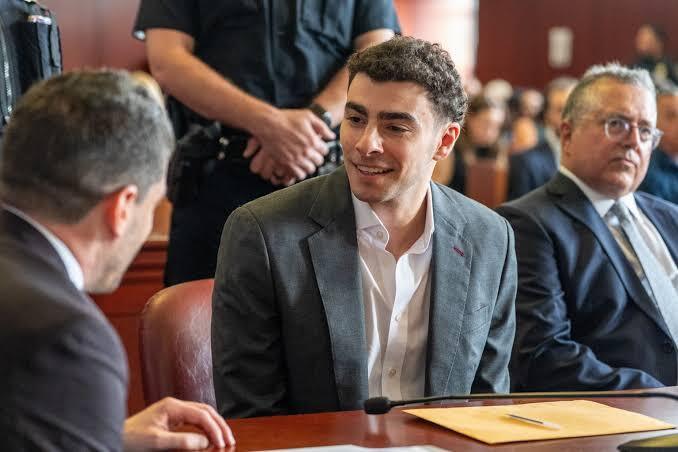
A surprise hearing scheduled for Friday August 14 in Luigi Mangione’s federal case has fueled widespread speculation that he may enter a plea — a development, if it occurs, that would significantly complicate his separate, already-underway New York state murder trial for the killing of UnitedHealthcare CEO Brian Thompson. Earlier this week, a judge ruled the jury in his state trial will remain anonymous, a rare procedural protection granted in cases with exceptional public profile and security concerns. The surprise federal hearing is today. Its outcome may reshape the entire legal landscape of the most publicly followed criminal proceeding in the country.
2-MINUTE CONTEXT — THE TWO-TRACK LEGAL SITUATION
Mangione faces two separate legal proceedings: a New York state murder trial for the December 2024 killing of Brian Thompson, and a federal case with separate charges. The existence of both creates a specific legal complexity: actions in one case can affect the other. A plea in the federal case, for example, could include cooperation terms that affect evidence or witness testimony in the state case. The state trial, already underway with a jury selected and evidence phase beginning, cannot simply be paused if the federal case produces new developments — but new developments could create grounds for delay motions or significantly change the defense strategy.
Brian Thompson was the CEO of UnitedHealthcare, one of the largest health insurance companies in the United States. His killing on a Manhattan street in December 2024 — before a healthcare company investor event — generated extraordinary public attention and a complicated public reaction in which some expressed sympathy for the alleged shooter alongside condemnation of health insurance practices. That public attention is specifically what led to the anonymous jury ruling: the court found the case’s profile created genuine security risks for jurors whose identities might become public.
WHAT A FEDERAL PLEA WOULD MEAN
If Mangione enters a plea in the federal case, several specific questions become immediately relevant:
▸ What is he pleading to? A plea to federal charges does not resolve state charges; the state case would continue separately
▸ What cooperation, if any, is he providing? Federal pleas often include cooperation agreements; in Mangione’s case, it is unclear what cooperation he could provide that would be of value to federal prosecutors
▸ Does the plea include any sentencing agreement? A negotiated sentence in the federal case could be structured to run concurrent or consecutive to any eventual state sentence
▸ Does a federal plea affect the state trial? It should not automatically do so, but it creates new facts and potentially new evidence that the state trial participants — prosecution and defense — must address
▸ Why surprise? Surprise hearings in high-profile cases typically indicate a development that the parties want to address quickly and have not publicized; a plea negotiation that has been finalized would produce exactly this kind of surprise scheduling
THE ANONYMOUS JURY — WHY IT MATTERS
Anonymous juries are rare in the United States. They are granted when a court finds a genuine, specific risk that juror identification would put those jurors in danger or would prevent them from delivering a verdict based solely on evidence and law. The Mangione state trial anonymous jury ruling reflects the specific assessment that this case’s public profile — including the complicated public reaction to Thompson’s killing — creates exactly that risk.
The public reaction to Thompson’s killing — in which some social media users expressed sympathy for the alleged shooter alongside criticism of health insurance companies — is the specific phenomenon the anonymous jury ruling is responding to. A juror whose identity becomes public in a case with that level of charged public attention faces realistic risks of harassment, threats, or pressure. The court determined those risks are real enough to justify the anonymity protection.
The jury is anonymous. The hearing is a surprise. The federal and state cases are running in parallel. The most publicly watched criminal trial in the country is also its most legally complex.
THE PUBLIC INTEREST DIMENSION
Mangione’s case has generated a level of public engagement that very few criminal proceedings reach. Part of that engagement reflects the specific public anger at health insurance industry practices — claim denials, coverage gaps, costs that have produced genuine suffering for millions of Americans — that Thompson’s killing crystallized. Part reflects the specific demographic and media profile of the alleged killer. ONYX notes this public interest dimension without treating it as legally relevant — public sympathy for or against a defendant is precisely what the anonymous jury ruling is designed to insulate the proceedings from.
WHAT HAPPENS NEXT
▸ Today’s federal hearing — its outcome will be reported within hours; ONYX will cover in subsequent packs
▸ If a plea is entered: immediate implications for the state trial timeline and strategy will be assessed
▸ If no plea: the surprise hearing will be explained by whatever the actual subject turns out to be
▸ State trial continues: the New York state murder trial is underway; its schedule is not formally dependent on the federal case
▸ Anonymous jury logistics: the state trial will proceed with jury confidentiality measures in place for the duration
| CONFIDENCE: HIGH | Surprise Friday federal hearing is from NPR confirmed reporting. Anonymous jury ruling in state trial is from documented court proceedings. Mangione’s charges (federal and state) are from confirmed legal filings. Brian Thompson killing (December 2024) is established public record. |
| ⚖️ BIAS CHECK — WHO IS SAYING WHAT | |
| Federal Prosecutors | Controlling the specific charges and any plea negotiation terms; not commenting publicly on the hearing subject |
| State Prosecutors (Manhattan DA) | Watching the federal case closely for any implications for their ongoing trial |
| Mangione Defense | Presumably party to whatever is prompting the surprise hearing; their strategy across both cases is opaque |
| Court / Judiciary | Anonymous jury ruling reflects genuine security assessment; the court is trying to protect the integrity of the process |
| Media / Public | Enormous attention; the public interest dimension is real and requires careful reporting that does not allow it to infect the legal analysis |
SOURCES
▸ NPR — surprise federal hearing, plea speculation, August 2026
▸ Anonymous jury ruling — New York state trial, documented court order
▸ Brian Thompson killing — December 2024 (established public record)
Q: What federal charges does Mangione face?
A: The specific federal charges in Mangione’s federal case are documented in the federal indictment. Federal charges for a killing of this type typically include using a firearm in connection with a violent crime, which carries federal penalties that can be pursued alongside state charges. The exact federal charge categories are in the public indictment.
Q: Can he be tried by both federal and state governments?
A: Yes. Under the dual sovereignty doctrine, both the federal government and a state government can prosecute the same individual for the same underlying conduct if that conduct violates both federal and state law. This is a well-established constitutional doctrine.
Q: What does “surprise hearing” mean exactly?
A: In the context of criminal proceedings, hearings are typically scheduled with advance notice to all parties. A surprise hearing — not scheduled far in advance, announced quickly — suggests a development that requires rapid judicial attention. In a plea context, it typically means the negotiation has concluded and the parties want to formalize it quickly.