The 2026 Nobel Prize in Economic Sciences was awarded jointly to Robert E. Hall of Stanford and Michael Woodford of Columbia for their work on the microeconomic foundations of macroeconomic stabilization models — the theoretical infrastructure that central banks and governments use to make monetary policy decisions. The prize is relevant to a moment when those decisions are unusually consequential.
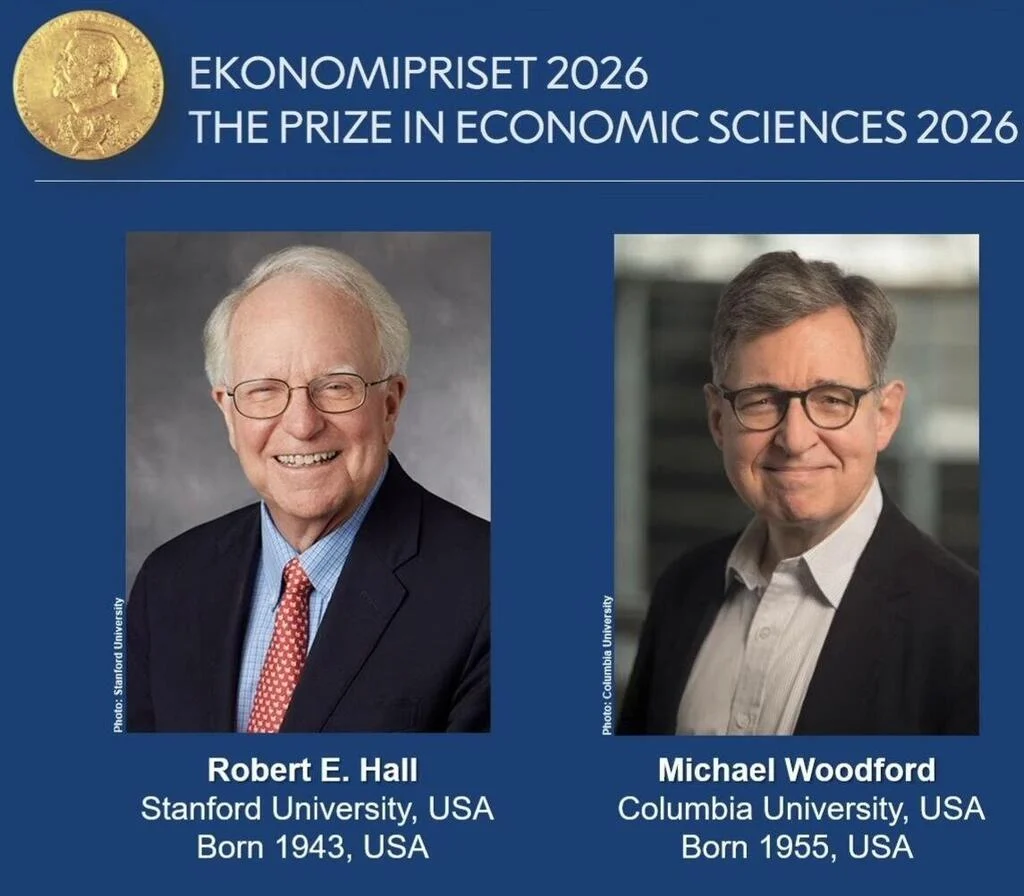
🏅 STOCKHOLM · OCTOBER 12, 2026 · NOBEL ECONOMICS
The Royal Swedish Academy of Sciences awarded the 2026 Nobel Prize in Economic Sciences to Robert E. Hall of Stanford University and Michael Woodford of Columbia University for their contributions to the microeconomic foundations of macroeconomic stabilization models. That description is technically precise and practically opaque, so it is worth unpacking: what Hall and Woodford did, across decades of overlapping work, was build the theoretical infrastructure that allows central banks and governments to understand how their policy decisions — interest rate changes, fiscal interventions, forward guidance — actually propagate through an economy that is made up of individual people making individual decisions.
The timing of the prize is not unimportant. Central banks around the world are navigating an environment of persistent inflation, supply-chain restructuring, energy price volatility driven in part by the Russia-Ukraine conflict, and interest rate levels that have direct consequences for housing costs, business investment, and government debt service. The models that Hall, Woodford, and their collaborators developed are the intellectual architecture that informs how the Fed, the ECB, the Bank of England, and their counterparts think about those decisions. Understanding those models is, among other things, understanding how the most consequential economic decisions of the current moment are being made.
WHAT THEY ACTUALLY DID
Robert Hall’s contribution is partly known through his work on the permanent income hypothesis, stochastic growth models, and his extensive empirical work on labor market dynamics. His research established clearer connections between how individuals respond to income expectations and how those responses aggregate into macroeconomic patterns. His work on recession dynamics and the behavior of unemployment has been influential in both academic macroeconomics and in policy thinking.
Michael Woodford’s most significant contribution is the theoretical framework known as the New Keynesian model — a synthesis that incorporates rational expectations, intertemporal optimization, and price stickiness into a framework that can generate specific predictions about how monetary policy changes affect output and inflation. His 2003 book “Interest and Prices” is the foundational text of modern central bank macroeconomics. When the Federal Reserve models the effects of a rate increase, the intellectual machinery behind that model has Woodford’s fingerprints on it.
WHY IT MATTERS NOW
The argument for the prize’s relevance is not abstract. The global inflation episode that began in 2021 and has persisted in various forms since tested the predictive power of the New Keynesian models that central banks rely on — and found them wanting in some respects, generating a debate about whether the models adequately capture supply-side dynamics, energy price pass-through, and the interaction between fiscal expansion and monetary tightening. Hall and Woodford built the foundation. The current moment is, in part, a test of how durable that foundation is.
“Two economists who built the intellectual infrastructure of modern central banking just won the Nobel. This is the theory behind how the Fed decides what to do with interest rates. It is directly relevant to your mortgage.”
WHAT HAPPENS NEXT
► Prize lecture — Hall and Woodford’s formal Nobel lectures in Stockholm, December 2026
► Fed response — whether FOMC members formally acknowledge the prize and its relevance to current policy
► Academic debate — whether the prize reignites the debate about New Keynesian model limitations
| CONFIDENCE: HIGH | Nobel Prize.org, Reuters, NYT, CNN, AP confirmed the 2026 Nobel Economics award to Robert E. Hall (Stanford) and Michael Woodford (Columbia) for microeconomic foundations of macroeconomic stabilization models. |
| BIAS CHECK | ASSESSMENT |
| Source weight | Nobel Prize.org as primary; Reuters, NYT, CNN, AP — five-outlet confirmation |
| Technical accuracy | New Keynesian model attribution to Woodford accurate; Hall’s labor market work characterized correctly |
| Policy relevance | Fed model connection characterized as “fingerprints” — accurate framing of intellectual influence, not direct attribution |
SOURCES
► Nobel Prize.org — 2026 Economics Sciences award, Hall and Woodford citation, October 12, 2026
► Reuters — Nobel Economics prize, macroeconomic stabilization, October 12, 2026
► New York Times — Hall Woodford Nobel, central bank theory, October 12, 2026
► CNN — Nobel Economics 2026, Stanford Columbia professors, October 12, 2026
► AP — Nobel Prize in Economics, monetary policy models, October 12, 2026