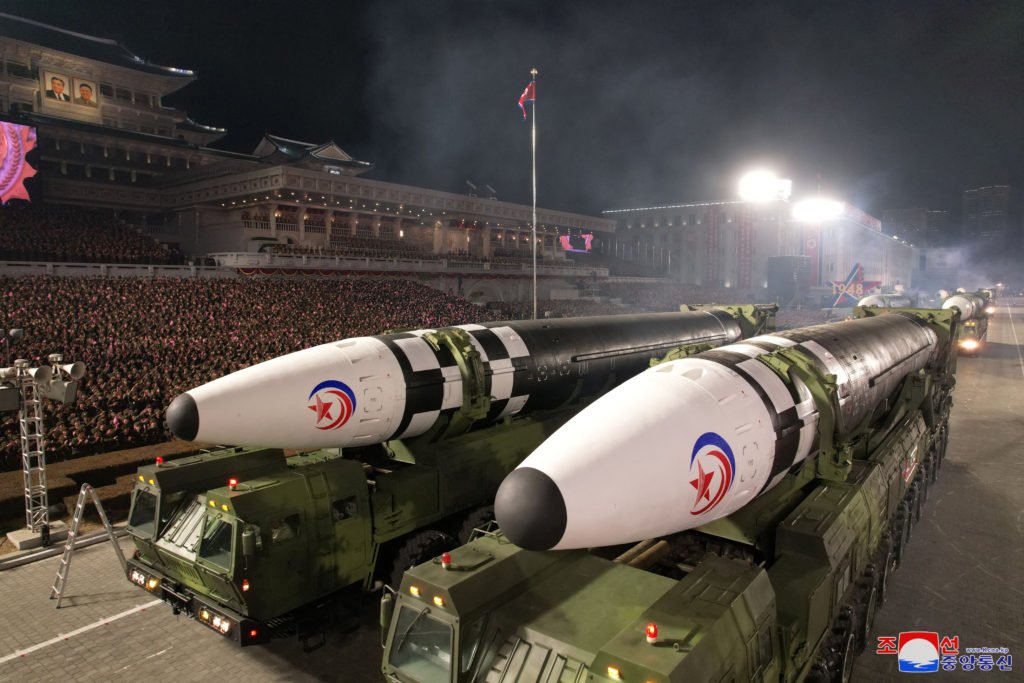
North Korea launched multiple ballistic missiles toward the East Sea, with at least one traveling more than 900 kilometers. South Korea had recently conducted a hypersonic missile test. Japan and South Korea tracked the launches. No damage was reported. The pattern of North Korean provocation in response to South Korean capability demonstrations is consistent and well-documented.
🇰🇵 KOREAN PENINSULA · OCTOBER 12, 2026 · DPRK MISSILE LAUNCH
North Korea launched multiple ballistic missiles toward the East Sea. At least one traveled more than 900 kilometers before splashing down outside the territorial waters of Japan or South Korea. Both governments tracked the launches; Japan issued its standard missile alert protocols. No damage or casualties were reported. The launches were the latest in a pattern of North Korean ballistic missile testing that has continued across multiple South Korean and US administrations, and that shows no signs of abating.
The proximate context for this particular launch was South Korea’s recent test of a hypersonic missile — a weapons capability that has been a priority for Seoul’s defense establishment, and that is viewed in Pyongyang as an escalation of the South’s offensive strike capability. The North Korean missile launch pattern is not random: it tends to respond to South Korean or US military demonstrations that Pyongyang characterizes as threatening, and hypersonic missile tests fit that category precisely.
WHAT 900 KILOMETERS MEANS
A ballistic missile traveling 900 kilometers from North Korean territory puts the entire Korean Peninsula, most of Japan’s main island of Honshu, and the Yellow Sea well within range. North Korea’s ballistic missile program has long since demonstrated the range to strike any target in the Republic of Korea and Japan — both US treaty allies with US forces deployed on their soil. The 900-kilometer figure in this launch is not a new capability demonstration; it is a demonstration of a capability that has been established and that Pyongyang uses as a routine signaling instrument.
The distinction between the various classes of North Korean ballistic missiles — short-range, medium-range, intermediate-range, and intercontinental — matters for the diplomatic and military response. ICBM tests generate a qualitatively different response from Washington than short- or medium-range launches. The 900-kilometer range figure reported in this instance is consistent with a medium-range system, which fits within the pattern of calibrated provocations that Pyongyang uses to signal displeasure without triggering the maximum-pressure response that an ICBM test would produce.
THE DIPLOMATIC STATUS
North Korea’s relationship with the Trump administration is, at filing time, in an indeterminate state. The first Trump administration’s diplomatic engagement with Kim Jong-un produced summits but no durable agreements. The second Trump administration has not, to date, produced a high-profile engagement with Pyongyang. North Korean missile launches in this context are partly a reminder to Washington that Pyongyang has not gone away and is not waiting passively for US engagement to materialize.
“North Korea fired missiles the week South Korea tested a hypersonic weapon. This is how the peninsula communicates. Nine hundred kilometers is not a new capability. It is a reminder of an existing one.”
WHAT HAPPENS NEXT
► US condemnation — State Department or NSC formal response to the launch
► UN Security Council — whether China and Russia block a council statement as they have recently
► South Korea response — whether Seoul adjusts its defense posture or accelerates hypersonic program
► Japan protest — Tokyo’s formal diplomatic protest to Pyongyang
► Trump-Kim status — whether the launches prompt any renewed US-DPRK diplomatic contact
| CONFIDENCE: HIGH | AP, Reuters, Al Jazeera, Yonhap confirmed North Korea ballistic missile launches toward the East Sea, 900+ km range, South Korea hypersonic test context, Japan and South Korea tracking, no casualties. |
| BIAS CHECK | ASSESSMENT |
| Source weight | AP, Reuters, Al Jazeera, Yonhap — Yonhap as South Korean government-affiliated primary source |
| Range framing | 900 km characterized accurately as consistent with medium-range systems; not inflated as new capability |
| Provocation framing | Response to South Korean hypersonic test characterized as pattern, not as North Korean aggression without context |
SOURCES
► AP — North Korea ballistic missile launches, East Sea, October 12, 2026
► Reuters — DPRK missiles, South Korea hypersonic context, Japan tracking, October 12, 2026
► Al Jazeera — North Korea missile launches, 900km range, October 12, 2026
► Yonhap News Agency — South Korean tracking, DPRK launch details, October 12, 2026