Official Chinese outlets described the new rules as an attempt to decouple global supply chains and warned of retaliatory measures; the response signals that Beijing views the semiconductor controls as a strategic confrontation rather than a trade dispute.
CHINA · SEMICONDUCTORS · EXPORT CONTROLS · TRADE · DECOUPLING
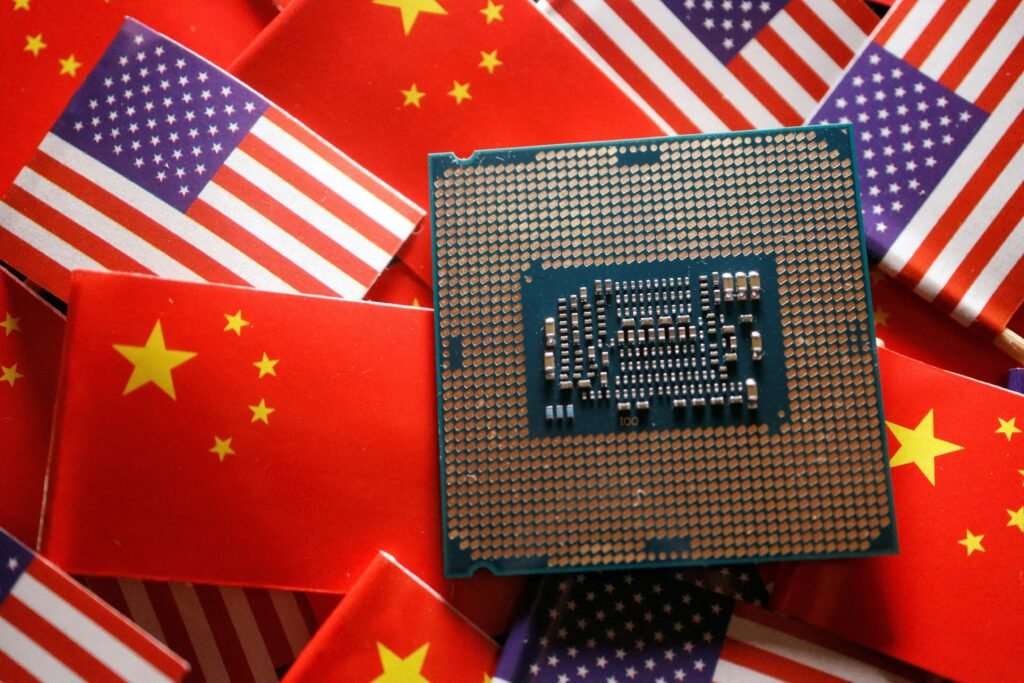
Chinese state media on Thursday described the latest United States semiconductor export control rules as an attempt to decouple global technology supply chains and warned that Beijing would take retaliatory measures; Reuters, the South China Morning Post, and the Associated Press all confirmed. The state media characterization of the rules as deliberate decoupling rather than national security-motivated export controls reflects the standard framing the Chinese government applies to American technology restrictions: by characterizing the controls as economic aggression rather than legitimate security measures, Beijing positions itself as the aggrieved party in a framework that justifies a symmetrical retaliatory response. The specific retaliatory measures warned of were not detailed in Thursday state media statements but are expected by analysts to include further restrictions on Chinese exports of rare earth materials and other inputs in which China holds supply chain leverage.
Reuters provided detail on the specific semiconductor export controls that triggered the Chinese state media response. The Biden administration and its successors have implemented successive rounds of semiconductor export controls designed to prevent China from acquiring advanced chips and the manufacturing equipment needed to produce them domestically. The cumulative effect of these controls has been to constrain the development of Chinese domestic semiconductor capacity at the most advanced nodes, with the latest rules closing loopholes and extending the control perimeter to cover chip designs and manufacturing process inputs that prior rules had not addressed. Reuters noted that the controls are specifically designed to impair Chinese military and AI development, which the US government has identified as the national security rationale for the export control framework.
The South China Morning Post Analysis
The South China Morning Post provided the most detailed analysis of the Chinese government and industry response to the latest controls. SCMP, which provides coverage of Chinese affairs from Hong Kong with both Chinese and international audience awareness, noted that Chinese semiconductor industry leaders have been publicly more sanguine about the effect of the controls than state media rhetoric suggests, arguing that Chinese domestic semiconductor development has accelerated precisely because of the controls and that the technology gap the controls are designed to maintain is narrowing. SCMP analysis suggested a tension between the official state media condemnation — which serves a political signaling function — and the more pragmatic industry assessment, which acknowledges the controls have imposed real costs while also accelerating domestic alternatives.
The Associated Press provided the American government response context. The Commerce Department, which administers the export control framework through the Bureau of Industry and Security, issued a statement defending the latest controls as necessary national security measures implemented under existing statutory authority and consistent with American obligations under international trade agreements. The AP noted that the controls have been coordinated with allied nations — Japan, the Netherlands, and South Korea, among others — whose semiconductor equipment manufacturers are among those affected, and that the multilateral coordination of the controls is part of a deliberate strategy to prevent China from simply sourcing restricted equipment through third countries.
“The United States is using technology controls to contain China. This is not about national security. It is about preserving American hegemony in the technology sector.” — Chinese state media editorial cited by Reuters
The Retaliation Risk
Reuters analyzed the retaliation landscape that the Chinese state media warnings point to. China holds supply chain leverage in several technology-relevant material categories that it has used or threatened to use in prior US-China trade confrontations, most notably in rare earth minerals that are inputs to semiconductor and electronics manufacturing. A Chinese decision to restrict rare earth exports in response to the semiconductor controls would impose costs on American and allied manufacturers that use those inputs — a symmetrical supply chain pressure that Beijing has demonstrated a willingness to deploy in past confrontations. The escalation risk is a function of whether Beijing calculates that retaliation serves its strategic interests more than the ongoing negotiation channel that the state media rhetoric coexists with.
WHAT HAPPENS NEXT
► Chinese government to announce specific retaliatory measures or proceed through WTO dispute mechanism
► Commerce Department to monitor for Chinese circumvention of new controls through third countries
► Allied semiconductor equipment manufacturers to assess compliance burden of latest rule extensions
► US-China trade relationship to continue in dual track of confrontation and selective engagement
| CONFIDENCE: HIGH | Reuters, the South China Morning Post, and AP all confirmed the Chinese state media criticism, the decoupling characterization, and the retaliation warning. Three-source convergence, including SCMP for a specific Chinese domestic industry perspective. |
| Bias Check | ||
| Left-Lean | Center | Right-Lean |
| Controls framed as American economic nationalism undermining global technology collaboration and Chinese development. | Reports state media criticism, control rationale, allied coordination, and retaliation risk factually. | Controls framed as necessary national security measures; China’s military AI development is a legitimate target. |
SOURCES
► Reuters — State media criticism, decoupling characterization, retaliation warning, control detail, November 12, 2026
► South China Morning Post — Chinese industry response, domestic semiconductor development acceleration, SCMP analysis
► Associated Press — Commerce Department defense, allied coordination, WTO framework, circumvention monitoring