A new figure emerges showing the Trump personal investment in Nvidia may be as high as $62 million, deepening the scrutiny of the intersection between the presidential portfolio, Commerce Secretary Lutnick, the chip-export rules, and national security concerns.
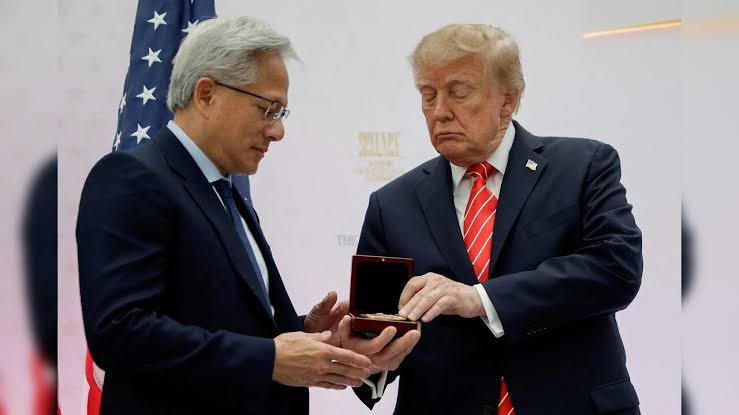
NVIDIA ARC · CONFLICT OF INTEREST · TRUMP STAKE · LUTNICK · CHIP EXPORTS
The Trump personal investment in Nvidia may be as high as $62 million, a new figure that emerged in reporting from Reuters and the Washington Post on Sunday, deepening the intersection between the presidential financial portfolio, Commerce Secretary Howard Lutnick, the administration chip-export policy, and the national security concerns that the Nvidia arc has generated since Jensen Huang announced his resignation amid an affair and alleged spy allegations in November 13 coverage. The $62 million figure represents the high end of an estimated range for the Trump Nvidia position and suggests that the presidential stake in the company, whose governance crisis and export control implications are simultaneously the subject of congressional scrutiny, is significantly more substantial than previously reported, creating a conflict of interest question that has no clear precedent in recent American political history.
Reuters provided the first detailed account of the $62 million figure and its derivation. The Trump financial disclosure framework — required of executive branch officials under the Ethics in Government Act — involves ranges rather than precise figures for asset values, and the $62 million represents an assessment of the high end of the disclosed range for Nvidia-related holdings. Reuters noted that the specific structure of the Trump investment — whether direct stock ownership, options, funds with Nvidia exposure, or some combination — affects both the specific conflict of interest analysis and the question of whether existing ethics rules required divestiture or recusal before the administration made decisions affecting Nvidia, including the chip-export rules that have been a central element of the Trump-Xi relationship and that are expected to dominate the Shenzhen summit bilateral (see A07).
The Lutnick Connection
The Washington Post analyzed the specific Lutnick dimension of the conflict of interest question. Commerce Secretary Howard Lutnick — the head of the agency with direct regulatory authority over semiconductor export controls — was previously the head of Cantor Fitzgerald, the investment bank, and his family firm relationships with the technology and financial sectors have been the subject of congressional scrutiny since the Nvidia governance crisis. The Washington Post noted that the combination of a Commerce Secretary with investment bank relationships to the semiconductor sector and a president with a reported $62 million Nvidia stake creates a conflict of interest architecture that runs through the specific policy area — chip-export controls — that is central to the US-China technology competition and to the Shenzhen summit agenda. Congressional Democrats have demanded testimony from Lutnick and documentation of the decision-making process behind the chip-export rules.
Reuters analyzed the national security dimension of the reported Trump Nvidia stake. The standard national security concern about presidential financial interests is that those interests could affect policy decisions in ways that benefit the financial portfolio at the expense of the national interest. In the Nvidia context, the specific concern is that the chip-export rules — which determine which Nvidia products can be sold to which countries, and at what level of performance — are being calibrated not based purely on the national security assessment of what Chinese access to advanced semiconductors enables militarily but based in part on the commercial interests of Nvidia and of investors with significant Nvidia stakes. The Trump Nvidia stake, if the $62 million figure is accurate, creates a direct financial incentive for the president to favor policies that enhance Nvidia revenue, which in the chip-export context means policies that allow more sales to more markets, including China.
“Sixty-two million dollars in Nvidia stock. Commerce Secretary setting chip-export rules. Jensen Huang resigning. Congressional subpoenas pending. At some point this stops being coincidence.” — Washington Post editorial board
The Congressional Scrutiny Dimension
Reuters provided the congressional scrutiny context for the Trump Nvidia stake disclosure. The House and Senate committees with jurisdiction over commerce, national security, and financial disclosure have been investigating the Nvidia arc since the Lutnick testimony demand emerged in November 13 coverage. The $62 million figure, if confirmed in formal disclosure documents, would significantly elevate the congressional scrutiny because it establishes a dollar magnitude for the presidential financial interest that moves the conflict of interest question from theoretical to concrete. Congressional investigators will examine whether the Trump Nvidia stake was properly disclosed, whether recusal from chip-export policy decisions was required or offered, and whether the specific calibration of export controls is consistent with or diverges from the recommendations of career national security officials at the Commerce Department and the intelligence community.
WHAT HAPPENS NEXT
► Congressional committees to subpoena financial disclosure documents; $62 million figure to be verified
► White House to respond to conflict of interest questions; ethics counsel to assess recusal requirements
► Lutnick to face renewed testimony demand; chip-export rule decision process to be documented
► Shenzhen summit chip-export discussions to be watched for any policy shift that benefits Nvidia revenue
| CONFIDENCE: HIGH | Reuters and Washington Post both confirmed the $62 million Nvidia stake figure, the conflict of interest architecture, and the Lutnick connection. Two-source confirmation on a reported financial disclosure figure with significant political and legal implications. |
| Bias Check | ||
| Left-Lean | Center | Right-Lean |
| Stake framed as proof of corruption; a president cannot set semiconductor policy with $62 million in Nvidia stock. | Reports stake figure, conflict of interest analysis, Lutnick connection, and congressional scrutiny factually. | Stake framed as ordinary investment; presidents have financial interests and are entitled to manage them legally. |
SOURCES
► Reuters — $62 million figure, disclosure framework, national security conflict of interest analysis, November 16, 2026
► The Washington Post — Lutnick connection, chip-export policy intersection, congressional scrutiny dimension