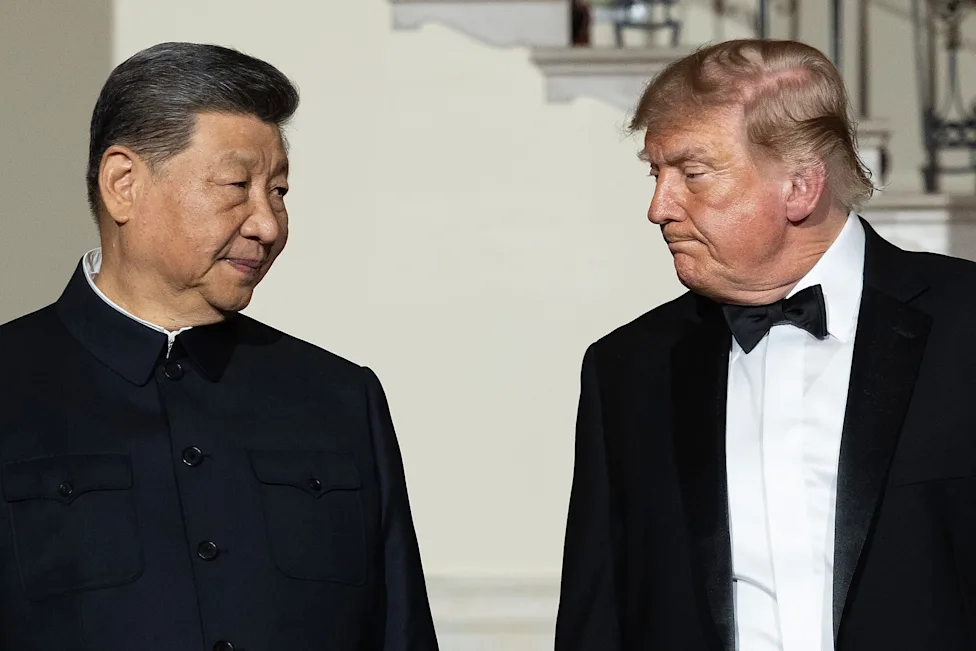
Semiconductor export controls and the possibility of joint artificial intelligence safety steps are expected to dominate the bilateral discussions between Trump and Xi at APEC, sitting at the intersection of technology competition, national security, and the Nvidia conflict-of-interest scrutiny.
TECHNOLOGY · CHIP EXPORTS · AI SAFETY · TRUMP-XI · SHENZHEN · NVIDIA ARC
Semiconductor export controls — the specific rules governing which American-designed chips can be sold to Chinese buyers at what performance levels — and the possibility of joint steps on artificial intelligence safety are expected to be the dominant technology agenda items in the bilateral discussions between President Trump and Chinese President Xi Jinping at APEC in Shenzhen, Reuters confirmed on Sunday, with the technology agenda sitting at the intersection of the ongoing US-China technology competition, the national security considerations that have driven American chip-export policy since the Biden administration, and the specific conflict of interest scrutiny generated by the Trump Nvidia stake and the Lutnick Commerce Department role in setting those very rules. The bilateral technology agenda is in this sense the most combustible element of the summit because it simultaneously involves the most concrete near-term policy decisions and the most direct connection to the domestic political and financial controversies surrounding the administration.
Reuters provided the clearest account of what each side wants from the chip-export discussion. The Chinese position — consistently and publicly stated — is that American chip-export controls are illegitimate technology protectionism dressed up in national security language, and that the specific performance thresholds set by export control rules are designed not to prevent genuine military applications of advanced chips but to slow Chinese civilian technology development across a broad range of industries. Beijing wants the export controls loosened or eliminated, and the APEC setting provides an opportunity to press this demand directly with the president. The American position, as stated by the Commerce Department and the national security establishment, is that advanced semiconductors have direct applications in military AI, autonomous weapons, and signals intelligence that require restriction regardless of the stated civilian purpose of the Chinese buyers.
The AI Safety Dimension
Reuters provided detail on the AI safety dimension of the bilateral agenda. Joint steps on AI safety — in which the United States and China would agree on some set of principles, standards, or restrictions governing the most dangerous applications of artificial intelligence — have been discussed in diplomatic channels since 2023 as a potential area of limited cooperation that does not require the two countries to resolve their broader technology competition. The Biden administration initiated AI safety discussions with China in 2023-2024, and the Trump administration has approached the question with a mix of continued engagement and skepticism about whether Chinese commitments would be verifiable. Reuters noted that an AI safety agreement reached at Shenzhen — however limited in scope — would represent a significant diplomatic achievement because it would be the first formal US-China agreement on the management of a transformative technology.
Reuters analyzed the specific tension between the chip-export control discussion and the AI safety discussion. The two are logically connected: restricting Chinese access to the most powerful chips is one mechanism for limiting Chinese AI development capacity, while an AI safety agreement would involve committing to restrict certain AI applications regardless of the hardware used to develop them. A deal that trades loosened chip-export controls for stronger AI safety commitments is analytically coherent, but it would require the administration to make a judgment that Chinese AI safety commitments are worth more than the access restriction that the export controls provide — a judgment that the national security community has historically been reluctant to endorse. The Nvidia conflict of interest dimension adds to the analytical complexity: a deal that loosens export controls benefits Nvidia revenue and therefore the Trump portfolio, creating the question of whether the trade is being made on national security grounds or financial grounds.
“The chip conversation is the summit. Everything else — Ukraine, Iran, nuclear — depends on whether Trump and Xi can find a technology framework that both sides can live with.” — Reuters diplomatic correspondent
The Export Control Architecture
Reuters provided technical context on the export control architecture that the bilateral discussion will engage. The specific rules — known as the Export Control Reform Act framework and implemented through Commerce Department Entity List designations and licensing requirements — have been progressively tightened since 2019 to restrict Chinese access to chips designed with American technology, using American equipment, or manufactured by companies with American investment. The most recent rules introduced performance thresholds that limit the specific chips — including advanced Nvidia data center GPUs — that can be exported to China without a license. The licensing process gives the Commerce Department — now under Lutnick — significant discretion over which Chinese buyers can access which chip capabilities, and that discretion is at the center of both the national security concern and the conflict of interest question.
WHAT HAPPENS NEXT
► Bilateral outcome on chip exports to be announced; any performance threshold changes to be analyzed
► AI safety framework language to be released; verifiability of Chinese commitments to be assessed
► Congressional committees to review any export control changes for Nvidia financial interest connections
► Technology industry to assess commercial implications of summit outcome for semiconductor sector
| CONFIDENCE: HIGH | Reuters confirmed the chip-export and AI safety bilateral agenda items, the Chinese and American positions, and the tension between the two agenda dimensions. Single major wire service source on a confirmed summit agenda analysis. |
| Bias Check | ||
| Left-Lean | Center | Right-Lean |
| Export controls framed as corporate protectionism; AI safety deal framed as the responsible path to cooperation. | Reports bilateral agenda, Chinese and US positions, AI safety dimension, and export control architecture factually. | Export controls framed as essential national security tool; any loosening for AI safety trade is a dangerous concession. |
SOURCES
► Reuters — Chip-export bilateral agenda, Chinese and US positions, AI safety dimension, export control architecture analysis, November 16, 2026