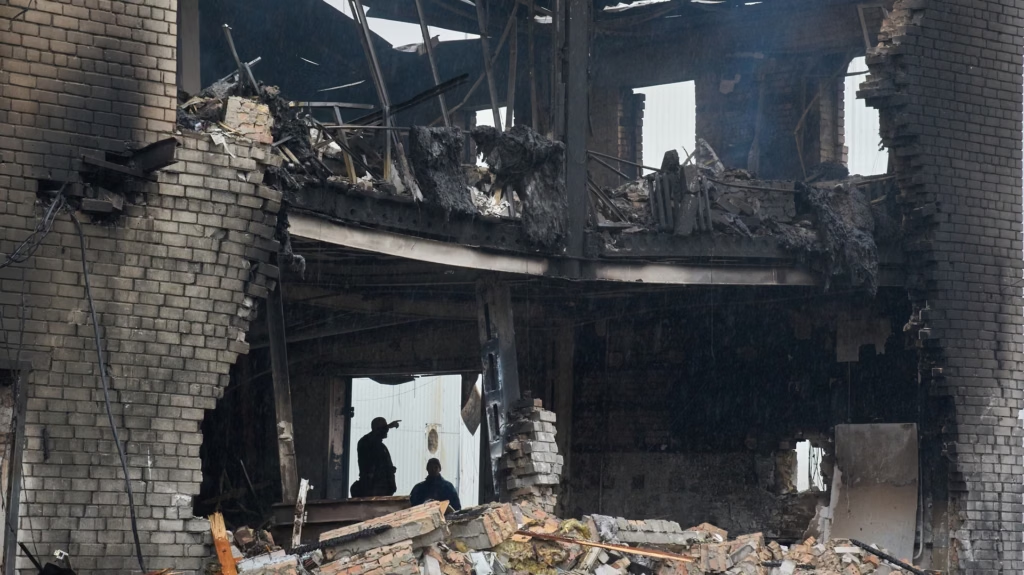
Russian missiles and drones struck Kyiv, killing at least eight people, damaging bridges and power systems, and hitting diplomatic missions, in the most extensive Russian strike campaign on the Ukrainian capital since the war began.
UKRAINE ARC · RUSSIAN STRIKES · KYIV · 8 KILLED · EMBASSIES HIT · RETALIATION · KERCH
Russian missiles and drones struck Kyiv and other Ukrainian cities in what the Associated Press, CNN, BBC, and the Financial Times described as the most extensive Russian strike campaign on the Ukrainian capital in the duration of the war, killing at least eight civilians, damaging bridges and power infrastructure, and striking diplomatic missions in the Ukrainian capital, in direct retaliation for the Ukrainian destruction of the Kerch Bridge. The scale and targeting of the Russian strike package is extraordinary: Kyiv bridges, power generation and transmission infrastructure, and the diplomatic district where embassies are concentrated have each been targeted in previous Russian strike campaigns, but their simultaneous targeting in a single coordinated operation represents a qualitative escalation in Russian strike ambition and execution. The embassy strikes — which hit or caused damage to multiple foreign diplomatic missions — carry specific significance under international law and will generate immediate diplomatic responses from the countries whose missions were affected.
The AP and CNN provided the casualty and damage assessment as of initial reporting. At least eight civilians were killed in the Kyiv strikes, with additional casualties in other cities targeted in the same operation; the final casualty figures were expected to rise as rescue operations continued in areas where buildings collapsed or where fires from fuel and infrastructure continued to burn. The power infrastructure targeting — hitting both generation capacity and high-voltage transmission infrastructure — is designed to produce cascading outages across the Ukrainian grid that go beyond the immediate strike zone, replicating the strategy that Russia deployed in the winter of 2022-2023 to try to freeze the Ukrainian civilian population into submission. BBC provided detail on the bridge targeting, noting that the specific Kyiv bridges struck included crossings that are critical to the movement of emergency services, humanitarian aid, and military logistics in and around the capital.
The Embassy Strike Dimension
The Financial Times and BBC provided the most detailed reporting on the embassy strikes, which represent the most diplomatically significant element of the Russian attack. Under the Vienna Convention on Diplomatic Relations, diplomatic premises are inviolable — the receiving state is obligated to protect them from intrusion or damage — and damage to foreign embassies in Kyiv by Russian strikes places Ukraine in the position of a receiving state that failed to protect the premises of its diplomatic guests. The practical implication is that countries whose embassies were damaged will make formal diplomatic protests — to Russia for the attack, and potentially to Ukraine for the failure of protection — and the incident will be raised in the UN Security Council. The FT noted that Russia, as a permanent member of the Security Council, will veto any resolution condemning the strikes, but that the debate itself will generate documentation of the attack and international political pressure on Moscow.
CNN and the AP analyzed the Putin retaliation vow context. Putin had stated publicly that the Kerch Bridge destruction would be met with a severe Russian response, and the mass strike campaign fulfills that commitment in terms of scale and ambition, though the specific selection of Kyiv bridges as targets is a deliberate mirror of the bridge targeting that the Ukrainian operation represented: Russia is demonstrating that it can destroy Ukrainian crossing infrastructure just as Ukraine destroyed Russian crossing infrastructure. CNN noted that the mirror targeting is both a military and a symbolic response — it says that Russia can impose the same infrastructure cost on Ukraine that Ukraine imposed on Russia — and that the embassy strikes add a dimension of deliberate provocation of the international community that goes beyond proportionate retaliation.
“They destroyed our bridge. We destroyed their bridges, their power, and we reminded the world that nothing in Kyiv is beyond our reach.” — Russian military spokesperson cited by CNN
The Strategic Assessment
The Financial Times provided the strategic assessment of the Russian strike campaign in the context of the Shenzhen summit outcome. The mass strikes occurred after the Shenzhen summit concluded without a Ukraine ceasefire framework, and their timing reflects the Russian assessment that the diplomatic track has not produced the concessions that would justify military restraint. Russia used the Shenzhen summit period to pursue its diplomatic objectives — a legitimizing meeting with Trump and Xi, a nuclear talks commitment — and then launched the mass strikes after the summit concluded, suggesting that the diplomatic and military tracks are not in tension but are sequential: diplomacy first, then military action when diplomacy does not produce sufficient concessions. The FT noted that this sequencing sends a signal about Russian strategy that is distinct from the narrative of a Russia desperate for a Shenzhen settlement: Russia attended the summit and also launched the largest strike of the war on Kyiv.
WHAT HAPPENS NEXT
► Ukrainian air defense to assess damage and casualties; rescue operations to continue in strike zones
► Embassy countries to file formal diplomatic protests; UN Security Council debate to be convened
► Western allies to assess whether the mass strikes trigger additional military aid for Ukraine
► Power restoration effort to begin; winter heating season makes grid repair a humanitarian emergency
► Ukrainian military to plan next response; whether Kerch retaliation cycle continues or escalates further
| CONFIDENCE: HIGH | Associated Press, CNN, BBC, and Financial Times all confirmed the mass strikes, at least eight killed, bridge and power targeting, and embassy hits. Four-source confirmation across wire, broadcast, and premium financial press on the most significant military event of the edition. |
| Bias Check | ||
| Left-Lean | Center | Right-Lean |
| Strikes framed as deliberate war crimes; civilian infrastructure and diplomatic premises are protected under IHL. | Reports strike scope, casualty figures, embassy targeting, Putin retaliation context, and strategic assessment factually. | Strikes framed as proportionate response to Ukrainian bridge destruction; Russia warned this would happen. |
SOURCES
► Associated Press — Strike confirmation, casualty figures, power and bridge targeting, November 20, 2026
► CNN — Putin retaliation context, mirror targeting analysis, mass strike scope
► BBC — Embassy strike detail, Vienna Convention implications, bridge targeting specifics
► Financial Times — Embassy diplomatic fallout, strategic assessment, Shenzhen-to-strikes sequencing analysis