The International Court of Justice issued a landmark ruling that Myanmar committed genocide against the Rohingya Muslim minority in its 2017 military campaign, drawing immediate calls from human rights organizations for international sanctions and accountability measures.
ICJ · MYANMAR · GENOCIDE · ROHINGYA · LANDMARK RULING · RIGHTS GROUPS · SANCTIONS
The International Court of Justice — the principal judicial organ of the United Nations, based in The Hague — issued a landmark ruling that Myanmar committed genocide against its Rohingya Muslim minority during the military campaign of 2017, BBC, Al Jazeera, the New York Times, and the Associated Press confirmed on Thursday. The ICJ ruling is the first by the UN’s top court to formally characterize the 2017 Myanmar military operations against Rohingya communities in Rakhine State as genocide — the highest category of international crime under the 1948 Genocide Convention —, and it establishes a legal foundation for international sanctions, accountability mechanisms, and reparations claims that human rights organizations have been pursuing since the 2017 campaign. The ruling arrives seven years after the events it characterizes, reflecting the pace of proceedings at the ICJ, and in a geopolitical environment where the enforcement of international humanitarian law judgments faces significant great-power obstruction.
BBC and Al Jazeera provided the most detailed reporting on the ICJ ruling and its legal content. The court found that the acts committed by the Myanmar military — which included mass killings of Rohingya civilians, mass rape, the destruction of Rohingya villages, and the forced displacement of approximately 700,000 Rohingya to Bangladesh — met the legal definition of genocide under the Convention on the Prevention and Punishment of the Crime of Genocide. The specific legal finding of genocidal intent — which requires proof that acts were committed with the purpose of destroying a national, ethnic, racial, or religious group in whole or in part — is the most demanding element of the genocide definition and the one that courts have historically been most reluctant to establish. The ICJ finding that this intent was present in the 2017 Myanmar military campaign is therefore a significant legal determination that will shape future international law on the definition of genocide.
The Rights Groups Response
The New York Times and BBC reported on the rights groups’ response to the ICJ ruling. Human Rights Watch, Amnesty International, Fortify Rights, and other organizations that have documented the 2017 Myanmar campaign issued statements welcoming the ruling and calling for the international community to respond with concrete accountability measures: targeted sanctions against the Myanmar military leadership responsible for the campaign, referral of individual perpetrators to the International Criminal Court, and support for the Rohingya reparations claims that the ICJ ruling establishes a legal foundation for. The AP noted that the rights groups also called specifically on the United States, the European Union, and the United Kingdom to implement or extend the targeted sanctions against Myanmar military officials that have been in place since 2019 in response to the original UN Special Rapporteur findings on the 2017 campaign.
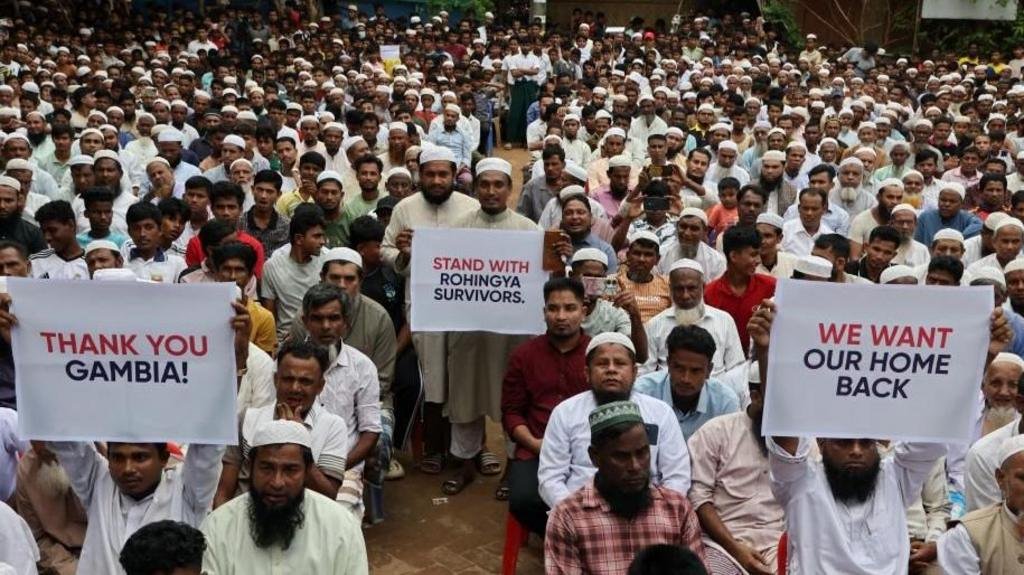
Al Jazeera provided the perspective of the Rohingya community in Bangladesh — where approximately 700,000 Rohingya remain in the refugee camps of Cox Bazar, the largest refugee settlement in the world — on the ICJ ruling. For the Rohingya community, which has been waiting for seven years for international legal recognition of what was done to them, the ICJ ruling represents an affirmation of their experience and an acknowledgment that the 2017 campaign was not, as the Myanmar military claimed, a counterterrorism operation, but a genocide. Al Jazeera noted that community leaders expressed cautious hope about the ruling while emphasizing that the legal recognition is not yet matched by the practical accountability — the return of Rohingya to Myanmar under conditions of safety and dignity — that the community continues to seek.
“The world said never again after the Holocaust. The world said never again after Rwanda. The court has now said what happened to us is genocide. Now we need the world to act.” — Rohingya community leader cited by Al Jazeera
The Enforcement Question
The New York Times and BBC analyzed the enforcement question that makes the ICJ ruling significant in legal terms but uncertain in practical terms. The ICJ has jurisdiction but lacks enforcement power: it cannot compel Myanmar to comply with its judgments, it cannot arrest perpetrators, and it cannot impose sanctions. Enforcement of ICJ rulings depends on the UN Security Council, which can take enforcement action under Chapter VII of the UN Charter — but which includes China and Russia as permanent members who have historically protected Myanmar from UN Security Council action on the Rohingya issue. The practical enforcement of the ICJ ruling will therefore depend on the willingness of individual states and regional organizations to impose their own bilateral sanctions, to restrict arms sales and military cooperation with Myanmar, and to support the ongoing ICC investigation of Myanmar military officials that is proceeding on a separate legal track.
WHAT HAPPENS NEXT
► UN Security Council debate to be convened; whether China and Russia allow any resolution is the key question
► Western states to assess whether to extend or intensify sanctions on Myanmar military officials
► ICC investigation of individual perpetrators to be assessed in light of the ICJ genocide finding
► Rohingya community to pursue reparations claims using the ICJ ruling as legal foundation
| CONFIDENCE: HIGH | BBC, Al Jazeera, New York Times, and AP all confirmed the ICJ genocide ruling, the Rohingya victims context, and the rights group response. Four-source confirmation across UK, Qatari, American premium, and wire services on a landmark legal ruling. |
| Bias Check | ||
| Left-Lean | Center | Right-Lean |
| Ruling framed as indictment of international community inaction; genocide was preventable, and no one acted. | Reports ICJ ruling, legal content, rights group response, Rohingya community perspective, and enforcement question factually. | Ruling framed as legal accountability achieved; the international legal system worked as designed to document the atrocity. |
SOURCES
► BBC — ICJ ruling confirmation, legal content analysis, rights group response, enforcement question, November 20, 2026
► Al Jazeera — Rohingya community perspective, Bangladesh refugee context, genocide definition significance
► The New York Times — Rights groups’ demands, ICC investigation connection, enforcement mechanism analysis
► Associated Press — Ruling confirmation, 2017 campaign documentation, sanctions calls