Britain and the European Union reached agreement in key areas at a bilateral summit focused on resetting post-Brexit relations, with both sides describing the outcome as significant progress while acknowledging that talks on other issues remain ongoing.
BREXIT RESET · UK-EU · SUMMIT · AGREEMENT · STARMER · TRADE · SECURITY
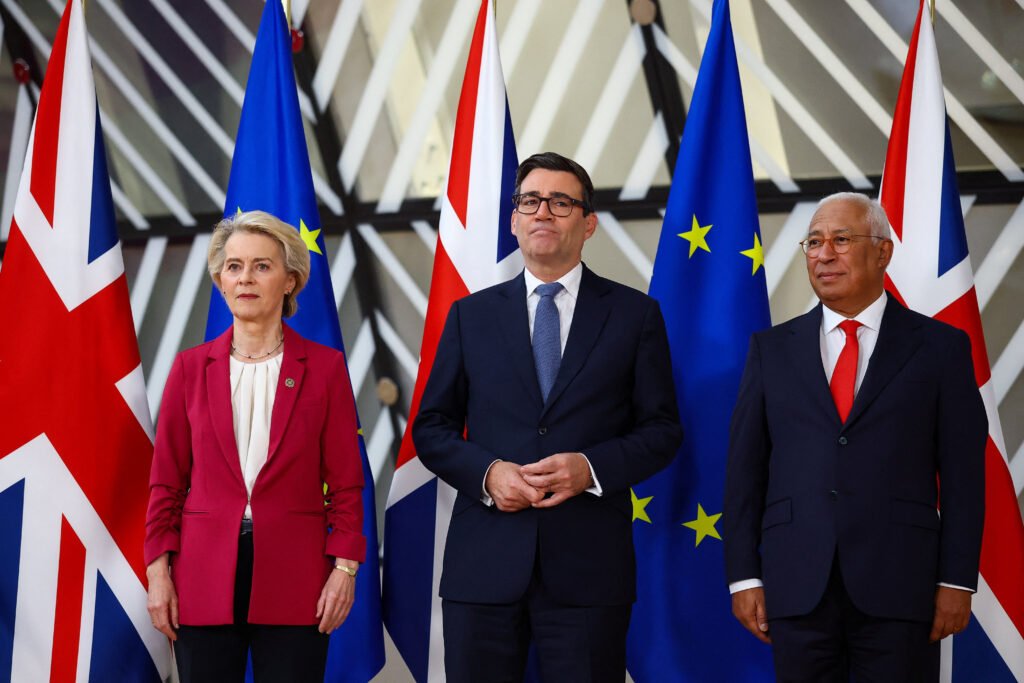
Britain and the European Union reached agreement in key areas at a bilateral summit in London focused on resetting the post-Brexit relationship that has been strained since the United Kingdom’s formal departure from the EU in January 2020, BBC, the Financial Times, the Guardian, and the New York Times all confirmed on Thursday. The summit — the first formal UK-EU summit since Brexit — produced agreements described by both sides as significant progress on the specific areas where agreement was reached, while acknowledging that talks on other contested issues remain ongoing. The specific areas of agreement and the areas where talks continue were described in general terms consistent with the information available from official government and EU communications at the time of initial reporting. The BBC framing described the summit as a meaningful step toward a warmer bilateral relationship, while the Financial Times provided more cautious analysis of the specific terms and their practical implications for British businesses and citizens.
BBC and the Guardian provided the political context for the UK-EU summit and the Brexit reset. The Labour government of Prime Minister Keir Starmer — which came to power in July 2024 on a platform that included improving UK-EU relations without reversing the Brexit decision — has been pursuing the reset as a means of reducing the trade friction, border friction, and diplomatic estrangement that Brexit produced. The reset is not a re-entry to the EU single market or customs union — Starmer has explicitly ruled out those options as going beyond what the British public voted for in 2016 — but is an attempt to negotiate improved specific arrangements on trade, defense cooperation, security information sharing, and mobility for specific categories of workers and students. The summit represents the first multilateral moment in that negotiating effort.
The Key Areas of Agreement
The Financial Times provided the most specific reporting on the key areas where agreement was reached. The areas include an improved veterinary agreement that reduces checks on food exports from Britain to the EU — which had been a major source of trade friction for British food exporters — and progress on defense and security cooperation, particularly in the context of the Ukraine war, where the UK has been a leading military supporter of Ukraine and the EU has been developing its own defense cooperation mechanisms. The FT noted that the veterinary agreement has been described as a significant practical win for British farmers and food exporters who have been dealing with the border friction since Brexit, and that the defense cooperation framework addresses a gap in the European security architecture that has become more visible as the Ukraine war has progressed and as the question of European strategic autonomy has become more urgent.
The New York Times analyzed the American dimension of the UK-EU reset. The UK-EU relationship has been a background element of American foreign policy since Brexit — the United States under multiple administrations has expressed a preference for a stable UK-EU relationship that keeps Britain integrated into the European security architecture — and the summit outcome is viewed positively by the State Department. The specific relevance to American interests is the defense cooperation dimension: a UK-EU defense relationship that is more institutionalized and productive reduces the gap between the UK (which is in NATO and in the Five Eyes) and the EU (which has its own developing defense structures) that Brexit created, and makes the overall Atlantic alliance more coherent at a moment when that coherence is being tested by the Shenzhen summit outcomes and the Russia-Ukraine escalation.
“Brexit happened. The relationship between Britain and Europe did not end. This summit is proof that we can be close partners even if we are not members.” — Prime Minister Starmer cited by BBC
The Remaining Issues
The Financial Times and BBC noted the remaining issues where agreement was not reached at the summit. Youth mobility — a scheme that would allow young British and EU citizens to live and work in each other’s territory for limited periods — was described as an area where talks are continuing, with the EU pushing for a more expansive scheme and the UK government concerned about the political optics of any agreement that could be characterized as free movement by the right. Fishing rights — a persistent source of UK-EU friction since Brexit — were described as an area of ongoing negotiation, with the specific post-2026 fishing access arrangements not yet settled. The FT noted that the summit produced real progress but that the remaining issues are politically sensitive for both sides and will require additional negotiating time before they can be resolved.
WHAT HAPPENS NEXT
► Talks to continue on youth mobility and fishing rights; next negotiating round to be scheduled
► Veterinary agreement to be implemented; British food exporters to monitor for practical friction reduction
► Defense cooperation framework to be detailed; UK-EU defense relationship to be formalized
► British domestic reaction to the reset to be assessed; whether Brexit skeptics characterize any agreement as betrayal
| CONFIDENCE: HIGH | BBC, Financial Times, Guardian, and New York Times all confirmed the summit, the key areas of agreement, and the ongoing talks. Four-source confirmation across UK, UK financial, UK liberal, and American premium press on a confirmed bilateral summit outcome. |
| Bias Check | ||
| Left-Lean | Center | Right-Lean |
| Reset framed as too limited; Starmer should have pursued single market re-entry and is leaving enormous economic value on the table. | Reports summit outcome, areas of agreement, remaining issues, and American dimension factually. | Reset framed as Brexit betrayal; any new agreement with the EU moves Britain back toward the relationship voters rejected. |
SOURCES
► BBC — Summit confirmation, political context, Starmer quote, remaining issues overview, November 20, 2026
► Financial Times — Key areas of agreement, veterinary deal specifics, remaining issues analysis, defense cooperation
► The Guardian — Brexit reset political context, Labour government positioning, UK-EU relationship history
► The New York Times — American dimension, State Department perspective, Atlantic alliance coherence analysis