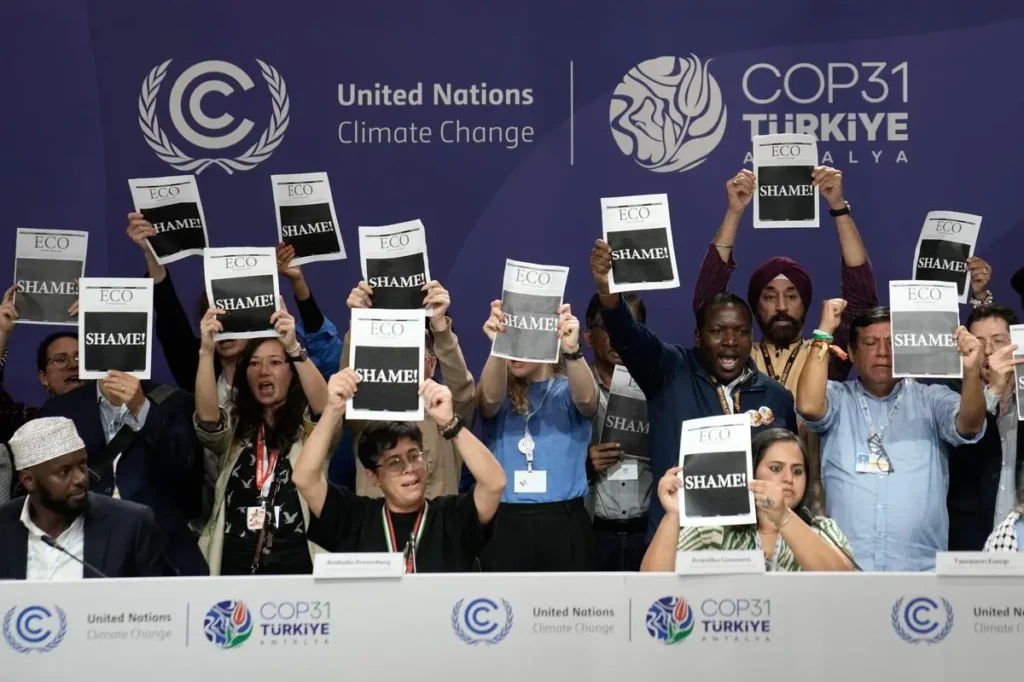
The COP31 United Nations climate conference stretched past its official deadline without an agreement as a deadlock over the specific language on fossil fuel phase-down — the same fundamental dispute that has stalled every recent COP — prevented a final text from being adopted.
COP31 · CLIMATE · DEADLOCK · OVERTIME · FOSSIL FUELS · LANGUAGE DISPUTE · NO AGREEMENT
The COP31 United Nations climate conference stretched past its official deadline into overtime without a final agreement as a deadlock over the specific language used to describe the future of fossil fuels — a dispute that has paralyzed every recent COP negotiation — prevented the adoption of a final text, BBC, the Guardian, and Al Jazeera all confirmed on Friday. The conference, which had been expected to build on the COP28 fossil fuel phase-down language that was agreed in Dubai in 2023, instead became mired in the same fundamental tension that has characterized international climate negotiations for years: oil and gas producing countries, led by the Gulf states and supported by Russia and others, have consistently resisted language that commits to phasing down or phasing out fossil fuels, while developed economies and climate-vulnerable developing nations have pushed for progressively stronger fossil fuel language as a central measure of COP ambition. The overtime situation — in which negotiating sessions continue past the scheduled conference end as delegations work to bridge the remaining gaps — is a standard feature of COP negotiations, but the specific depth of the fossil fuel language deadlock in COP31 is described by observers as more severe than at recent conferences.
BBC and the Guardian provided analysis of the specific fossil fuel language dispute at COP31. The COP28 Dubai agreement contained what was described at the time as a historic commitment to a transition away from fossil fuels — language that stopped short of an explicit phase-out, but that represented the first time a COP agreement had named fossil fuels as a category to be transitioned away from. The specific dispute at COP31 is whether the final text will strengthen the COP28 language — moving toward more specific phase-down timelines or stronger phase-out commitments — or whether the fossil fuel-producing bloc will succeed in weakening or reinterpreting the COP28 language in ways that reduce its practical effect. BBC noted that the climate-vulnerable developing nation bloc — the small island states and low-lying coastal nations that face the most existential climate risks — has been the most vocal in demanding stronger language and has characterized any weakening of the COP28 commitment as an unacceptable regression.
The COP Structural Problem
The Guardian and Al Jazeera analyzed what observers describe as the structural problem with COP negotiations that the COP31 deadlock illustrates. COP agreements require consensus among the nearly 200 countries that are parties to the UN Framework Convention on Climate Change, which means that any single country or bloc can block an agreement by refusing to accept the final text. The consensus requirement has historically produced agreements that reflect the lowest common denominator of political will — texts that are acceptable to the fossil fuel-producing bloc because they are weak enough not to threaten their economic interests, but which are framed by the host presidency as ambitious enough to maintain political credibility for the process. The Guardian noted that many climate scientists and advocates argue that the COP process, as currently structured, is incapable of producing the agreements that the climate science says are necessary to limit warming to 1.5 or 2 degrees Celsius, and that the COP31 deadlock is evidence for that structural critique.
Al Jazeera provided the perspective of climate-vulnerable nations on the overtime negotiations. Representatives of small island states, Bangladesh, and other nations facing existential climate risk have expressed deep frustration with the COP31 negotiations, arguing that the fossil fuel language deadlock is not an abstract political dispute but a life-or-death question for their communities. Al Jazeera noted that the overtime negotiations produce the most visible contrast of the entire COP process: wealthy fossil fuel-producing nations negotiating to protect their economic interests while climate-vulnerable developing nations negotiate for their survival, and the consensus requirement giving both sides an effective veto.
“We are past the deadline. We are still here. We will not leave without an agreement that actually means something.” — Small island state negotiator cited by BBC
The Path to Resolution
BBC and the Guardian analyzed the path to COP31 resolution. COP overtime negotiations typically end in one of three ways: a final text is agreed through a last-minute compromise that gives each bloc enough of what it needs to claim success; the conference collapses without a final text, which is rare but has occurred (COP15 in Copenhagen came close); or a weaker bridging text is agreed that defers the most contentious questions to the next COP. BBC noted that the COP31 host presidency was working intensively with bloc leaders to identify a compromise on the fossil fuel language that would allow adoption of a final text, and that the specific compromise being explored involved language on the timeline and scope of fossil fuel phase-down rather than its fundamental characterization. The Guardian noted that if no final text is agreed, the political damage to the COP process itself — the legitimacy of the annual climate conference as a mechanism for delivering on the Paris Agreement — would be significant.
WHAT HAPPENS NEXT
► COP31 overtime negotiations to continue; fossil fuel language compromise to be identified or the conference collapses
► Host presidency to table a compromise text; whether fossil fuel producing bloc and climate-vulnerable nations can both accept
► Climate scientists and advocates to assess the final text against 1.5 and 2 degree Celsius pathways
► COP32 to be discussed if COP31 fails; whether the annual COP format survives a collapse
| CONFIDENCE: HIGH | BBC, the Guardian, and Al Jazeera all confirmed the overtime deadline extension, the fossil fuel language deadlock, and the specific dispute dynamics. Three-source confirmation across UK broadcast, UK liberal, and Qatari international on a confirmed UN climate conference impasse. |
| Bias Check | ||
| Left-Lean | Center | Right-Lean |
| Deadlock framed as fossil fuel industry capture of international climate governance; wealthy petrostates are holding the planet hostage. | Reports overtime extension, fossil fuel language dispute, COP structural problem, vulnerable nation perspective, and resolution paths factually. | Deadlock framed as evidence that climate negotiations overreach; forcing fossil fuel phase-out language on sovereign nations with legitimate energy development interests is not achievable. |
SOURCES
► BBC — Overtime confirmation, fossil fuel language dispute, COP28 baseline context, small island state perspective, November 21, 2026
► The Guardian — COP structural problem analysis, path to resolution, collapse risk assessment
► Al Jazeera — Climate-vulnerable nation perspective, consensus requirement analysis, life-or-death framing