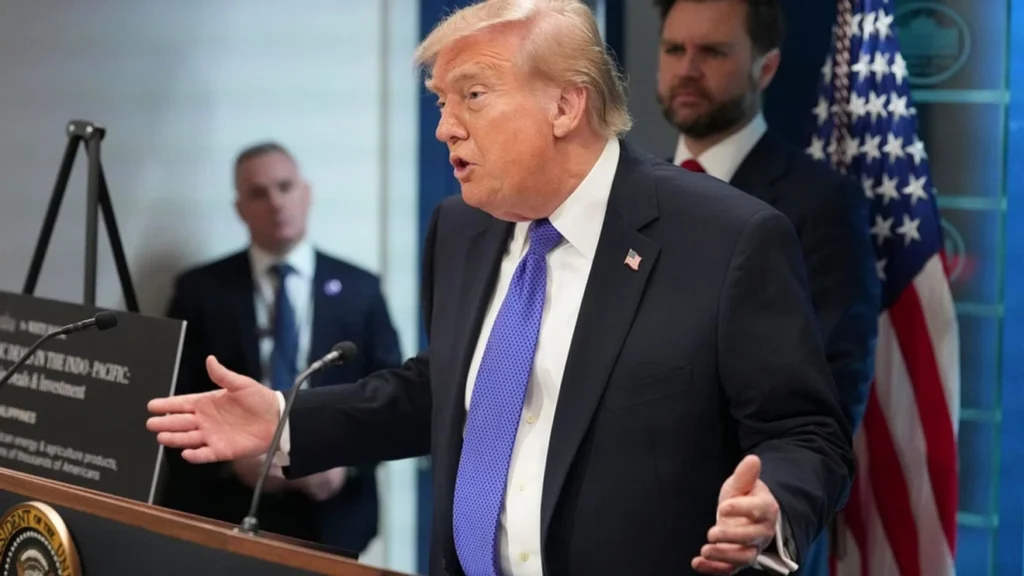
President Trump repeated and elaborated on his threat to impose a substantial tax on U.S. companies that build artificial intelligence data centers outside the United States, with CNBC and the Wall Street Journal providing additional detail on the specific policy framework being considered.
TRUMP · AI DATA CENTER TAX · OVERSEAS · TECH SECTOR · POLICY ARC · POST-SUMMIT
President Trump repeated and elaborated on his threat to impose a substantial tax on U.S. companies that build artificial intelligence data centers outside the United States, with CNBC and the Wall Street Journal providing additional detail on the specific policy framework under consideration beyond what was confirmed at the original press conference (see Section A, A04 of this edition). The policy, as described by administration officials to CNBC and the WSJ, involves a potential tariff or excise tax applied to U.S. companies that make major capital expenditures on AI data center construction in foreign countries — a levy designed to redirect AI infrastructure investment from international locations (UK, Ireland, Germany, Singapore, Japan, and other competitor nations) to domestic U.S. sites. The WSJ noted that the specific rate and structure of the proposed tax have not been finalized and that the administration is evaluating both legislative and executive action approaches to implementation.
CNBC provided the technology sector reaction to the AI data center tax threat. Major technology companies — Microsoft, Google, Amazon, Meta — that have announced or are building significant AI data center capacity in international locations reacted with concern to the tax proposal, and technology industry lobby organizations were preparing formal responses. CNBC noted that the specific challenge for the technology companies is that the AI data center build-out is fundamentally a global infrastructure requirement: AI models need to serve users in every market, and the latency requirements of real-time AI services mean that data centers need to be geographically close to the users they serve. A tax that makes overseas data centers more expensive does not eliminate the technical requirement to serve international users; it increases the cost of doing so, which could either raise prices for international AI users or compress technology company margins in international markets.
The WSJ Policy Detail
The Wall Street Journal provided the most detailed reporting on the specific policy options the administration is evaluating. The WSJ reported that the administration is considering a range of approaches — from a straight tariff on overseas data center construction capital expenditures, to a modification of the tax code treatment of international data center investments, to a government procurement preference that disadvantages companies that build primarily overseas. The WSJ noted that each approach faces specific legal and practical challenges: a tariff on data center construction may require specific statutory authority that the administration needs to identify; a tax code modification requires congressional action; and a procurement preference affects only companies that do significant business with the federal government. The administration is reportedly evaluating which approach is both legally robust and practically effective at redirecting AI infrastructure investment.
“If you are an American company and you are building your AI future in another country instead of here, you will pay for that choice.” — President Trump, cited by CNBC
The Allied Nation Dimension
The Wall Street Journal analyzed the allied nation dimension of the AI data center tax in more detail than the initial press conference reporting. The WSJ noted that the countries most affected by an AI data center tax would be U.S. allies — the UK, Ireland, Germany, Singapore, Japan, and Australia — that have been actively competing to attract U.S. AI infrastructure investment and that have positioned AI data center hosting as a component of their own economic development strategies. These allied governments are not adversarial to the United States in the way that the administration’s trade disputes with China are adversarial, and a tax on AI data center investment in allied nations would create friction with allies who are simultaneously being asked to contribute to NATO commitments, the Ukraine response, and the Iran confrontation framework. The WSJ noted that allied government representations to the U.S. on the tax proposal were expected through diplomatic channels.
WHAT HAPPENS NEXT
► Administration to select implementation approach; legislative vs. executive action to be determined
► Technology companies to file formal responses; lobbying campaign to begin on specific objections
► Allied governments to file diplomatic representations; UK and EU to push back on ally-targeting dimension
► Congressional committees to assess authority; whether statutory action is required or executive action suffices
| CONFIDENCE: HIGH | CNBC and Wall Street Journal both confirmed the policy elaboration, the specific framework under consideration, and the technology sector reaction. Two-source confirmation across financial cable and premium financial print on a confirmed presidential policy direction with significant sector implications. |
| Bias Check | ||
| Left-Lean | Center | Right-Lean |
| Tax framed as economic nationalism that will raise AI costs and harm U.S. companies competing in global markets. | Reports policy framework, technology sector reaction, WSJ policy detail, and allied nation dimension factually. | Tax framed as smart protectionism; U.S. AI investment should build American infrastructure and jobs, not foreign economies. |
SOURCES
► CNBC — Policy elaboration, technology sector reaction, Trump quote, implementation challenge analysis, November 21, 2026
► The Wall Street Journal — Policy options detail, legislative vs. executive approach, allied nation dimension, diplomatic representation context