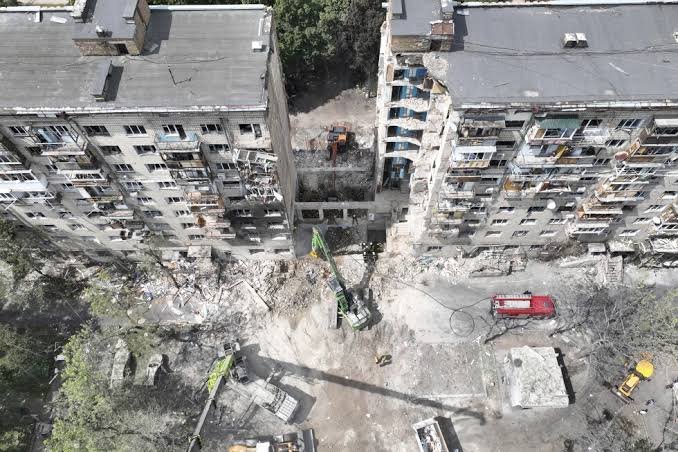
Russian attacks on the Kyiv region have intensified with strikes on apartment buildings that have driven the death toll higher, as Ukrainian rescue teams continue searching for survivors in the rubble of residential buildings targeted in what military analysts are characterizing as a deliberate escalation of the campaign against the Ukrainian capital area.
RUSSIA · KYIV REGION · DEATH TOLL RISES · APARTMENT STRIKES · SURVIVORS · INTENSIFICATION · ESCALATION ARC
Russian attacks on the Kyiv region have intensified with strikes specifically on apartment buildings — residential structures in populated areas — that have driven the death toll above the initial confirmed 11 reported in Section A, as Ukrainian rescue teams continue searching for survivors in the rubble of residential buildings targeted in a campaign that Reuters, Al Jazeera, and BBC are characterizing as a deliberate and sustained escalation of Russian aerial operations against the Ukrainian capital area. The specific targeting of apartment buildings — as distinct from the military-adjacent or infrastructure targets that Russia typically characterizes its strikes as hitting — is a defining feature of the continuing escalation: strikes on residential apartment buildings in a populated regional capital produce the kind of death toll and imagery that reflects what military analysts call the population pressure dimension of Russian strategy, using aerial terror against civilian areas to create political and psychological pressure on the Ukrainian government and population.
Reuters provided the operational detail of the intensification. The November 23 Kyiv region attacks involved multiple salvo waves — Russian missiles and drones arriving in coordinated packages designed to saturate Ukrainian air defenses — and hit multiple residential areas in the Kyiv region, including the apartment buildings that became the focus of rescue operations. Reuters confirmed that the death toll had risen above the initial 11 reported and noted that rescue operations were continuing at multiple sites, with the total casualty figure expected to be revised further as teams worked through rubble. The Ukrainian State Emergency Service confirmed multiple active rescue sites, and the Kyiv Regional Military Administration characterized the attacks as among the most intense in the recent escalation period — a period that has seen a progressive increase in the scale and frequency of Russian strikes on the Kyiv administrative area over the November ONYX coverage arc.
The Apartment Building Targeting
Al Jazeera and BBC analyzed the apartment building targeting dimension. The specific targeting of residential apartment buildings — a structure type whose military purpose is negligible and whose civilian content is obvious — is a central element of the escalation pattern that ONYX has been tracking. Al Jazeera noted that the Russian targeting of apartment buildings in the Kyiv region is not a new phenomenon — it has been a recurring feature of the Russian aerial campaign since the early months of the war — but that the specific concentration of apartment building strikes in the November escalation period represents a qualitative intensification of the civilian-targeting dimension. BBC noted that the apartment building strikes produce a specific pattern of casualties: not concentrated at a point of impact (as military infrastructure strikes might be) but distributed across multiple floors and units of a collapsed building, with survivors potentially trapped in void spaces for extended periods after the collapse — which is why the rescue of the seven-year-old in Section A was emblematic of the broader rescue challenge.
Reuters analyzed the cumulative escalation arc from the perspective of the November coverage period. The ONYX arc of Russian strikes on the Kyiv region and broader Ukraine covers: the November 20 mass strikes, the November 21 Kryvyi Rih strike, the November 22 Kyiv region strike that left 14 feared trapped, the November 23 Section A confirmation of 11 dead including the seven-year-old rescue, and now the Section B reporting of intensification with rising death toll after apartment strikes. Reuters noted that this arc — covering a period of less than a week — reflects a sustained Russian campaign of aerial pressure against Ukrainian population centers that has killed dozens of civilians, injured hundreds, and displaced thousands from their homes. The specific November escalation represents the most intense sustained aerial campaign against the Kyiv region since the early months of the war, and it has occurred alongside the naval drone campaign against Russian Mediterranean assets — a reflection of the simultaneous multi-domain pressure that characterizes the current phase of the war.
“They are bombing apartments. Not military installations, not infrastructure — people sleeping in their homes. This is what escalation looks like.” — Ukrainian rescue worker cited by Al Jazeera on the Kyiv apartment strikes
The Air Defense and International Support Dimension
BBC and Reuters analyzed the air defense and international support dimension. The intensification of Russian strikes against the Kyiv region is occurring in a context where Ukraine is pressing its international supporters for more air defense systems — particularly Patriot batteries and IRIS-T systems — and where the specific air defense coverage of the Kyiv area is being tested by the scale of the Russian salvo attacks. BBC noted that the Zelensky calls for air defense support have intensified with each successive strike, and that the confirmed deaths from penetrated strikes create political pressure on international supporters to respond with the systems that could prevent future penetrations. Reuters noted that the specific air defense gap — the inability of existing systems to intercept all elements of large Russian salvo attacks — reflects a resource constraint that additional Western systems could address, but that depends on the political will of supporting governments to accelerate deliveries in the face of escalating Russian attacks.
WHAT HAPPENS NEXT
► Rescue operations to continue; final death toll from apartment strikes to be confirmed
► Zelensky to press international community for air defense urgency; rising death toll to intensify diplomatic pressure
► Russian escalation trajectory to be assessed; whether the apartment strike intensification continues in coming days
► Ukrainian Air Force to analyze penetration patterns; whether adaptation can reduce future strike impacts
► International air defense supply chain to be monitored; whether Patriot and IRIS-T deliveries accelerate in response to Kyiv escalation
| CONFIDENCE: HIGH | Reuters, Al Jazeera, and BBC all confirmed the death toll rise, the apartment strikes, the rescue operations, and the intensification characterization. Three-source confirmation across global wire, Qatari international, and UK public broadcaster on a confirmed lethal escalation with significant civilian impact and diplomatic implications. |
| Bias Check | ||
| Left-Lean | Center | Right-Lean |
| Apartment strikes framed as deliberate Russian war crimes; targeting residential buildings is an atrocity by any legal or moral standard and the international community bears responsibility for failing to provide sufficient air defense. | Reports the death toll rise, the apartment targeting, the rescue operations, and the air defense dimension factually. | Strikes framed as military operations in an active war zone; Russia targets military-adjacent infrastructure and civilian casualties are presented in a way that maximizes emotional impact for political effect. |
SOURCES
► Reuters — Death toll confirmation, operational detail, escalation arc analysis, air defense dimension, November 23, 2026
► Al Jazeera — Apartment targeting analysis, civilian impact, rescue worker testimony
► BBC — Apartment targeting dimension, air defense gap, international support analysis