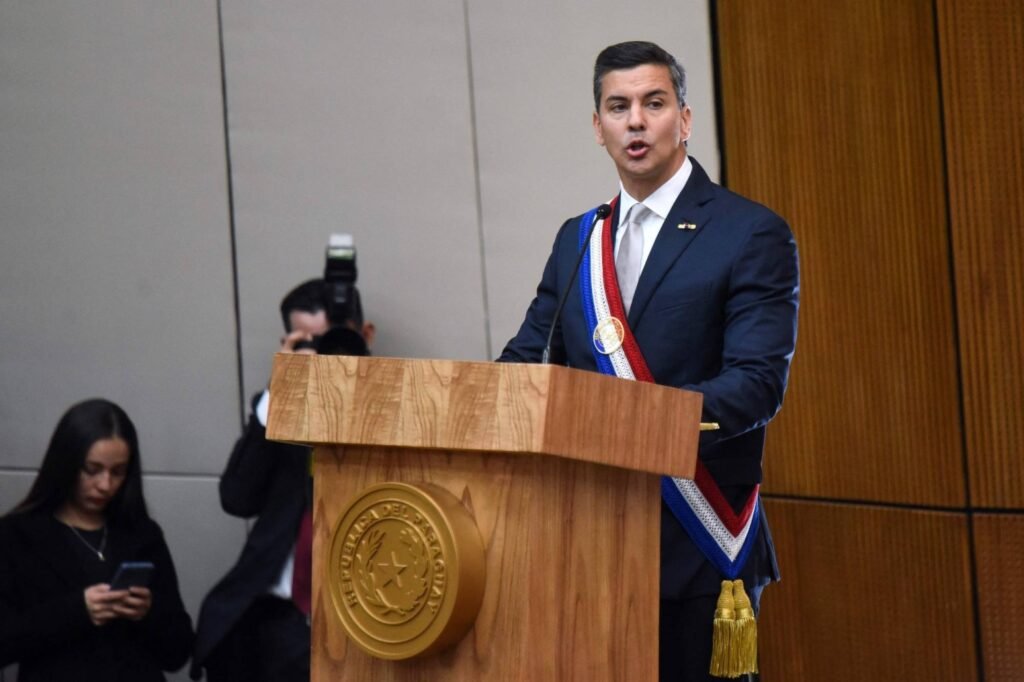
The Ueno crisis left millions unable to access their accounts; the president was impeached by the Chamber of Deputies and placed under house arrest pending a Senate trial, in the most significant Latin American political crisis of the year.
PARAGUAY · IMPEACHMENT · FINANCIAL CRISIS · LATIN AMERICA
The Paraguayan Chamber of Deputies impeached President Santiago Peña and ordered him placed under house arrest pending trial in the Senate, BBC, The Guardian, CBS News, and Al Jazeera reported on Saturday. The impeachment was triggered by the collapse of Banco Ueno, one of the largest financial institutions in Paraguay, which left millions of Paraguayan citizens unable to access their bank accounts in what the opposition and protest movements characterized as a catastrophic regulatory failure that the president could have prevented with timely intervention.
The Ueno bank collapse, which preceded the impeachment by several weeks, represented a systemic financial shock to the Paraguayan economy of a scale not seen in the country since the financial crises of the 1990s. BBC reported that Banco Ueno served approximately three million customers — roughly one third of the total Paraguayan population — and that the collapse of deposit access created immediate hardship for households across income levels, triggering the mass protest movement that generated the political pressure for the impeachment proceedings.
The Mechanics of the Impeachment
The Paraguayan constitution provides for presidential impeachment by a two-thirds vote of the Chamber of Deputies on grounds of poor performance, crimes, or violations of the constitution. CBS News reported that the Chamber voted 60-20 in favor of impeachment, well above the required two-thirds threshold, with members of the president’s own Colorado Party joining the opposition in sufficient numbers to produce the supermajority result. The Guardian noted that the speed of the Chamber vote — from the formal impeachment motion to the final vote took less than 48 hours and reflected the intensity of political pressure created by the bank crisis.
President Pena, placed under house arrest by order of the Supreme Court following the Chamber vote, retains the title of president while the Senate trial proceeds. Under Paraguayan constitutional procedure, a two-thirds Senate vote is required to remove him from office permanently; the vice president assumed acting executive authority during the house arrest period. Al Jazeera reported that the Senate trial was expected to begin within 15 days under constitutional timelines, with international observers from the OAS and UN expressing concern about the speed of the proceedings and the adequacy of due process protections.
“Millions of people cannot access their savings. Their money is gone. The president had the power to prevent this and did nothing.” — Opposition leader, Chamber of Deputies debate, as reported by BBC
The Regional Dimension
The Paraguayan political crisis arrives at a moment of significant turbulence across Latin America. The Pope Leo Latin America tour, documented on November 6, is proceeding through the region simultaneously. The Newsom death row commutation documented in the same edition has drawn attention to the death penalty divergence between the US and Latin American democracies. Paraguay impeachment adds a democratic accountability dimension to the regional picture, with both international support for the constitutional process and concern about its management.
WHAT HAPPENS NEXT
► Paraguayan Senate to begin formal impeachment trial within 15 days per constitutional timeline
► Acting president to manage Ueno bank resolution process and depositor compensation framework
► OAS and UN observers to monitor Senate trial for due process and constitutional compliance
► International Monetary Fund to assess Paraguay’s financial sector stability and potential assistance needs
| CONFIDENCE: HIGH | BBC, The Guardian, CBS News, and Al Jazeera all independently confirmed the impeachment and house arrest. Four-source convergence on a confirmed constitutional event. BBC has strong Latin America coverage; Al Jazeera provides strong developing-world institutional context. |
| Bias Check | ||
| Left-Lean | Center | Right-Lean |
| Impeachment framed as righteous accountability for neoliberal financial deregulation causing suffering. | Reports impeachment, bank collapse, and constitutional process factually; contextualizes scale of crisis. | Concern about impeachment speed and due process; focus on economic rather than political accountability. |
SOURCES
► BBC — Paraguay president impeached after Ueno bank collapse, house arrest ordered, November 7, 2026
► The Guardian — Paraguay impeachment, Chamber vote mechanics, constitutional process
► CBS News — President Pena impeached, 60-20 vote, acting president assumes authority
► Al Jazeera — Paraguay financial crisis and impeachment, international observer concerns