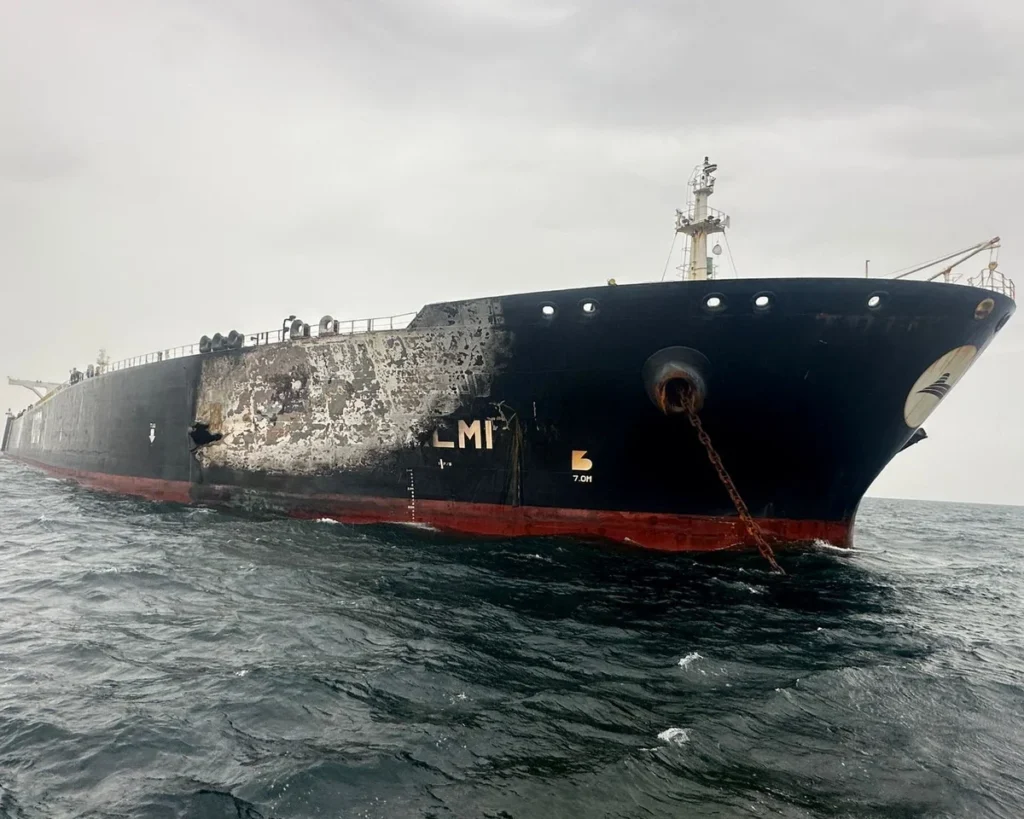
A projectile struck an oil tanker near the Strait of Hormuz as the vessel was exiting the waterway. The incident is part of a sustained pattern of maritime attacks in the Gulf that has accompanied the broader Iran-US-Houthi conflict escalation. No definitive attribution was available at filing time.
🌊 STRAIT OF HORMUZ · OCTOBER 13, 2026 · TANKER STRUCK
An oil tanker was hit by a projectile near the Strait of Hormuz as it exited the strait. Democracy Now and maritime reports confirmed the incident. The vessel, its flag state, cargo, and crew status were not fully detailed in available reporting at filing time. The Strait of Hormuz is the chokepoint through which approximately twenty percent of all globally traded oil passes. Incidents in or near that strait carry immediate implications for energy markets, for the insurance and routing decisions of commercial shipping, and for the operational picture of the US Navy and allied forces conducting presence operations in the Gulf.
The incident is the latest in a sustained pattern. The Gulf maritime threat environment has been elevated for months, accelerating sharply after the Iran-US direct military confrontation that produced the Pentagon casualty figures confirmed on October 12: 21 Americans dead, 865 wounded. Iranian proxies and Iran-aligned forces have used naval mines, kamikaze drone boats, anti-ship missiles, and projectiles of various types to attack commercial and military shipping in the Gulf. The Hormuz attack pattern has served multiple functions: creating economic pressure through insurance premium increases, deterring shipping that might otherwise transit freely, and demonstrating that Iran and its proxies can reach any vessel in the Gulf.
THE CHOKEPOINT CALCULUS
Twenty percent of globally traded oil transits Hormuz. Any sustained disruption to tanker traffic through the strait — whether through direct attacks, insurance exclusions, or routing avoidance — would produce oil price effects that propagate through every oil-dependent economy. The United States has maintained a naval presence in the Gulf partly to guarantee Hormuz transit. The fact that a tanker was struck as it exited the strait means the attack occurred in the zone where the US naval presence is most concentrated. Whether that reflects a bold challenge to US deterrence, a gap in coverage, or a lucky shot from a limited actor is part of the attribution question that maritime security analysts will examine.
The insurance dimension is already in play. Lloyd of London and related marine insurance markets have been adding Gulf of Oman and Hormuz risk premiums to tanker policies for months. An attack on a vessel exiting Hormuz will extend or increase those premiums. Higher insurance costs mean higher shipping costs, which mean higher delivered oil prices, which eventually affect the end consumer price of energy. The maritime security situation is not abstract; it connects to the price at the gas pump.
ATTRIBUTION AND THE PATTERN
No attribution was confirmed at filing time. The range of actors with both the motive and the capability to strike a tanker near Hormuz includes: Iran Revolutionary Guard Corps naval units, Houthi forces operating with extended-range naval weapons, and other Iran-aligned proxies with maritime capabilities. The pattern of prior attacks suggests Iranian ecosystem involvement in most incidents, but individual strikes have not always been definitively attributed. The US and allied intelligence communities will complete a damage and attribution assessment.
“A tanker was hit exiting Hormuz. Twenty percent of globally traded oil goes through that strait. The insurance rates are already up. The Navy is already there. And it still happened.”
WHAT HAPPENS NEXT
► Vessel status — damage assessment, crew condition, cargo status
► Attribution — US Navy and allied intelligence assessment of the strike source
► Insurance response — Lloyd of London and marine market adjustment to Gulf risk premiums
► Shipping routing — whether additional commercial operators reroute away from Hormuz
► US military response — whether the strike triggers any operational response
| CONFIDENCE: MODERATE | Democracy Now and maritime reports confirmed a projectile strike on an oil tanker near the Strait of Hormuz on exit transit. Vessel details and attribution not established at filing time. |
| BIAS CHECK | ASSESSMENT |
| Source weight | Democracy Now, maritime reports — lower-tier for this specific incident; key facts noted as unavailable |
| Attribution | Not attributed; range of capable actors described as analytical framing |
| Hormuz statistics | 20% globally traded oil cited as established maritime fact |
| Insurance framing | Premium increases characterized as ongoing established pattern, not projection |
SOURCES
► Democracy Now — Oil tanker struck near Strait of Hormuz exit, October 13, 2026
► Maritime reports — Gulf incident tracking, Hormuz transit attack, October 13, 2026