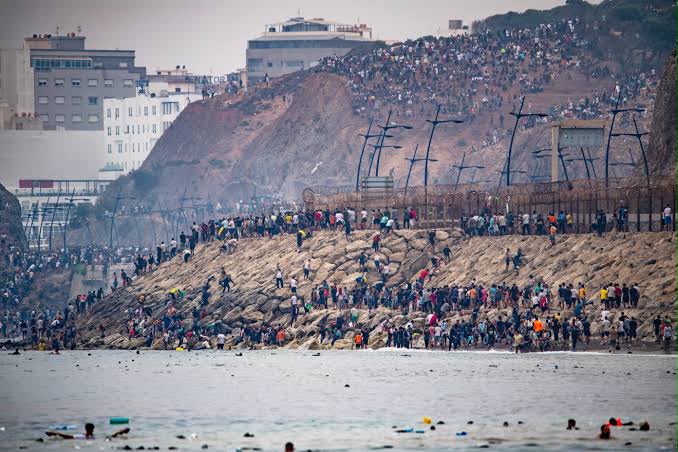
Following a serious border breach at Spain’s Ceuta enclave — the EU territory on Morocco’s northern coast where a crisis killed 67 people just days ago — EU member countries are actively downplaying the political divide over what happened and what should happen next. NPR reports the “smoothing over” effort obscures genuine, deep disagreement within the EU about migration enforcement, border security spending, and burden-sharing among member states.

THE EU DIVIDE THAT’S BEING HIDDEN
On the surface, EU countries express solidarity with Spain and general support for “effective” border management. Beneath the surface, the same debates that have paralyzed EU migration policy for 30 years remain unresolved.
| WHAT NORTHERN EU COUNTRIES WANT | WHAT SOUTHERN EU COUNTRIES WANT |
| Stronger external border enforcement by Spain and Italy | Financial and operational support from northern states for external border management |
| Return and deportation deals with Morocco and other origin countries | Legal pathways and processing capacity to handle asylum claims |
| Less burden-sharing for asylum seekers who reach EU territory | EU-wide responsibility sharing once people reach EU soil |
| National control over immigration decisions | Standardized EU-wide reception and processing standards |
Spain is caught between these two positions. It is the external border frontline state that is expected to prevent crossings, but it is also the state that experiences the humanitarian consequences of those crossings when they succeed and turn deadly.
THE POLITICAL SMOOTHING OPERATION
EU diplomatic language around migration crises is specifically designed to signal unity while obscuring disagreement. Phrases like “effective and humane border management,” “European solidarity,” and “addressing root causes” are formulations that every EU country can agree to publicly while holding entirely incompatible views about what those words actually mean in practice.
The “smoothing over” NPR identifies is not deception for its own sake — it reflects the genuine diplomatic calculation that public EU division over migration would strengthen far-right political movements that are explicitly campaigning on anti-EU migration platforms across the continent. The diplomatic unity is fragile, functional, and real in its political consequences even when it masks substantive disagreement.
WHAT HAPPENS NEXT
▸ EU emergency funding for Spanish border management is likely — this is the standard response to Ceuta crises
▸ Morocco will use its border enforcement leverage for its own diplomatic purposes — watch for EU-Morocco bilateral negotiations on aid or trade in exchange for tighter Moroccan border control
▸ Far-right parties across Europe will cite the breach in their fall campaign messaging
▸ The 67 death toll from last week will factor into humanitarian organizations’ demands for legal pathway expansion
| CONFIDENCE: HIGH | NPR reporting on EU response to Spain border breach is documented. EU migration policy divide is established from years of public debate. Ceuta 67-death context is from prior ONYX reporting (August 2). |
| ⚖️ BIAS CHECK — WHO IS SAYING WHAT | |
| Northern EU Countries | Publicly: solidarity. Privately: pressing Spain and Italy to prevent crossings from reaching EU territory |
| Southern EU Countries (Spain, Italy, Greece) | Publicly: EU solidarity needed. Privately: demanding financial and operational support in exchange for external border enforcement |
| EU Commission | Maintaining the unified facade; cannot afford to let the divide become fully public before upcoming EU budget negotiations |
| Far-Right EU Parties | Using the breach to argue the EU migration framework has fundamentally failed; not interested in the cooperative policy solutions |
| Humanitarian Organizations | Demanding legal pathways; rejecting the “stop crossings” framing as causing the deaths; pointing to the 67 dead |
SOURCES
▸ NPR — EU migration political divide response to Spain border breach, August 2026
▸ ONYX August 2 coverage — Ceuta 67 deaths context
▸ EU migration policy divide — established public record of 30+ years of negotiations