
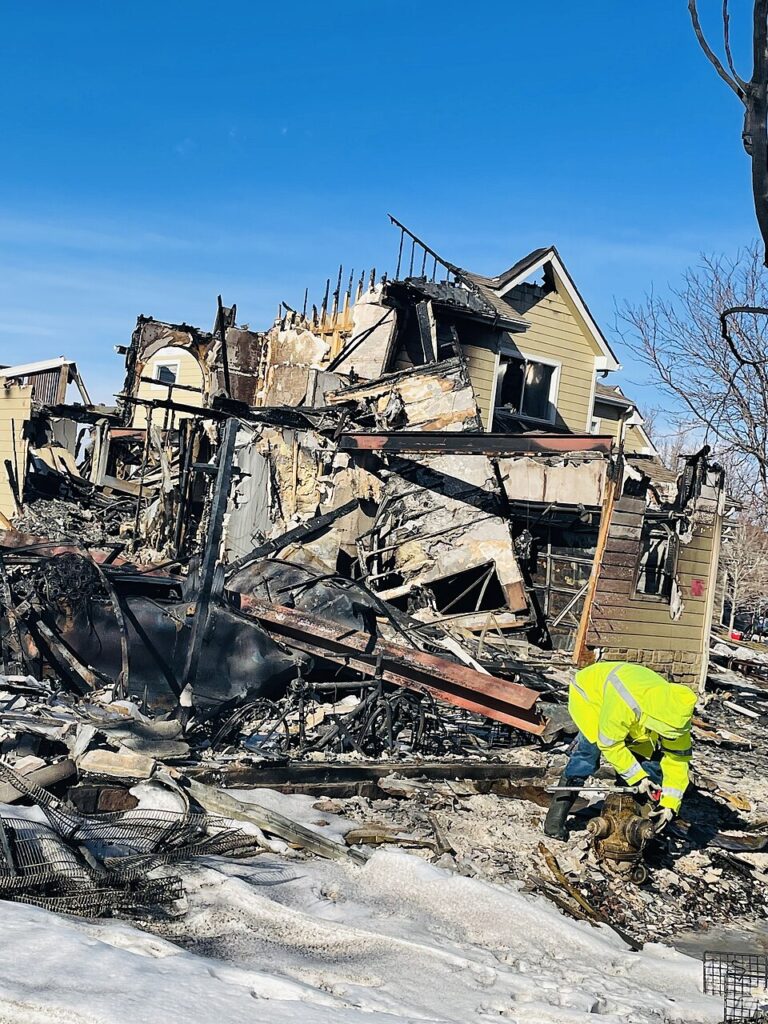
The Old Trails Fire ignited near Spokane, Washington Saturday and within hours had burned through 3,500 acres and destroyed an estimated 600 structures, triggering Level 3 “Leave NOW” evacuations across large portions of the city. The National Weather Service issued Washington State’s first-ever “particularly dangerous situation” (PDS) red flag warning. More than 40,000 customers lost power. The Washington National Guard mobilized overnight. Emergency Management Director Robert Ezelle issued a statement that stripped away any bureaucratic softening: “You’ve got fires burning in towns. You’ve got level 3 evacuations like I haven’t seen before.”
2-MINUTE CONTEXT — WHAT MAKES THIS FIRE HISTORIC
A “particularly dangerous situation” red flag warning is the National Weather Service’s highest-tier fire weather alert — reserved for conditions so extreme that any fire ignition is likely to become immediately uncontrollable and life-threatening. The NWS has issued PDS warnings in other western states — California, Oregon, Nevada — but this is the first time in recorded history that Washington State’s specific atmospheric and fuel conditions reached the threshold for this designation.
The conditions that produce a PDS designation typically include: sustained winds above 30–40 mph, relative humidity below 10–15%, temperatures significantly above seasonal norms, and critically dry vegetation with low dead fuel moisture content. The Pacific Northwest has historically had a shorter fire season than California due to higher average humidity — that characteristic is shifting as the region experiences longer, drier summer periods.
Spokane specifically sits in eastern Washington, which has a climate profile distinctly different from western Washington’s maritime climate. Eastern Washington is more semi-arid, with hotter summers and drier fuel conditions than Seattle or the coast. But even by eastern Washington standards, Saturday’s conditions were exceptional.
600 STRUCTURES IN HOURS — THE FIRE’S SPEED
Six hundred destroyed structures in a matter of hours is not a number that fire agencies use lightly. For context: the 2017 Tubbs Fire, which was at the time California’s most destructive fire ever, destroyed approximately 5,600 structures — but burned over two weeks. The Old Trails Fire destroyed roughly 600 structures in a single night. Speed is the critical variable.
Structure-to-structure fire spread — where one burning home ignites its neighbor without direct fire contact — accelerates wildfire destruction in suburban and urban-adjacent areas. This is the mechanism that made the 2018 Paradise, California Camp Fire so catastrophic (18,804 structures destroyed). The Old Trails Fire appears to have exhibited similar dynamics in Spokane’s residential areas.
“You’ve got fires burning in towns. You’ve got level 3 evacuations like I haven’t seen before… This is a very dangerous and very complex series of events.”
— Washington Emergency Management Director Robert Ezelle, August 2, 2026
Level 3 evacuation orders mean exactly one thing: you leave immediately, with nothing but what you can grab in minutes, because the fire is so close and moving so fast that any delay may make evacuation impossible. People who receive Level 3 orders and choose to stay are making a decision that fire authorities believe may cost them their lives.
WHY THIS MATTERS
The “first-ever” PDS designation for Washington is a data point that matters beyond Saturday night’s fire. It marks a threshold crossing — a point at which conditions in a state not historically associated with catastrophic fire weather have become severe enough to trigger the highest available alert category. This is how climate-driven wildfire expansion works: not as a linear progression, but as a series of threshold crossings, each one representing a new normal that previous planning frameworks did not account for.
For residents of Spokane and eastern Washington, the practical implications are immediate. Insurance availability in high-fire-risk areas is already tightening across the West — several major insurers have withdrawn from California and Oregon. Washington’s first PDS designation will be noted by actuaries and will likely accelerate that trend in eastern Washington.
For emergency management planners nationally, the Old Trails Fire will become a case study in suburban fire behavior under extreme weather conditions, joining Paradise and the 2021 Marshall Fire in Colorado as reference events that have redefined what “worst case scenario” looks like in western American communities.
| Acres burned 3,500+ within hours of ignition | Structures destroyed ~600 estimated by state fire officials |
| Customers without power 40,000+ as of Saturday night | Washington PDS warnings (all-time) 1 first-ever — August 2, 2026 |
POLITICAL IMPACT
▸ Washington Governor — immediate state emergency declaration expected; federal disaster declaration request to Trump administration
▸ Trump administration — must respond to a domestic natural disaster emergency in a Democratic governor’s state simultaneously with the Iran diplomatic situation
▸ Climate policy: the PDS first-ever designation will be cited by climate advocates and Democratic politicians as evidence of accelerating fire risk that demands federal response
▸ FEMA: already stretched by multiple concurrent disasters; Spokane will add to the load
▸ Insurance industry: actuarial threshold crossed — eastern Washington fire risk reclassification likely to follow
WHAT HAPPENS NEXT
▸ Damage assessment teams will provide final structure loss count — 600 is an estimate; the confirmed number may be higher or lower
▸ Cause of ignition will be investigated — powerline contact, vehicle, or human causes are all possible in this wind event
▸ Federal disaster declaration request from Washington governor will be tracked — Trump’s response time and approval will be noted
▸ Spokane residents under Level 3 orders will begin returning home when firefighters certify it is safe — for those whose homes no longer exist, this is the beginning of a long recovery process
▸ Insurance claims will overwhelm local adjusters — federal and state assistance programs will be the primary resource for uninsured and underinsured residents
| CONFIDENCE: HIGH | All figures — 3,500 acres, ~600 structures, 40,000 power outages, Level 3 evacuations, first-ever PDS — are from official Washington state emergency management and NWS sources. Ezelle quote is on the record. National Guard mobilization is confirmed. |
| ⚖️ BIAS CHECK — WHO IS SAYING WHAT | |
| Washington State Emergency Management | Official, urgent language; emphasizing unprecedented conditions without political framing |
| National Weather Service | Technical: first-ever PDS designation is a factual meteorological classification, not an editorial judgment |
| Democrats / Climate Advocates | Will connect the PDS first-ever designation to climate policy; linking to need for federal wildfire mitigation funding |
| Republicans | Likely to focus on state-level emergency management response; forest management and fuel reduction policy will be highlighted |
| Insurance Industry | Silent publicly but adjusting risk models internally; eastern Washington fire risk will be repriced |
| Spokane Local Media | Leading with human stories; evacuee accounts; community resource lists |
| National Media | Large coverage given combination of first-ever PDS + proximity to Iran crisis coverage weekend — some coverage displacement |
SOURCES
▸ Washington Emergency Management Director Robert Ezelle — direct quote, August 2, 2026
▸ National Weather Service — first-ever PDS designation for Washington state, August 2, 2026
▸ Washington DNR — “new fires can grow out of control rapidly” warning
▸ Washington National Guard — mobilization confirmation
▸ Utility company — 40,000+ customer power outage data
QUESTIONS YOU MAY STILL HAVE
Q: What is a “Level 3” evacuation order and why does it matter?
A: Level 3 is the highest evacuation level in Washington’s three-tier system. Level 1 = be ready to leave; Level 2 = be set to leave; Level 3 = leave NOW. Level 3 means the threat is immediate and life-threatening, and authorities are not able to guarantee rescue for people who stay.
Q: Is 600 structures a final number?
A: No — it is an early estimate from fire officials working during active firefighting. The confirmed number will be produced by damage assessment teams after the fire is controlled and areas are safe to access. The final count may be higher or lower.
Q: Is this connected to climate change?
A: The first-ever PDS designation for Washington is consistent with documented climate trends showing longer, hotter, drier fire seasons expanding northward and into historically lower-risk areas. Attribution of any individual fire to climate change requires specific scientific analysis — but the threshold being crossed for the first time is consistent with what climate scientists have projected for the Pacific Northwest.