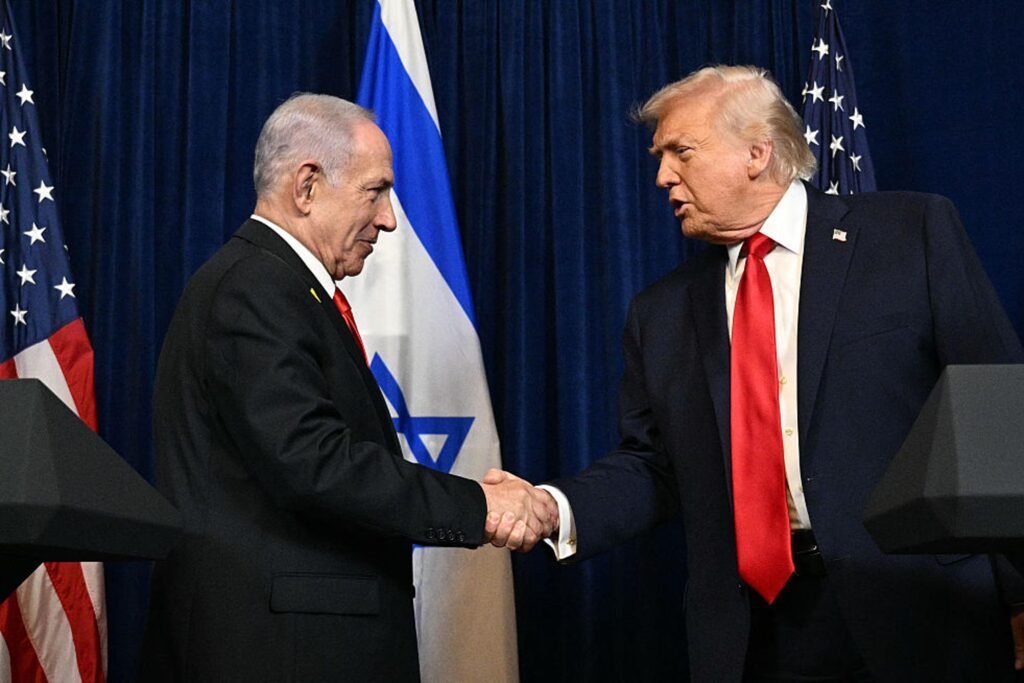
Donald Trump publicly endorsed Benjamin Netanyahu for re-election days before Israeli parliamentary elections, calling it a “complete and total endorsement.” American presidents do not typically intervene in allied democratic elections. Trump is not a typical president, and Netanyahu is running in an election where the outcome has significant implications for U.S. policy in the Middle East.
POLITICS · TRUMP · NETANYAHU · ISRAEL · ELECTIONS
WASHINGTON — President Donald Trump offered what he described as a “complete and total endorsement” of Israeli Prime Minister Benjamin Netanyahu days before Israel is scheduled to hold parliamentary elections, according to NYT and regional reporting. The endorsement was delivered publicly, not through diplomatic back channels, and represents an unusual instance of an American president intervening directly in the democratic process of an allied country — a practice that the United States has historically criticized when undertaken by other powers in elections elsewhere.
The timing is deliberate. Netanyahu election campaign has been running on themes that closely parallel Trump first-term political positioning: claims of persecution by political opponents and the judiciary, framing of critics as enemies of the state, and appeals to a nationalist voter base that sees external security threats as the primary political issue. Trump endorsement reinforces that alignment and provides Netanyahu with a visible association with the most powerful ally of the Israeli state.
What the Endorsement Does Politically
In Israeli domestic politics, a Trump endorsement carries real weight with the right-wing voter base that Netanyahu depends on. The association with Trump is a signal of U.S. support at a moment when Israeli relations with the administration have been close but complicated — the Gaza situation, the West Bank escalation, and the Iran confrontation all require U.S. backing that Netanyahu has been cultivating. The endorsement is, from Netanyahu perspective, valuable external validation in a campaign where his opponents are questioning both his judgment and his legal integrity.
The interference question will be raised by critics in both countries. American norms around non-interference in allied elections have been inconsistently applied across administrations, but a “complete and total endorsement” days before a vote is explicit in a way that even critics of prior administrations have not seen from Washington. Whether it affects the election outcome depends on Israeli voters, not American commentary.
“I give my complete and total endorsement to Prime Minister Netanyahu. He is the right man at the right time for Israel, and Israel needs him now.” — President Trump, via NYT
WHAT HAPPENS NEXT
► Israeli elections scheduled — result will determine whether Netanyahu forms the next government.
► Netanyahu opponents in Israel are criticizing the endorsement as foreign interference in Israeli democracy.
► U.S. State Department has not issued any commentary on or distancing from the endorsement.
► Outcome of Israeli election will shape the U.S.-Israel relationship on Gaza, West Bank, and Iran.
► Regional governments are watching the Israeli election closely given its implications for coalition dynamics.
| CONFIDENCE: HIGH | Trump endorsement statement confirmed by NYT and regional reporting. Quote confirmed as stated. Netanyahu political context from established Israeli election coverage. U.S. historical non-interference norms from established diplomatic record. |
| Bias Check | ||
| Left-Lean | Center | Right-Lean |
| Frames endorsement as unprecedented foreign interference in allied democracy. | Reports the endorsement, the quote, and the timing as confirmed. | Welcomes endorsement as affirmation of strong U.S.-Israel alliance under Trump. |
| Assessment | ONYX presents confirmed facts and the interference question as genuinely noted across the spectrum. Effect on Israeli election outcome flagged as dependent on voters. | |
SOURCES
► New York Times — Endorsement statement and quote
► Regional reporting — Israeli political reaction and context