Trump and Xi reportedly agreed that humans must oversee military AI decisions. ONYX examines what the agreement covers, what it leaves unresolved, and why enforcement matters.

President Donald Trump and Chinese President Xi Jinping have agreed, according to Treasury Secretary Scott Bessent, that human beings must remain involved in military decisions involving artificial intelligence. The statement, delivered after Trump’s meetings in Shenzhen, offers a rare point of alignment between Washington and Beijing at a moment when both governments are racing to dominate the technology. But it is also a reminder of a basic problem: agreeing that AI should not launch a major military action is easier than defining who counts as “human oversight,” what counts as a major action, and what happens if either side breaks the understanding.
Bessent, speaking on CNBC’s Squawk on the Street on November 20, said Trump and Xi agreed that “humans should always be involved in any military decisions” involving what the administration calls “super intelligence,” or SI. He added that SI should not be allowed to operate autonomously in “major military actions.”
The formulation is deliberately broad. It does not announce a treaty, a binding verification regime, or a detailed rulebook for autonomous weapons. It is, at least as publicly described, a political understanding between two leaders whose countries remain strategic rivals. That distinction matters. A shared principle can establish a diplomatic baseline; it does not by itself prevent a crisis, restrain a battlefield algorithm, or resolve how either military would prove compliance.
What was agreed
Bessent framed the agreement as one of the more consequential outcomes of Trump’s Asia trip. He said the two presidents concurred that no major military operation should be launched without human involvement, even as the United States and China continue competing for leadership in AI.
The language matters because the administration has increasingly preferred “super intelligence” to “artificial intelligence.” In a September fact sheet, the White House said Trump and Xi had agreed to use that term for the relevant emerging technologies and had established a U.S.-China Super Intelligence Dialogue to discuss risks and benefits. The same fact sheet said the countries would create a bilateral communication channel for SI incidents.
That earlier groundwork helps explain why the latest statement is not entirely out of nowhere. The two governments had already created a diplomatic channel for discussing AI-related risks. What Bessent described in Shenzhen appears to be a narrower, more consequential extension of that conversation: military decision-making, where the stakes include escalation, civilian harm, and the possibility that a machine-driven error could be mistaken for deliberate aggression.
The Shenzhen setting
The comments followed Trump’s meeting with Xi in Shenzhen, where the U.S. president also met Russian President Vladimir Putin. The White House described the November 19 gathering as a trilateral summit and said the leaders discussed the international situation and committed to maintaining strategic stability and international security.
The setting gave the AI discussion added weight. Shenzhen is not merely a summit city; it is a symbol of China’s technological ambitions and a center of its advanced manufacturing ecosystem. Trump’s visit also came amid an intensifying U.S. effort to preserve an advantage in advanced computing while limiting China’s access to certain American chips.
Trump himself had struck a more expansive tone a day earlier. In a Fox News interview from Shenzhen, he said he and Xi both wanted AI regulations for safety purposes and would work together on “reasonable” rules. China’s embassy in Washington said the two countries should strengthen communication and coordination, prevent AI security risks, and ensure that AI remains under human control.
Those statements are compatible with Bessent’s account, but they are not identical. Trump described a general interest in safety-oriented regulation. The Chinese embassy emphasized human control. Bessent went further by applying the principle specifically to military decisions and major military actions. The public record therefore supports the existence of a shared principle, but not yet a fully specified operational agreement.
Why military AI is different
Civilian AI systems can fail in ways that are costly, embarrassing, or dangerous. Military AI can fail in ways that are irreversible.
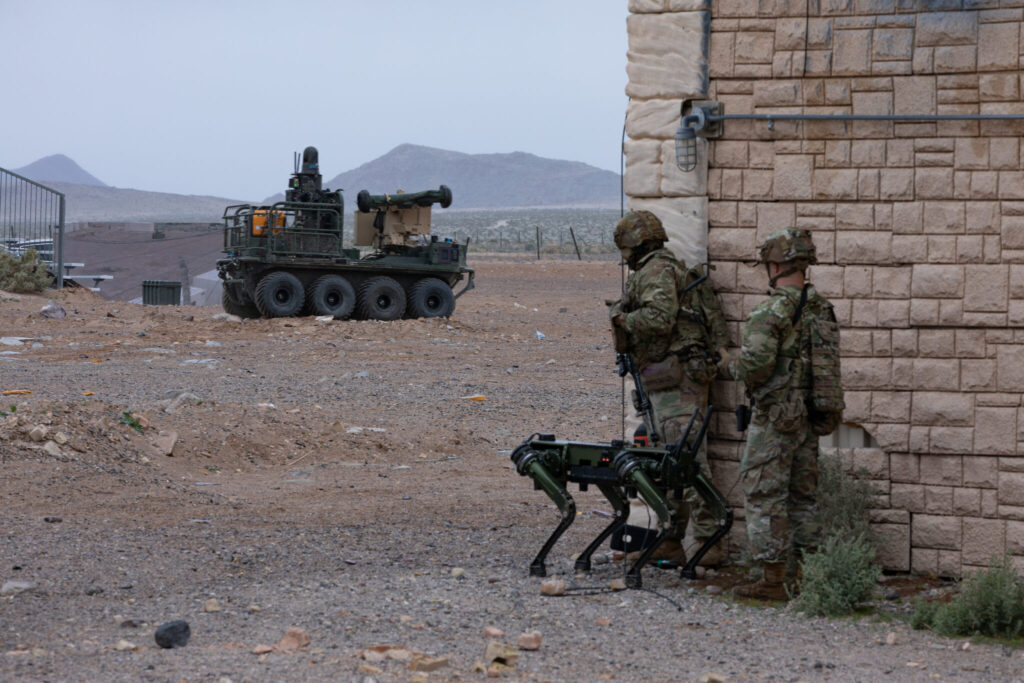
An algorithm may help identify targets, assess threats, manage logistics, process sensor data, or recommend a response. The question is not whether militaries will use such tools; they already use automation across many functions. The question is whether a human commander retains meaningful authority over decisions that could kill people, trigger escalation, or initiate a major operation.
Bessent’s formulation suggests that Trump and Xi recognize that distinction. His claim that AI should not be autonomous for “major military actions” implies a boundary between routine assistance and decisions with strategic consequences. But the phrase leaves considerable room for interpretation. Is launching a missile a major action? What about authorizing a cyber operation, moving forces, activating air defenses, or ordering a drone strike?
The absence of definitions is not necessarily fatal. Diplomatic understandings often begin with broad language and become more concrete through follow-up talks, military-to-military contacts, and incident-management procedures. But in this case, the risk is that each side interprets “human involvement” in a way that preserves its own operational freedom.
Competition continues
Bessent was explicit that the agreement does not end the underlying rivalry. He said the competition between the United States and China for AI supremacy would continue. His argument was that the two sides can compete for technological leadership while accepting a narrow rule: no major military operation without a human decision-maker.
That position reflects the central tension in U.S. policy. Washington wants to lead in advanced AI, attract investment, and maintain a technological edge over China. At the same time, it wants to reduce the chance that AI becomes a source of accidental war or strategic instability.
The White House has described its approach as one of accelerating innovation while protecting American technology from foreign exploitation. Its priorities page says the administration launched a national SI strategy, expanded federal support for emerging technologies, and prioritized secure domestic supply chains. It also says the United States has attracted more than $2.7 trillion in technology and SI investment, including $90 billion in SI and energy investments in Pennsylvania.
Those figures are administration claims, not independently audited measures of technological superiority. But they illustrate the political framing: AI leadership is presented as both an economic opportunity and a national-security requirement. That framing makes cooperation on military safeguards politically useful, but it also makes deep restraint difficult. Neither government wants to concede an advantage in a technology it regards as strategically decisive.
Chips remain the sharper dispute
The military-AI understanding sits alongside a more concrete and contentious issue: access to advanced semiconductors.
Bessent said Nvidia’s H200 remains the most advanced AI chip China can purchase under license, following what he characterized as Trump’s “very firm line.” He said Chinese orders for the H200 had been limited as China works to build its own chip stack, and argued that China remains years behind.
That claim should be treated as an administration assessment rather than a neutral technical verdict. China’s domestic semiconductor industry has made progress, but advanced chipmaking remains constrained by access to leading-edge equipment, materials, design tools, and manufacturing capacity. Bessent’s broader point, however, is clear: export controls are not simply about individual chips. They are about slowing China’s ability to build the computing infrastructure needed for large-scale AI development.
The issue has also become more complicated through remote access. On November 16, the Commerce Department issued a rule requiring data centers to obtain licenses before providing remote computing access to companies based in China and other restricted countries. The rule also added licensing requirements for chip exports to Indonesia, Malaysia, Singapore, Thailand, and Brazil.
Bessent said the administration expects “proper chip restrictions” to remain in place and that remote access has been curtailed. His comments signal that Washington sees cloud access, not just physical chip shipments, as part of the export-control perimeter.
The Nvidia distraction
Bessent also said the Trump-Xi meeting did not address allegations involving former Nvidia chief executive Jensen Huang. Huang resigned on November 12 after reports alleged that he had an affair with a woman whom U.S. intelligence suspects of spying for China. Beijing has denied the claim, and Nvidia CFO Colette Kress is serving as interim CEO.
The episode is politically explosive because it combines three sensitive subjects: a major American technology company, alleged Chinese intelligence activity, and U.S. export controls. But Bessent’s account suggests that the leaders’ AI discussion was not derailed by it. The more durable issue is structural: whether U.S. firms can sell advanced computing power to Chinese customers without enabling military or intelligence applications that Washington considers unacceptable.
What enforcement would require
If the agreement is to mean more than a diplomatic talking point, it will need mechanisms that can survive political turbulence.
The first requirement is a shared definition of the covered decisions. “Major military action” is too vague to serve as a reliable restraint unless both governments identify categories of operations that require human authorization.
The second is a communication channel that works during a crisis. The September fact sheet said the United States and China had agreed to establish a bilateral channel for SI incidents. That is a sensible starting point, but its value depends on whether it can function quickly, at senior levels, and without being treated as a propaganda exercise.
The third is verification. Neither side is likely to accept intrusive inspections of military AI systems. But they could still agree on narrower measures: notifications after certain incidents, commitments not to delegate final launch authority to autonomous systems, and regular technical discussions on failure modes and escalation risks.
The fourth is domestic implementation. A leader can endorse a principle in Shenzhen, but military bureaucracies, defense contractors, intelligence agencies, and commanders must translate it into rules, training, procurement requirements, and accountability. That is where diplomatic language usually meets institutional reality.
What it means for Americans
For most Americans, the immediate effect of the agreement may be limited. It does not change a tax bill, lower prices, or directly alter daily life. Its importance lies in prevention.
A misunderstanding involving AI-enabled military systems could escalate quickly. A misidentified target, a malfunctioning automated system, or a misread signal could create a crisis between two nuclear-armed powers. Human oversight is not a guarantee against error, but it preserves a point at which political judgment, legal constraints, and diplomatic caution can intervene.
The agreement also has implications for the technology sector. U.S. AI companies, chipmakers, cloud providers, and defense contractors operate in a market shaped by export controls, national-security reviews, and geopolitical risk. A more stable U.S.-China understanding could reduce the chance of abrupt escalation. It does not remove the commercial uncertainty created by licensing rules, remote-access restrictions, and the possibility of further controls.
The larger question
The deeper story is not simply that Trump and Xi discussed AI. It is that both governments appear to recognize a danger that neither wants to say aloud in full: increasingly capable AI could make war faster, more opaque, and harder to control.
The agreement, as described by Bessent, establishes a principle rather than a solution. It says humans must remain in the loop. It does not yet say which humans, under what authority, with what information, or with what ability to stop a system once it has begun acting.
That gap is where the real test lies. If Washington and Beijing can turn a broad statement into practical rules for military AI, the Shenzhen talks may be remembered as an early effort to prevent a new technology from making strategic instability worse. If they cannot, the agreement will remain what it currently appears to be: an important declaration of intent, issued by two governments still competing to build the machines it is meant to restrain.