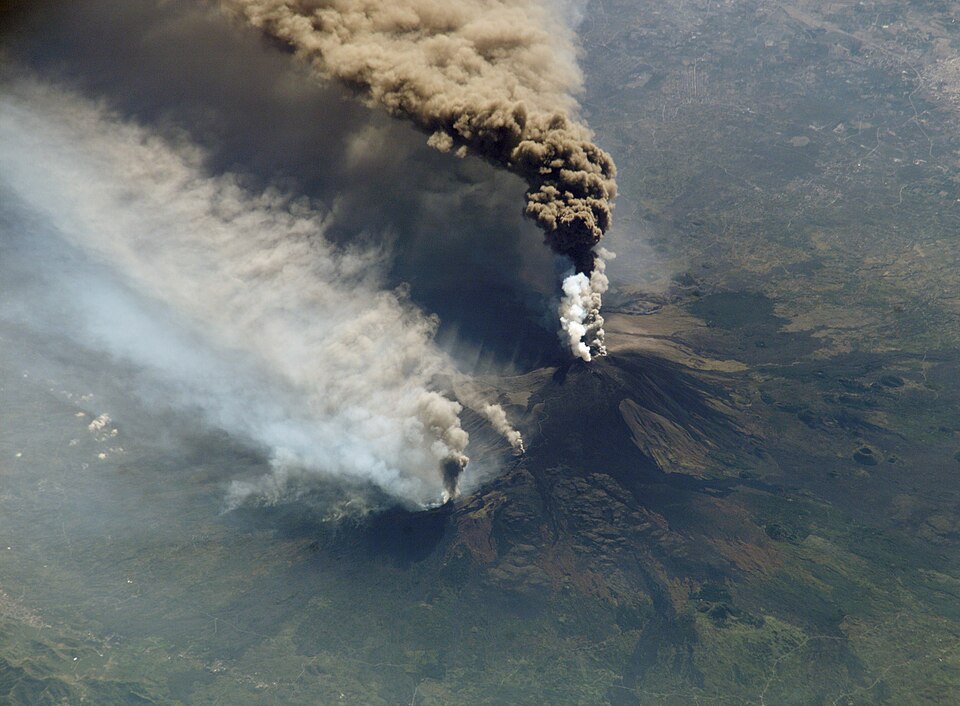
Europe’s tallest and most active volcano has been in continuous eruption since August 6 — now seven days and counting. Italy’s national volcanology institute (INGV) confirmed four effusive vents remain open along Etna’s eastern flank as of Wednesday, with volcanic tremor remaining high despite a slight decrease in lava effusion Wednesday morning. INGV’s own description: ‘the situation is constantly evolving’ with ‘unpredictable’ consequences. This is scientific language for: we are monitoring continuously, we have no reliable end-date projection, and this could continue for a long time.
2-MINUTE CONTEXT — WHAT KIND OF ERUPTION THIS IS
Not all volcanic eruptions are the same. Etna’s current eruption is primarily effusive — meaning it is producing lava flows rather than explosive columns of ash and pyroclastic material. Effusive eruptions are generally less immediately dangerous to human life than explosive ones, but they produce sustained hazards: slow-moving lava that destroys everything in its path, continuous ash emissions that disrupt aviation, and the potential to evolve into more explosive phases if the underground plumbing system changes.
The four vents open on Etna’s eastern flank are the specific geographic concern. The eastern flank is where lava most directly threatens populated areas — Catania is on the eastern slopes of Etna, and the flank slope faces toward the most densely populated parts of the region. Lava moving eastward on the flanks has historically been the scenario that triggers evacuations of villages and agricultural areas.
THE AVIATION IMPACT
Catania’s Fontanarossa Airport — Sicily’s busiest airport and the gateway for most Mediterranean tourism to the island — has been operating under ash disruption protocols since the eruption began. The specific aviation safety concern: volcanic ash contains silica particles that melt in jet engine temperatures and re-solidify on cooler engine components, potentially causing engine failure. Even thin ash concentrations at flight altitude can be hazardous.
Airlines serving Catania have been adjusting schedules, routes, and approach procedures in response to INGV’s ash emission reports. This is not a complete closure — the airport has been operating with disruptions rather than shut down entirely — but the sustained ash emissions mean every departure and arrival requires real-time ash concentration assessment.
WHY “PROTRACTED” IS THE KEY WORD
INGV’s description of this as a potentially ‘protracted event’ is significant. Most Etna eruptions run in cycles — episodes of intense activity followed by pauses, with the total event typically lasting days to weeks. A ‘protracted’ characterization suggests INGV is not anticipating a rapid return to quiet. The underlying volcanic tremor — the seismic signal that indicates magma movement beneath the surface — remaining high is the specific diagnostic indicator that more surface activity is likely.
INGV’s language is precise because it has to be: ‘unpredictable’ and ‘constantly evolving’ mean we do not know. In volcanology, not knowing is an honest answer.
THE EASTERN FLANK GEOLOGY
Etna’s eastern flank has a documented structural weakness: it is slowly sliding toward the sea at a rate of approximately a few centimeters per year. This gravitational instability creates fracture zones that make it easier for magma to find new pathways to the surface in that specific region — which is part of why the current eruption has produced four separate vents rather than concentrating at the summit. The flank’s fragility is both a geological explanation for the current eruption pattern and a long-term concern: if the sliding accelerates during volcanic activity, it could trigger a flank collapse, which would be a far more serious event.
WHAT HAPPENS NEXT
▸ INGV monitoring will continue around the clock; watch for tremor level changes as the primary indicator of eruption intensity trajectory
▸ Catania airport will continue operating under ash disruption protocols; full closure remains possible if ash concentration increases
▸ Lava flow mapping — INGV and civil protection are tracking the extent of lava on the eastern flank; whether it approaches inhabited areas is the evacuation trigger
▸ Effusion rate monitoring — the Wednesday decrease in lava effusion is a tentatively positive sign; whether it continues or reverses is the key near-term variable
▸ The ‘protracted event’ characterization means this story continues through next week at minimum
| CONFIDENCE: HIGH | Eruption since August 6, four effusive vents, volcanic tremor remaining high, and INGV ‘protracted’ / ‘unpredictable’ / ‘constantly evolving’ language are all from INGV confirmed reporting. Eastern flank geology (sliding tendency) is from established volcanological literature. |
| ⚖️ BIAS CHECK — WHO IS SAYING WHAT | |
| INGV (Italy’s volcanology institute) | Scientific institution reporting observed conditions accurately; appropriately cautious about predictions they cannot reliably make |
| Civil Protection / Catania Airport | Managing the practical disruption consequences; their communications will be focused on specific safety guidance |
| Airlines Serving Catania | Balancing operational economics with safety; each airline’s ash-avoidance protocols differ in specific thresholds |
| Tourism Industry | Significant economic concern; peak Mediterranean summer; sustained disruption affects the entire Sicily tourism season |
SOURCES
▸ INGV (Istituto Nazionale di Geofisica e Vulcanologia) — eruption status, four vents, tremor levels, August 2026
▸ Established volcanological literature — Etna eastern flank sliding tendency
Q: Is the lava going to reach Catania?
A: Catania is approximately 25-30 km from Etna’s summit and sits at lower elevation on the volcano’s eastern slope. Lava flows from the current vents would need to travel significant distance and sustain themselves over inhabited terrain to reach Catania itself. The more immediate lava risk is to higher-elevation villages and agricultural areas on the flank. INGV does not currently characterize Catania as under direct lava threat.
Q: What is the difference between effusive and explosive eruptions?
A: Effusive: magma reaches the surface as lava, flowing from vents. Slower, produces lava flows and ash emissions. Explosive: gas pressure in the magma exceeds the ability of the magma to contain it, causing violent fragmentation. Produces ash columns, pyroclastic flows, and ballistic projectiles. Etna does both at different times; the current eruption is primarily effusive but maintains explosive potential.