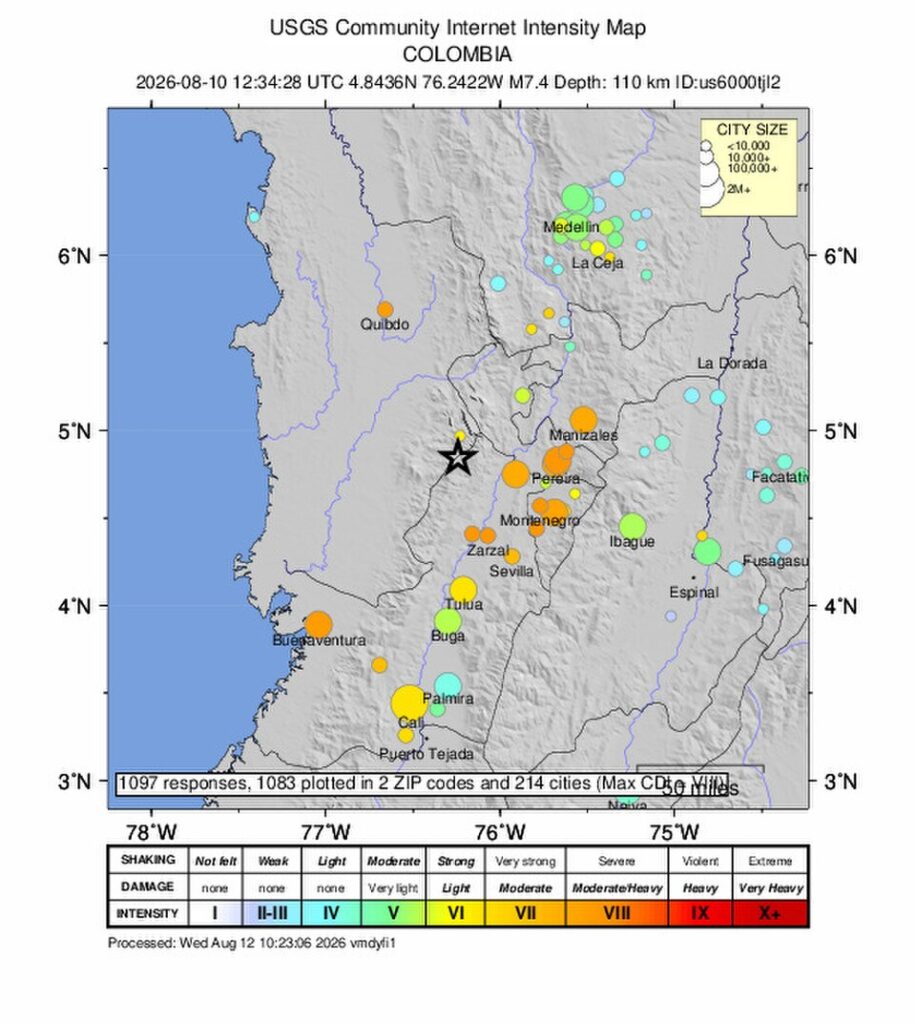
President de la Espriella toured Colombia’s earthquake-affected coffee-growing region this week to announce specific economic relief measures for residents, according to CNN — a concrete government response that moves beyond emergency rescue to address the longer-term economic damage facing one of Colombia’s most agriculturally significant regions. The coffee region — the Eje Cafetero, or Coffee Axis — is the productive heart of Colombian coffee, a UNESCO World Heritage agricultural landscape, and a critical export economy that the earthquake has materially disrupted.

THE COFFEE REGION’S SPECIFIC EARTHQUAKE VULNERABILITY
The Colombian Coffee Axis — encompassing Caldas, Risaralda, and Quindío departments, with Manizales and Pereira as major cities — was specifically affected by the earthquake. The region sits in the Central Andes, which is seismically active; the 1999 Armenia earthquake in this same region killed over 1,000 people. The current earthquake’s impact on the coffee region includes: structural damage to coffee processing facilities; disruption of the agricultural labor force; damage to roads that are the supply chain for coffee export; and the displacement of farmworker communities.
Colombia produces approximately 13 million bags of coffee annually, making it the third largest producer globally. The Eje Cafetero is responsible for a significant share of that production. Disruption to a harvest cycle — if the earthquake’s damage affects planting, harvesting, or processing during a critical seasonal window — produces export losses that ripple through the entire agricultural economy.
WHAT THE ECONOMIC RELIEF ACTUALLY COVERS
Specific relief measures announced by de la Espriella, as available in CNN reporting:
▸ Agricultural credit relief for farmers whose infrastructure or crops were damaged — allowing delayed payments and restructured loans
▸ Immediate cash assistance for displaced families in the most affected municipalities
▸ Expedited assessment and repair of agricultural roads and supply chain infrastructure
▸ Emergency housing support for farmworkers whose housing was damaged or destroyed
The specific amounts and eligibility criteria for these measures were not fully detailed in available reporting as of publication. CNN’s coverage describes the president’s tour and the announcement of measures rather than a fully published relief package with specific figures.
WHY THE COFFEE REGION MATTERS BEYOND COLOMBIA
Colombian coffee’s disruption has global implications for coffee markets. Colombia’s coffee production contributes to global supply in ways that matter for commodity pricing, for US and European coffee companies that source Colombian beans specifically, and for the Colombian peso’s export-driven value. An earthquake that disrupts even one season’s coffee production in the Eje Cafetero has downstream effects that are traceable on commodity exchanges.
WHAT HAPPENS NEXT
▸ Full relief package details will be published as the Bogotá government formalizes the measures announced during the tour
▸ Agricultural damage assessment — the extent of farm and infrastructure damage will take weeks to formally document
▸ Manizales mayor’s month-long home assessment process (Story 17) is the specific timeline that individual relief allocation depends on
| CONFIDENCE: MODERATE | De la Espriella coffee region tour and relief measures announcement are from CNN confirmed reporting. Specific relief amounts and eligibility criteria are not detailed in available reporting. Colombian coffee production figures (13 million bags, third largest globally) are from established trade data. |
SOURCES
▸ CNN — de la Espriella coffee region tour and relief measures, August 2026
▸ Colombian coffee production data — International Coffee Organization (established trade data)